Biodiversity at Higher Level: The same statement as SL. At Higher Level, use the three levels to explain why losing genetic diversity matters as much as losing species.
Practise this as you read
- Outline the three levels of biodiversity.
- Suggest why high biodiversity makes an ecosystem stable.
Free preview
This is the free notes preview
You're reading the free notes. Aimnova Pro unlocks the full study experience — and you can try it with your first topic free to keep:
- FlashcardsLock in vocabulary and key terms with spaced repetition.
- Practice questionsAnswer exam-style questions and get instant AI marking.
- Mock exams & past-paper vaultSit full mocks and see exactly how examiners award marks.
- Personalised study planA daily plan built around your exam date and weak areas.
The big idea: Biodiversity is the variety of life — the number of different species in an area, the range of ecosystems, and the genetic variety within each species.
Why it matters now
- A community with many different species tends to be more stable.
- If one species is lost, others can still carry out its job, so the ecosystem keeps working.
- Right now, human activity is destroying biodiversity faster than at almost any time in Earth's history.
- This crisis is sometimes called the sixth mass extinction.
- Biodiversity
- The variety of life in an area — at three levels: ecosystem diversity, species diversity and genetic diversity.
- Species richness
- The number of different species present in a community.
- Ecosystem stability
- The ability of an ecosystem to keep functioning and recover after a disturbance.
Three levels of biodiversity: - Species diversity — how many different species live there. - Ecosystem diversity — how many different ecosystems (and habitats) the area contains. - Genetic diversity — the variety of genes within a single species.
High biodiversity usually means all three are high.
Why more species means more stability. In the high-diversity web (left), removing the beetle leaves other prey to feed the bird — the web holds. In the low-diversity web (right), removing the only consumer starves the bird and the whole chain collapses: there is no backup.
Interactive diagram
Explore the labelled diagram, charts and maps for this topic in full study mode.
See how examiners mark answers
Answer exam-style questions with model answers. Learn exactly what earns marks and what doesn't.
Biodiversity matters for two kinds of reasons. The first is functional: a varied community is more resilient.
How a varied community stays resilient
- Different species play different roles, and many roles overlap.
- If a disease wipes out one pollinating insect, other pollinators can still do the job — so the ecosystem keeps running.
- A community with only one pollinator has no backup and can collapse.
The second is the direct value to humans. Wild species give us food, medicines, timber and clean water, and ecosystems provide services such as pollinating crops, recycling nutrients and storing carbon. Many of these are hard or impossible to replace once a species is gone.
| Why biodiversity matters | What it means | Example |
|---|---|---|
| Ecosystem stability | more species → more resilient to disturbance | if one pollinator dies out, others still pollinate |
| Ecosystem services | free 'work' that ecosystems do for us | bees pollinate crops; wetlands clean water |
| Food & resources | wild species are sources of food and materials | wild crop relatives, timber, fish stocks |
| Medicines | many drugs are derived from wild organisms | compounds from plants, fungi and microbes |
| Future / unknown value | a lost species can never be recovered | an undiscovered species may hold a future cure |
Stability is the headline mark: In the exam, the safest reason to give for why biodiversity matters is ecosystem stability: more species means more resilience, because the loss of any one species is more likely to be covered by another.
Extinction is irreversible — once a species is gone, its genes and its role are gone forever.
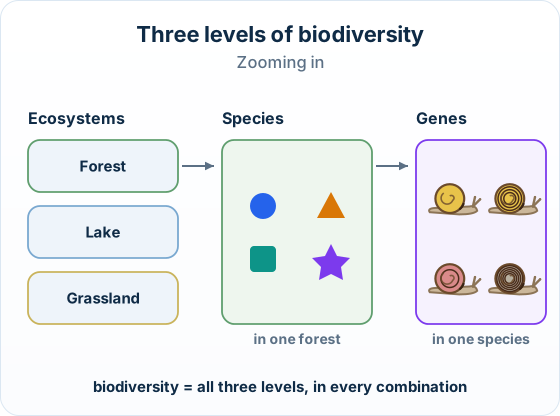
The big idea: Biodiversity is the variety of life in all its forms, levels and combinations: ecosystem diversity, species diversity and genetic diversity.
The points to remember
- Ecosystem diversity: the variety of ecosystems in an area, such as forest, lake and grassland.
- Species diversity: the variety of species in one ecosystem.
- Genetic diversity: the variety of alleles within one species.
- The levels combine: many ecosystems hold many species, and each species holds many alleles.
- Losing diversity at any level is a loss of biodiversity.
Remember it as: Places, kinds, genes.
Real example: Cavendish bananas: Almost every banana sold in shops is a Cavendish, grown as clones with the same genes. A fungal disease that can kill one plant can kill them all: low genetic diversity, high risk.
Count all three levels:
Not only the number of species: A list of species is only one level. A population can lose genetic diversity, or a region can lose a whole ecosystem, while the species count stays the same.
Study smarter, not longer
Most students waste 40% of study time on topics they already know. Our AI tracks your progress and optimizes every minute.
How this is tested: On Paper 2 a 2-mark Suggest question gives you a short scenario — for example an animal that raises the number of species in a habitat — and asks why that added biodiversity matters.
Where the marks come from
- The marks come from linking more species to a benefit.
- Benefit 1: greater stability / resilience.
- Benefit 2: more ecosystem services.
- On Paper 1A the same idea appears as a multiple-choice question on the causes of biodiversity loss.
Exam-style question — why added biodiversity matters
Ecologists found that when otters returned to a river, the number of fish and insect species in the river increased. Suggest why this rise in biodiversity is beneficial for the river ecosystem. [2]
How to score both marks
- Pick a benefit of more species. More species means the ecosystem is more stable / resilient — there is more 'backup' if conditions change.
- Link it to the scenario. With more fish and insect species, if one species declines, others can take over its role, so food webs keep working and the ecosystem keeps functioning.
- Answer the command term (Suggest). A clear benefit, tied to the data: greater species richness makes the river ecosystem more stable and better able to recover from disturbance.
Final answer
More species makes the river ecosystem more stable and resilient: if one species is lost, others can carry out its role, so the ecosystem keeps functioning and recovers more easily from disturbance.
What a full-mark answer contains: Mark 1: names a benefit of higher biodiversity (stability / resilience / ecosystem services).
Mark 2: links it back to the data — more species means a lost role can be covered by another species, so the ecosystem keeps working.