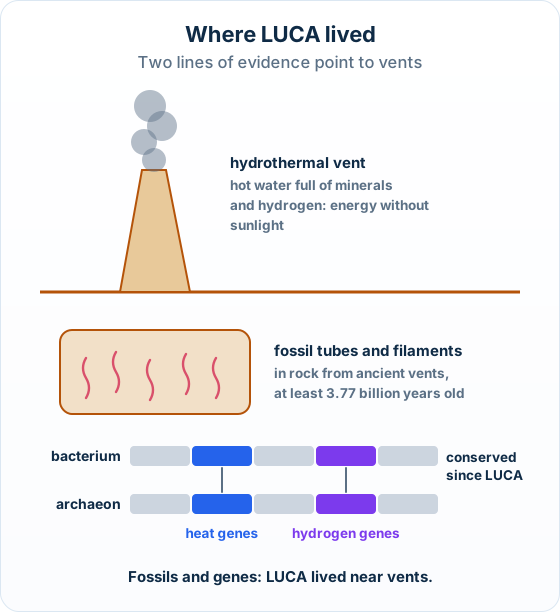
The big idea: Two kinds of evidence suggest LUCA lived near hydrothermal vents: fossils in rock formed at ancient vents, and genes that all life still shares.
The points to remember
- A hydrothermal vent is a crack in the seafloor where hot water rich in minerals and hydrogen pours out.
- Fossil evidence: rock that precipitated at ancient seafloor vents holds tiny tubes and filaments made by microbes.
- Some of these vent fossils are at least 3.77 billion years old, among the oldest signs of life.
- Genomic evidence: genes conserved in both bacteria and archaea are thought to come from LUCA.
- Those conserved genes are for living in heat and using hydrogen without oxygen: a vent lifestyle.
- Prokaryotes living near vents today have similar gene sequences, and many sit near the base of the tree of life.
Remember it as: Vent rock and vent genes.
Real example: the Nuvvuagittuq rocks: In 2017 scientists described tiny tubes and filaments of iron oxide in vent rock from the Nuvvuagittuq belt in Quebec, Canada. They are thought to be fossil microbes at least 3.77 billion years old.
Keep the claim exact when you write about it:
Nobody found LUCA itself: No LUCA organism has been found. The evidence is indirect: vent fossils and genes shared by living prokaryotes.
Free preview
This is the free notes preview
You're reading the free notes. Aimnova Pro unlocks the full study experience — and you can try it with your first topic free to keep:
- FlashcardsLock in vocabulary and key terms with spaced repetition.
- Practice questionsAnswer exam-style questions and get instant AI marking.
- Mock exams & past-paper vaultSit full mocks and see exactly how examiners award marks.
- Personalised study planA daily plan built around your exam date and weak areas.
Start Studying Free Full access to Aimnova Pro · cancel anytime
The big idea: Vents had what the first cells needed: energy, catalysts and shelter, all without sunlight or oxygen.
The points to remember
- Vents supply chemical energy (hydrogen and minerals), so no sunlight is needed.
- Minerals such as iron and sulfur could act as catalysts before there were enzymes.
- Differences between hot vent water and cold seawater create gradients that can drive reactions.
- The deep sea shielded early life from ultraviolet light, as there was no ozone layer.
What a vent supplies
- Hydrogen and minerals for energy
- Iron and sulfur minerals as catalysts
- Shelter from ultraviolet
What that means for LUCA
- No need for sunlight
- Reactions before enzymes
- Molecules not broken down by UV
Real example: Lost City: The Lost City vent field in the Atlantic Ocean, found in 2000, has white mineral chimneys up to 60 m tall. Its warm, hydrogen-rich water supports microbes that live without sunlight.
Know your predicted grade
Take timed mock exams and get detailed feedback on every answer. See exactly where you're losing marks.
Try Mock Exams FreeYour first topic is free to keep • No credit card required
How it is tested: May 2026 asked, as a Paper 1A item, which evidence suggests LUCA evolved near vents. A Paper 2 Outline of the two lines of evidence is the likely longer shape.
IB-style questionOutline[3 marks]
Outline the evidence that the last universal common ancestor (LUCA) evolved near hydrothermal vents.
Model answer plan
See the answer broken into clear points, with guidance on how each point earns marks.