The big idea: Nobody saw the first cells, so their dates are estimated: from fossils in dated rock, and from a molecular clock in the genes of living things.
The points to remember
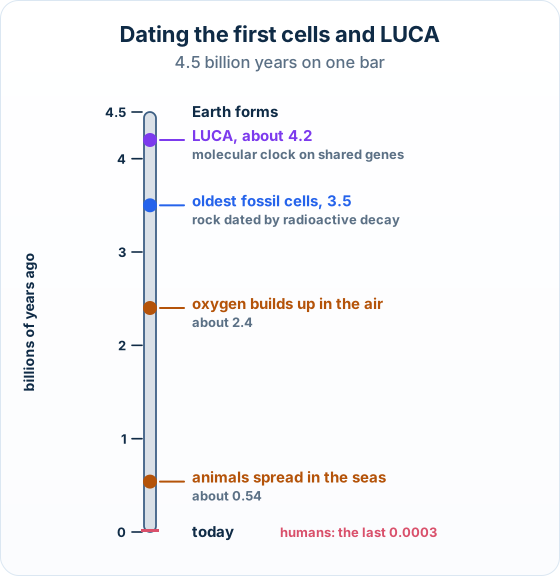
- Fossils: the oldest widely accepted fossil cells and stromatolites are about 3.5 billion years old.
- Radiometric dating: the rock around a fossil is dated from the decay of radioactive isotopes, which happens at a known, steady rate.
- Chemical traces: carbon left by living things in even older rocks hints that life may be older still.
- Molecular clock: differences in genes build up at a roughly steady rate, so counting them estimates when lineages split.
- Using genes shared by all life, the molecular clock puts LUCA at about 4.2 billion years ago.
- All these dates are estimates with a range, not exact measurements.
Remember it as: Rocks date the fossils; genes date LUCA.
Real example: the Pilbara stromatolites: In the Pilbara region of Western Australia, layered rock mounds built by microbes, called stromatolites, are about 3.5 billion years old. Layers of volcanic rock around them are dated by radioactive decay.
Keep the two approaches apart when you write about them:
LUCA has no fossil: LUCA's date comes from the molecular clock, not from a fossil. Fossils date the oldest cells we can find.
Free preview
This is the free notes preview
You're reading the free notes. Aimnova Pro unlocks the full study experience — and you can try it with your first topic free to keep:
- FlashcardsLock in vocabulary and key terms with spaced repetition.
- Practice questionsAnswer exam-style questions and get instant AI marking.
- Mock exams & past-paper vaultSit full mocks and see exactly how examiners award marks.
- Personalised study planA daily plan built around your exam date and weak areas.
Start Studying Free Full access to Aimnova Pro · cancel anytime
The big idea: Life has been evolving for more than 3.5 billion years. Squeeze Earth's history into one day to see how long that is.
The points to remember
- The Earth formed about 4.5 billion years ago; life appeared within its first billion years.
- Life has been evolving for over 3.5 billion years: an immense length of time.
- On a 24-hour clock of Earth's history, the first fossil cells appear at about 5 in the morning.
- Animals appear at about 9 in the evening; all of human history fills the last few seconds.
- Such a long time explains how small changes added up to all the diversity of life.
| Event | Billions of years ago | On a 24-hour clock |
|---|---|---|
| Earth forms | 4.5 | midnight |
| LUCA (molecular clock) | about 4.2 | about 1.35 am |
| Oldest fossil cells | about 3.5 | about 5.20 am |
| Oxygen builds up in the air | about 2.4 | about 11.10 am |
| Animals spread in the seas | about 0.54 | about 9.05 pm |
| Modern humans | 0.0003 | the last 6 seconds |
Real example: the Grand Canyon: The rock layers of the Grand Canyon, USA, span more than 1.5 billion years of Earth's history. That is still less than half the time life has existed.
Learn what examiners really want
See exactly what to write to score full marks. Our AI shows you model answers and the key phrases examiners look for.
Try AI Feedback FreeYour first topic is free to keep • No credit card required
How it could be asked: No paper has asked this yet. Likely shapes: a Paper 2 Outline of the approaches used to date the first cells and LUCA, or a molecular-clock calculation in Paper 1B.
IB-style questionOutline[3 marks]
Outline the approaches used to estimate the dates of the first living cells and of LUCA.
Model answer plan
See the answer broken into clear points, with guidance on how each point earns marks.