The double helix at Higher Level: The same statement as SL. At HL the drawing is worth four marks, and a seven-mark answer can ask how DNA's structure suits its function, so learn the structure with what each part does.
Practise this as you read
- Draw two pairs of nucleotides, antiparallel, with hydrogen bonds labelled.
- Link each feature to its job: sequence stores information; pairing makes copying exact.
Free preview
This is the free notes preview
You're reading the free notes. Aimnova Pro unlocks the full study experience — and you can try it with your first topic free to keep:
- FlashcardsLock in vocabulary and key terms with spaced repetition.
- Practice questionsAnswer exam-style questions and get instant AI marking.
- Mock exams & past-paper vaultSit full mocks and see exactly how examiners award marks.
- Personalised study planA daily plan built around your exam date and weak areas.
The big idea: DNA is made of two strands twisted around each other into a double helix — the famous spiral-staircase shape.
How the two strands fit
- The two strands run in opposite directions (we say they are antiparallel).
- They are held together by their bases, which pair up in a fixed way: A with T, and G with C.
The two 'rails'
- Each strand has a sugar–phosphate backbone
- The backbones run in opposite directions (antiparallel)
- They form the outside of the helix
The 'rungs'
- The bases stick inwards from each backbone
- A base on one strand pairs with a base on the other
- Each rung = one base pair held by hydrogen bonds
DNA as a ladder: two antiparallel sugar–phosphate backbones (5′→3′ opposite ways) with rungs of paired bases — A–T (2 hydrogen bonds) and G–C (3).
Interactive diagram
Explore the labelled diagram, charts and maps for this topic in full study mode.
Who worked it out: Watson and Crick proposed the double-helix model in 1953, using X-ray data from Rosalind Franklin.
Their model's first big reveal was the double-helix shape — and that the two strands are held together by paired bases.
Practice with exam-style questions
Answer exam-style questions and get AI feedback that shows you exactly what examiners want to see in a full-marks response.
DNA bases do not pair randomly. Each base has one partner that 'fits' it: this is called complementary base pairing.
The four bases and their partners
- The four bases of DNA are adenine (A), thymine (T), guanine (G) and cytosine (C).
- A always pairs with T.
- G always pairs with C.
- Complementary base pairing
- The rule that A pairs only with T, and G pairs only with C, on the two strands of DNA.
- Hydrogen bond
- A weak attraction that holds a base pair together; many of them along the molecule make the double helix stable.
- Antiparallel
- The two DNA strands run in opposite directions to each other.
- Base pair
- One base on one strand joined to its partner base on the other strand (A–T or G–C).
The two bases of a pair are joined by hydrogen bonds. Note that the bases are what bond across the helix — not the sugars or the phosphates.
An A–T pair is held by 2 hydrogen bonds; a G–C pair is held by 3. So a region rich in G–C pairs is held together a little more strongly.
| Base on one strand | Pairs with | Held by |
|---|---|---|
| Adenine (A) | Thymine (T) | 2 hydrogen bonds |
| Thymine (T) | Adenine (A) | 2 hydrogen bonds |
| Guanine (G) | Cytosine (C) | 3 hydrogen bonds |
| Cytosine (C) | Guanine (G) | 3 hydrogen bonds |
Chargaff's rule: Because A only ever pairs with T, the amount of A equals the amount of T.
In the same way, the amount of G equals the amount of C.
So if you know the percentage of one base, you can work out the others — a favourite Paper 2 calculation.
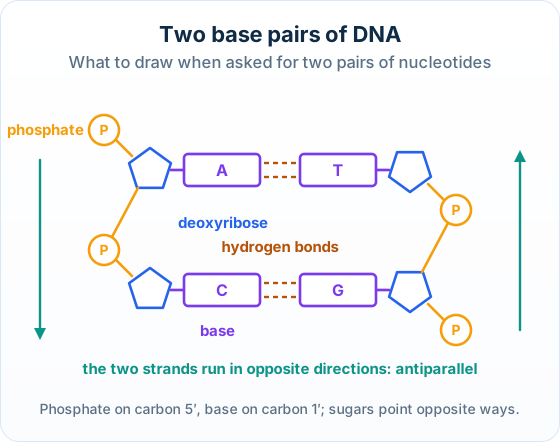
The big idea: When a question asks you to draw DNA, draw a short ladder, not a twisted helix: two antiparallel strands joined by base pairs.
The points to remember
- Each strand is a chain of nucleotides; draw two nucleotides per strand.
- In every nucleotide the phosphate joins carbon 5′ and the base joins carbon 1′ of the deoxyribose.
- The two strands are antiparallel: draw the second strand upside down, its sugars pointing the other way.
- A pairs with T, G pairs with C, the bases meeting in the middle.
- Join each pair with dashed hydrogen bonds and label at least one.
Remember it as: Upside down and opposite: A to T, G to C.
Easy marks to lose: Drawing both strands the same way up, so they are not antiparallel. Joining sugars or phosphates across the middle instead of bases. Writing a base as a letter when the question asks you to name it.
What the drawing shows is also what makes DNA work:
Why the structure fits the job: The base sequence stores the information. Because the bases pair A–T and G–C, each strand can act as a template to rebuild the other or to make RNA.
The hydrogen bonds are weak, so the strands can be separated for copying; the covalent backbones keep each strand intact.
Feeling unprepared for exams?
Get a clear study plan, practice with real questions, and know exactly where you stand before exam day. No more guessing.
How this is tested: This topic comes up on Paper 1A and on Paper 2.
Two question types
- On Paper 1A (multiple choice) you are often asked to identify which DNA components are joined by hydrogen bonds (the bases), or which complementary base pairs are correct (A–T, G–C).
- On Paper 2 a 2-mark Explain/Deduce question gives the percentage of one base and asks you to work out another, using Chargaff's rule.
IB-style question — work out a missing base percentage
A sample of DNA from a fungus is found to contain 28% adenine. Deduce the percentage of cytosine in this DNA, showing your reasoning. [2]
How to score both marks
- Use the pairing rule. A pairs with T, so the percentage of thymine also equals 28%. Together A + T make up 28 + 28 = 56% of the bases.
- The rest must be G + C. That leaves 100 − 56 = 44% shared between guanine and cytosine. Since G pairs with C, they are present in equal amounts, so each is 44 ÷ 2.
- Answer the command term. Cytosine = 22%.
Final answer
Adenine = thymine = 28%, so A+T = 56%; the remaining 44% is split equally between G and C, giving cytosine = 22%.
Check your reasoning: Your working should show both ideas: %A = %T (so T is also 28%) and %G = %C (so the leftover 44% splits in half). The final answer is cytosine = 22%.