RNA as a polymer at Higher Level: The same statement as SL. At HL you also need the direction in which the strand grows: each new nucleotide is joined to the 3′ end. That rests on exactly this reaction: condensation, sugar to phosphate.
Practise this as you read
- Name the joining reaction: condensation.
- Draw a short RNA strand with ribose, one strand, no thymine.
Free preview
This is the free notes preview
You're reading the free notes. Aimnova Pro unlocks the full study experience — and you can try it with your first topic free to keep:
- FlashcardsLock in vocabulary and key terms with spaced repetition.
- Practice questionsAnswer exam-style questions and get instant AI marking.
- Mock exams & past-paper vaultSit full mocks and see exactly how examiners award marks.
- Personalised study planA daily plan built around your exam date and weak areas.
The big idea: RNA is a long chain of nucleotides. Each one is added by a condensation reaction, which releases water and makes a covalent bond.
The points to remember
- A polymer is a long chain of small units called monomers.
- RNA is a polymer; its monomers are RNA nucleotides.
- Nucleotides are joined by condensation reactions.
- Each condensation releases one water molecule (H₂O).
- It makes a covalent bond from the sugar of one nucleotide to the phosphate of the next.
Remember it as: Condensation: join and lose water.
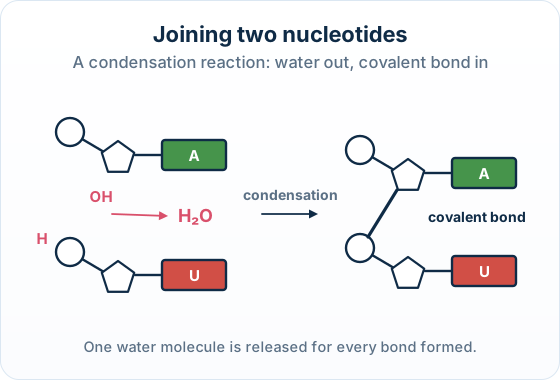
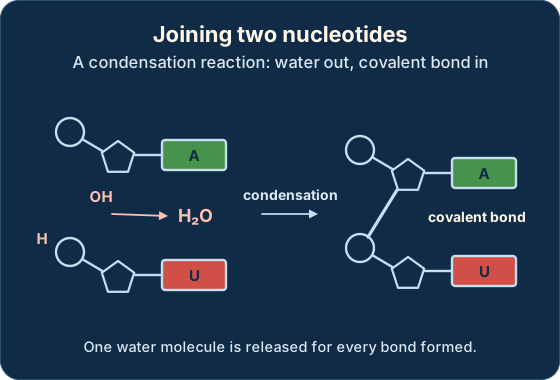
Do not swap the two reactions: Condensation joins monomers and releases water. Hydrolysis does the opposite: water is used to split the bond.
These chains can be very long:
Real example: the RNA at the heart of a ribosome: The largest RNA in a human ribosome is about 5 000 nucleotides long, every one added by a condensation reaction.
Get feedback like a real examiner
Submit your answers and get instant feedback — what you did well, what's missing, and exactly what to write to score full marks.
The big idea: To draw an RNA polymer, draw nucleotides one under another and join each ribose to the next phosphate.
The points to remember
- RNA is a single strand: draw one chain only.
- The sugar is ribose; the bases are A, C, G and U, never T.
- Join each ribose to the phosphate of the next nucleotide.
- All the bases stick out on the same side of the strand.
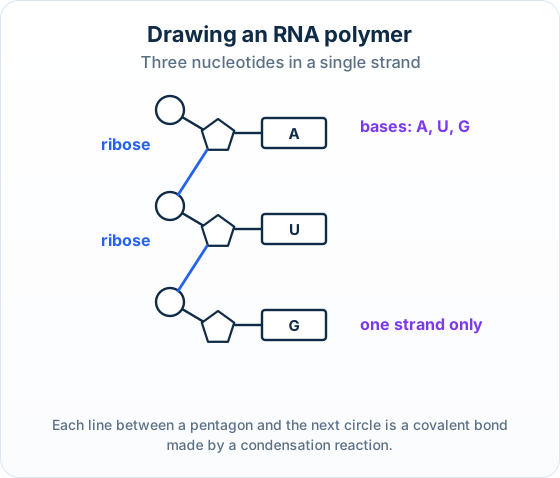
Three things that lose marks: Drawing two strands (that is DNA). Putting thymine in RNA. Joining the bases to each other instead of joining sugar to phosphate.
How it is asked: A one-mark State on the reaction, and drawing: a single nucleotide or a short RNA strand.
State the type of chemical reaction that joins two RNA nucleotides together.
Model answer plan
See the answer broken into clear points, with guidance on how each point earns marks.
And a drawing task in the same style:
Draw a labelled diagram of a short RNA polymer made of three nucleotides.
Model answer plan
See the answer broken into clear points, with guidance on how each point earns marks.