aımnova
DashboardMy LearningCrash CoursesStudy Plan

Aimnova site navigation

Stay in the loop

Get the latest study resources and updates

New features, study tips and exam insights — straight to your inbox.

IB Diploma

  • IB Past Papers
  • IB Study Notes
  • IB Question Bank
  • IB Mock Exams
  • IB Revision

IB Subjects

  • IB Math AA
  • IB Math AI
  • IB Economics
  • IB Business Management
  • IB Physics
  • IB Biology
  • View all IB subjects→

IB Past Papers

  • IB Math AA HL Past Papers
  • IB Math AA SL Past Papers
  • IB Math AI HL Past Papers
  • IB Math AI SL Past Papers
  • IB Economics HL Past Papers
  • IB Economics SL Past Papers
  • IB ESS Past Papers
  • View all past papers→

Study Resources

  • Study Notes
  • Question Bank
  • Mock Exams
  • Crash Courses
  • Flashcards
  • Revision Guide
  • Exam Skills
  • Command Terms
  • Grade Calculator
  • Exam Timetable 2026

Aimnova

  • Features
  • Pricing
  • For Teachers
  • For Schools
  • For Parents
  • About Us
  • Blog
  • Contact
aımnova

IB study, practice and feedback built around the real exam.

TermsPrivacyCookies·© 2026 Aimnova. All rights reserved.10c8990

Aimnova is not affiliated with or endorsed by the International Baccalaureate Organization (IB).

NotesBiology HLTopic 1.2Purine-to-pyrimidine bonding and the stability of the DNA helix
Back to Biology HL Topics
1.2.123 min read

Purine-to-pyrimidine bonding and the stability of the DNA helix (Biology HL)

IB Biology · Unit 1

Exam preparation

Practice the questions examiners actually ask

Our question bank mirrors real IB exam papers. Practice under timed conditions and track your progress across topics.

Start Practicing

Contents

  1. 1One purine with one pyrimidine
  2. 2Exam-style question (step by step)
The big idea: Each rung of the DNA ladder is one purine plus one pyrimidine. Both kinds of rung are the same length, so the helix is the same width all the way along.

The points to remember

  • Purines have two rings: adenine and guanine. Pyrimidines have one ring: cytosine and thymine.
  • Complementary pairing always joins one purine to one pyrimidine: A with T, and C with G.
  • An A–T pair and a C–G pair have the same length.
  • So the two backbones stay the same distance apart: the helix has the same 3-D structure whatever the sequence.
  • Two purines would be too long to fit, two pyrimidines too short: that regular shape helps keep the helix stable.
Remember it as: Big plus small: two rings meet one.
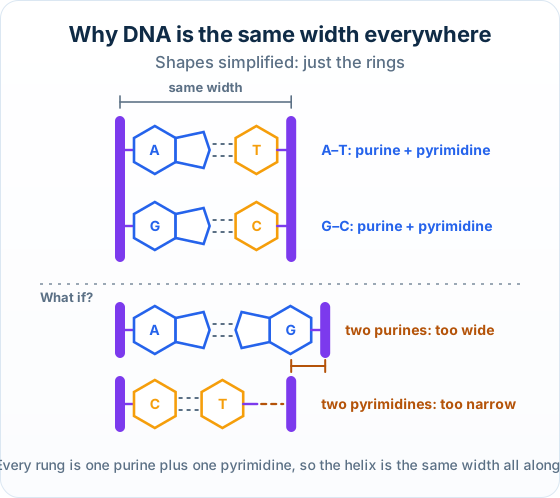
Two backbones a fixed distance apart, joined by an A–T rung and a G–C rung of the same length; below, a rung of two purines that is too long and a rung of two pyrimidines that is too short
Only purine plus pyrimidine fits the gap.
Real example: cardboard bases: In 1953 James Watson cut the four bases out of cardboard and moved them around on his desk. He saw that an A–T pair and a G–C pair had the same shape and size, which is how the pairs fit inside one regular helix.

Free preview

This is the free notes preview

You're reading the free notes. Aimnova Pro unlocks the full study experience — and you can try it with your first topic free to keep:

  • FlashcardsLock in vocabulary and key terms with spaced repetition.
  • Practice questionsAnswer exam-style questions and get instant AI marking.
  • Mock exams & past-paper vaultSit full mocks and see exactly how examiners award marks.
  • Personalised study planA daily plan built around your exam date and weak areas.
Start Studying Free Full access to Aimnova Pro · cancel anytime
How it is asked: A one-mark List on Paper 1B (which bases are purines, which are pyrimidines), or a short Explain of why the helix keeps the same shape.
IB-style questionList[1 mark]

A table shows the percentages of the four bases in DNA from several organisms. List the bases that are purines and the bases that are pyrimidines.

Model answer plan

See the answer broken into clear points, with guidance on how each point earns marks.

Claim your free topic

The same idea, asked as an Explain:

IB-style questionExplain[2 marks]

Explain why the DNA double helix has the same width whatever its base sequence.

Model answer plan

See the answer broken into clear points, with guidance on how each point earns marks.

Claim your free topic

Try an IB Exam Question — Free AI Feedback

Test yourself on Purine-to-pyrimidine bonding and the stability of the DNA helix. Write your answer and get instant AI feedback — just like a real IB examiner.

The table shows the base composition of DNA from three organisms.

the bases that are purines and the bases that are pyrimidines.
[1 mark]

Related Biology HL Topics

Continue learning with these related topics from the same unit:

1.1.1Water as the medium for life1.1.2Hydrogen bonds from the polar covalent bonds in water1.1.3Cohesion of water and its consequences for organisms1.1.4Adhesion of water to polar or charged materials
View all Biology HL topics
Improve your exam techniqueCommand terms, paper structure, and mark-scheme tips for Biology HL
Previous1.2.11Directionality of RNA and DNANextStructure of a nucleosome1.2.13

6 questions to test your understanding

Reading is just the start. Students who tested themselves scored 82% on average — try IB-style questions with AI feedback.

Start FreeView All Biology HL Topics