Speeches: same techniques, HL later: Direct address, a clear sense of audience, helpful signposting and a powerful close are speech skills that SL and HL learn together.
The speech: A speech (el discurso) is a text written to be spoken aloud to an audience — your class, an assembly, an event.
In Paper 1
- You choose it when the task tells you to address an audience or give a talk (a presentation, an assembly speech, a campaign).
- It's part of Unit 2: Text Types.
- The marks come from getting its conventions and register right (Criterion C), not just the message.
What HL adds later
- That persuasive, spoken-feel voice has to sustain a 450–600-word piece.
- Practise gripping an audience and landing a strong ending here. You'll then command the form whatever the prompt.
- el discurso
- the speech
- el público / la audiencia
- the audience
- el saludo al público
- the greeting/address to the audience
- el gancho
- the hook (what grabs attention)
- la llamada a la acción
- the call to action
- el cierre memorable
- the memorable closing
Spot it in the task: The task tells you to speak to a group. "Vas a dar un discurso…", "Pronuncia unas palabras ante…", "Prepara un discurso para…" → an audience → a speech. If it said "Escribe a tu amigo/a" you'd switch to an informal email (a different text type). Always read who the audience is first.
Tasks where it fits
- Speaking at a school assembly or for Mental Health Week
- Presenting a festival or a campaign to the school community
- Persuading classmates to vote, volunteer or give blood
Conventions the examiner checks
- A greeting to the audience and who you are
- Signposting: «En primer lugar...», «Por último...»
- A call to action, a memorable last line and thanks
Traps that cost Criterion C
- Writing it like an essay, with no audience
- «Estimado señor» or «Atentamente»
- Forgetting to thank the audience
También aparece como: presentación, charla, intervención en un debate (presentation / talk)
Free preview
Reading it is one thing — hearing it is another
You're reading the free notes. Aimnova Pro unlocks the full study experience — and you can try it with your first topic free to keep:
- Audio on every wordTap any vocabulary word or example to hear it read aloud in natural Spanish.
- FlashcardsLock in vocabulary and key terms with spaced repetition.
- Practice questionsAnswer exam-style questions and get instant AI marking.
- Mock exams & past-paper vaultSit full mocks and see exactly how examiners award marks.
- Personalised study planA daily plan built around your exam date and weak areas.
Speak to the room: Speak to the room in an energetic, persuasive tone.
How to speak to the room
- Use direct address (here, vosotros to a group).
- Use signposting (en primer lugar…).
- Use repetition to drive the message home.
- Speak to people: ask them questions, use exclamations.
- Consistency matters — drifting into a flat, written report tone breaks the register and costs you Criterion C.
Speech — do this
- Buenos días a todos. Hoy quiero hablaros de…
- En primer lugar,… En segundo lugar,…
- Os animo a… ¡Muchas gracias!
Report tone — avoid here
- El presente informe expone los datos.
- Se observa que el problema persiste.
- Sin más, se da por concluido el texto.
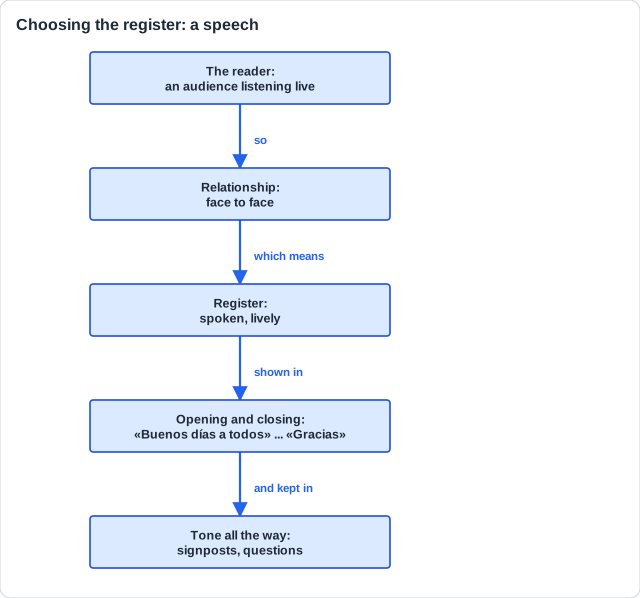
Stay consistent: Pick your form of address (vosotros for a group) and keep it from the greeting to the close. The verbs, pronouns (os, vuestro) and the closing all have to agree with that choice — never mix in tú or usted.
Learn what examiners really want
See exactly what to write to score full marks. Our AI shows you model answers and the key phrases examiners look for.
The five parts: Every speech follows the same shape. Hit all five parts and you've covered the conventions the examiner is looking for.
Speech — 5 parts
Address
Greet and name your audience. Buenos días a todos, queridos compañeros.
Hook
Grab attention — a question or a striking idea — and announce your topic. ¿Cuántos de vosotros…? Hoy quiero hablaros de…
Main points
Your message in clearly signposted points — the longest part. En primer lugar,… En segundo lugar,… Por último,…
Call to action
Tell the audience what to do. Por eso os animo a sumaros desde mañana.
Memorable close
A short, repeated, memorable ending + thanks. ¡Cuidémoslo juntos! Muchas gracias.
Address → Hook → Points → Call to action → Memorable close
Don't skip the frame: Students lose easy Criterion C marks by forgetting the address or the closing thanks. They take seconds and show you know the text type — never leave them out.
A model, part by part: Here's a complete speech built from the five parts above. Read it once for the message, then tap Ver traducción to check the English or the audio button to hear it.
Modelo: las 5 partes en acción
El discurso escrito, parte por parte
- Buenos días a todos, queridos compañeros y profesores.
- ¿Cuántos de vosotros tiráis un papel a la basura sin pensarlo dos veces? Hoy quiero hablaros de algo que está en nuestras manos: cuidar nuestro instituto.
- En primer lugar, podemos reciclar en cada aula. En segundo lugar, podemos apagar las luces al salir. Y, por último, podemos cuidar el patio entre todos.
- Por eso os animo a sumaros desde mañana mismo. Un pequeño gesto de cada uno se convierte en un gran cambio para todos.
- Nuestro instituto está en nuestras manos. ¡Cuidémoslo juntos! Muchas gracias.
Por qué puntúa — why it scores: This short speech earns marks on all three Paper 1 criteria — here's how:
A — Language /12
- Energetic, accurate language; vosotros throughout
- Signposting connectors: en primer lugar, por último, por eso
- Rhetorical question + imperative (cuidémoslo)
B — Message /12
- Clear purpose: persuades AND calls to action
- Ideas developed (three concrete points)
C — Conceptual /6
- Speech conventions: address + closing thanks
- Direct address to the audience (vosotros)
- Energetic, persuasive, memorable tone
Never wonder what to study next
Get a personalized daily plan based on your exam date, progress, and weak areas. We'll tell you exactly what to review each day.
A toolkit you can reuse: Learn a few ready-made phrases for each part. They make your speech sound natural and save time in the exam. Tap the audio button to hear them.
Para empezar (address & hook)
- Buenos días a todos. — Good morning everyone.
- Hoy quiero hablaros de… — Today I want to talk to you about…
- ¿Cuántos de vosotros…? — How many of you…?
Para los puntos (signposting)
- En primer lugar,… En segundo lugar,… — Firstly,… Secondly,…
- Por último,… / Para terminar,… — Finally,… / To finish,…
- Por eso… / Por esa razón… — That's why… / For that reason…
Para terminar (call to action & close)
- Os animo a… — I encourage you to…
- ¡Sumémonos todos juntos! — Let's all join in together!
- Muchas gracias por vuestra atención. — Thank you very much for your attention.
Use one from each: One address + hook, one or two signposted points, and a call to action + thanks is plenty — and instantly makes the text feel like a real speech.