Personal diary entry, HL edition: Dating the entry, writing in the first person and using a private register are core diary skills. SL and HL share them.
The personal diary: A personal diary (el diario personal) is a private entry where you write down what happened and how you feel about it — for yourself, not for any reader.
In Paper 1
- You choose it when the task tells you to write a diary entry / una entrada de diario about an experience.
- It's part of Unit 2: Text Types.
- The marks come from getting its conventions and register right (Criterion C), not just the events.
What HL adds later
- That intimate first-person voice has to fill a 450–600-word piece.
- It comes back as you reflect on your two studied works.
- Master the feel of it now.
- el diario (personal)
- the (personal) diary
- la entrada
- the entry (one dated piece)
- la fecha
- the date (every entry begins with one)
- la reflexión
- the reflection (what you think/feel about it)
- el registro íntimo
- intimate register (you write to yourself, in yo)
- el tono personal
- a private, heartfelt tone
Spot it in the task: The task names your format. “Escribe una entrada de tu diario…”, “Escribe en tu diario sobre…” → a diary → intimate, first-person. If it said “Escribe a tu amigo” you'd switch to an informal email (a different text type). Always read what format the task asks for first.
Tasks where it fits
- Reflecting on an argument with your parents
- Looking back on a first day: an exchange, an internship, a new school
- Writing about a moment that changed how you see something
Conventions the examiner checks
- The date and «Querido diario»
- First person, feelings and reflection
- Past tenses for what happened, present for how you feel now
Traps that cost Criterion C
- Writing to a reader as if it were a letter
- Only listing events, with no reflection
- A formal sign-off
Free preview
Reading it is one thing — hearing it is another
You're reading the free notes. Aimnova Pro unlocks the full study experience — and you can try it with your first topic free to keep:
- Audio on every wordTap any vocabulary word or example to hear it read aloud in natural Spanish.
- FlashcardsLock in vocabulary and key terms with spaced repetition.
- Practice questionsAnswer exam-style questions and get instant AI marking.
- Mock exams & past-paper vaultSit full mocks and see exactly how examiners award marks.
- Personalised study planA daily plan built around your exam date and weak areas.
Keep it personal and private: Write in the first person (yo) for yourself — no greeting to any reader.
The diary voice
- The tone is intimate and reflective.
- Say what happened, then how you feel about it.
- Often you address the diary itself (Querido diario).
Consistency matters: Slipping into a letter-to-a-reader style or formal phrasing breaks the register and costs you Criterion C.
Diary — do this
- Querido diario: hoy me ha pasado algo…
- Me siento feliz / triste porque…
- No puedo dejar de pensar en…
Letter to a reader — avoid here
- ¡Hola, Marta! ¿Qué tal?
- Te escribo para contarte…
- Un abrazo, / Atentamente,
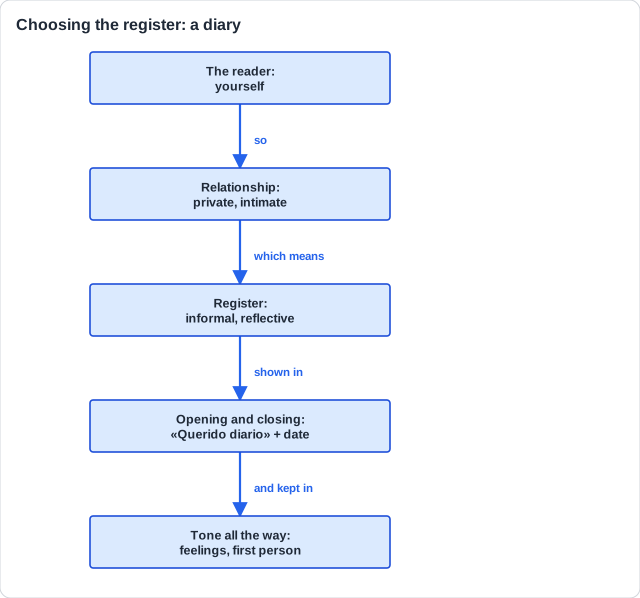
Stay consistent: Pick the yo voice and keep it from the date to the close. Verbs, pronouns (me, mi, conmigo) and the feelings you express all stay first-person — never address an outside reader as tú.
Study smarter, not longer
Most students waste 40% of study time on topics they already know. Our AI tracks your progress and optimizes every minute.
The five parts: Every diary entry follows the same shape. Hit all five parts and you've covered the conventions the examiner is looking for.
Personal diary — 5 parts
Dated entry
Begin with the date — every diary entry is dated. Sábado, 14 de junio
Opening
Address the diary and set the scene. Querido diario: hoy ha sido un día…
What happened today
Tell the events of the day in the first person — the longest part. Por la mañana… pero por la tarde…
Feelings & reflection
Say how you feel and what you make of it. Me siento… No puedo dejar de pensar en…
Looking ahead / close
Look to tomorrow and sign off to the diary. Mañana espero… Buenas noches, diario.
Date → Opening → What happened → Feelings → Looking ahead
Don't skip the frame: Students lose easy Criterion C marks by forgetting the date or the feelings/reflection. The date proves it's a diary, and the reflection is what makes it personal — never leave them out.
A model, part by part: Here's a complete diary entry built from the five parts above. Read it once for the message, then tap Ver traducción to check the English or the audio button to hear it.
Modelo: las 5 partes en acción
La entrada de diario, parte por parte
- Sábado, 14 de junio
- Querido diario:
- Hoy ha sido un día muy raro. Por la mañana suspendí el examen de matemáticas, pero por la tarde mi mejor amiga me dio una sorpresa increíble.
- No puedo dejar de pensar en lo nerviosa que estaba durante el examen. Me siento frustrada conmigo misma, aunque también muy agradecida por tener amigas así.
- Mañana espero estudiar más y empezar de nuevo con calma. Buenas noches, diario.
Por qué puntúa — why it scores: This short diary entry earns marks on all three Paper 1 criteria — here's how:
A — Language /12
- Personal, accurate language; yo throughout
- Connectors & contrast: pero, aunque, también
- Correct tenses (suspendí, ha sido, espero)
B — Message /12
- Clear content: the events AND a real reflection
- Ideas developed (the exam, the surprise, the resolve)
C — Conceptual /6
- Diary conventions: date + Querido diario + close
- Consistent intimate register (yo)
- Heartfelt, reflective tone
Practice with exam-style questions
Answer exam-style questions and get AI feedback that shows you exactly what examiners want to see in a full-marks response.
A toolkit you can reuse: Learn a few ready-made phrases for each part. They make your entry sound natural and save time in the exam. Tap the audio button to hear them.
Para empezar (opening the entry)
- Querido diario: — Dear diary,
- Hoy ha sido un día… — Today has been a … day…
- No sé por dónde empezar. — I don't know where to start.
Para reflexionar (feelings & reflection)
- Me siento… (feliz / triste / nervioso/a) — I feel… (happy / sad / nervous)
- No puedo dejar de pensar en… — I can't stop thinking about…
- Lo que más me sorprendió fue… — What surprised me most was…
Para terminar (looking ahead / close)
- Mañana espero… — Tomorrow I hope…
- A partir de ahora voy a… — From now on I'm going to…
- Buenas noches, diario. — Good night, diary.
Use one from each: One opener, one or two feelings phrases in the middle, and one closer is plenty — and instantly makes the entry feel like the real text type.