Social media posts: shared skill, HL stretch: Hashtags, a sharp hook, a clear call to action and a snappy online register are taught the same way at SL and HL.
The social media post: A social media post (la publicación en redes sociales) is a short, public message written to be read fast on a screen — on Instagram, X, TikTok or a school blog.
In Paper 1
- You choose it when the task asks you to post / publish something to followers or a community.
- It's part of Unit 2: Text Types.
- The marks come from getting its conventions and register right (Criterion C) — a hook, a clear call to action and hashtags — not just the message.
What HL adds later
- You reuse this punchy style inside a longer 450–600-word essay.
- Your Paper 2 reading texts are a touch denser.
- Get the formula down and you're set.
- la publicación / el post
- the post (the message itself)
- el gancho
- the hook — the attention-grabbing first line
- la llamada a la acción
- the call to action (what you ask readers to do)
- el hashtag / la etiqueta
- the hashtag (#…)
- los seguidores
- the followers (your readers)
- el registro cercano y directo
- a close, direct register (you address readers as tú/vosotros)
Spot it in the task: The task names a platform or a feed. “Escribe una publicación para las redes sociales…”, “Publica un mensaje en el blog del instituto…” → a public, online post → punchy register. If it said “Escribe una carta al periódico” you'd switch to a letter to the editor (a different text type). Always read where it's published first.
Tasks where it fits
- Inviting followers to an event or a campaign
- Sharing a cause: recycling, volunteering, a petition
- Telling followers about an experience with a photo
Conventions the examiner checks
- A hook in the first line
- Short paragraphs, hashtags, a mention
- A call to action: comment, share, come
Traps that cost Criterion C
- One long block of text
- Too many emojis instead of ideas
- No clear purpose
También aparece como: comentario en un foro, publicación en redes (online forum post)
Free preview
Reading it is one thing — hearing it is another
You're reading the free notes. Aimnova Pro unlocks the full study experience — and you can try it with your first topic free to keep:
- Audio on every wordTap any vocabulary word or example to hear it read aloud in natural Spanish.
- FlashcardsLock in vocabulary and key terms with spaced repetition.
- Practice questionsAnswer exam-style questions and get instant AI marking.
- Mock exams & past-paper vaultSit full mocks and see exactly how examiners award marks.
- Personalised study planA daily plan built around your exam date and weak areas.
Keep it short, punchy and direct: Use short sentences, direct address (tú or vosotros), and an energetic, friendly tone.
What the online voice uses
- A couple of emojis are welcome.
- A few hashtags are welcome.
- A clear call to action tells readers what to do next.
What to avoid: Avoid long, dense paragraphs and stiff formal phrasing. They break the online register and cost you Criterion C.
Social post — do this
- ¿Sabías que…?
- ¡No te lo pierdas! Comparte y etiqueta a un amigo.
- #CeroDesperdicio #BarrioVivo
Formal — avoid here
- Estimados seguidores:
- Me dirijo a ustedes para informarles de lo siguiente…
- Atentamente,
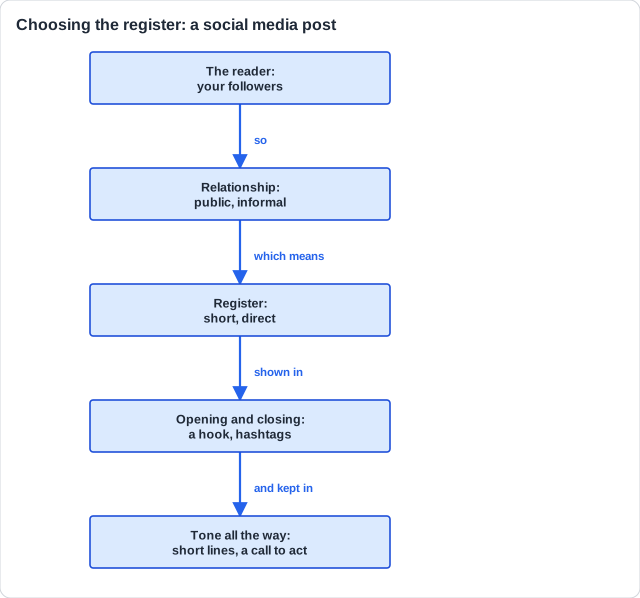
Stay consistent: Pick tú/vosotros and keep the close, direct tone from the hook to the hashtags. Verbs, pronouns (te, comparte, etiqueta) and the call to action all have to agree with that choice.
Feeling unprepared for exams?
Get a clear study plan, practice with real questions, and know exactly where you stand before exam day. No more guessing.
The four parts: Every social media post follows the same shape. Hit all four parts and you've covered the conventions the examiner is looking for.
Social media post — 4 parts
Hook
An attention-grabbing first line — a question, a surprising fact or an emoji. ¿Sabías que…?
Message
The point of the post, kept short and clear: what's happening, when and where. Este sábado abrimos un mercadillo solidario…
Call to action
Tell readers exactly what to do next. ¡No te lo pierdas! Comparte y etiqueta a un amigo.
Hashtags
A few relevant hashtags so the post is found and shared. #MercadilloSolidario #CeroDesperdicio
Hook → message → call to action → hashtags
Don't skip the frame: Students lose easy Criterion C marks by forgetting the call to action or the hashtags. They take seconds and instantly mark the text as a social post — never leave them out.
A model, part by part: Here's a complete social media post built from the four parts above. Read it once for the message, then tap Ver traducción to check the English or the audio button to hear it.
Modelo: las 4 partes en acción
La publicación escrita, parte por parte
- ¿Sabías que cada año tiramos toneladas de comida que todavía se puede aprovechar?
- Este sábado abrimos un mercadillo solidario en la plaza: traemos fruta, verdura y pan rescatados, y todo se vende a precio simbólico para ayudar al comedor del barrio.
- ¡No te lo pierdas! Pásate de 10 a 14 h, comparte esta publicación y etiqueta a un amigo que quiera echar una mano.
- #ComidaParaTodos #MercadilloSolidario #CeroDesperdicio #BarrioVivo
Por qué puntúa — why it scores: This short post earns marks on all three Paper 1 criteria — here's how:
A — Language /12
- Direct, accurate language; tú/vosotros throughout
- Connectors & variety: todavía, y todo se vende
- Correct verbs (tiramos, abrimos, comparte, etiqueta)
B — Message /12
- Clear purpose: announces the event AND rallies support
- Ideas developed (the cause, the details, the action)
C — Conceptual /6
- Post conventions: hook + call to action + hashtags
- Punchy, direct online register (tú/vosotros)
- Emojis and #etiquetas used appropriately
Memorize terms 3x faster
Smart flashcards show you cards right before you forget them. Perfect for definitions and key concepts.
A toolkit you can reuse: Learn a few ready-made phrases for each part. They make your post sound natural and save time in the exam. Tap the audio button to hear them.
Para el gancho (hooks)
- ¿Sabías que…? — Did you know…?
- ¡No te lo pierdas! — Don't miss it!
- Atención, [seguidores]: tenemos novedades. — Heads up, [followers]: we've got news.
Para la llamada a la acción (call to action)
- Comparte si estás de acuerdo. — Share if you agree.
- Etiqueta a un amigo. — Tag a friend.
- Pásate, dale a 'me gusta' y coméntanos. — Come along, like it and comment.
Para las etiquetas (hashtags)
- #CeroDesperdicio — #ZeroWaste
- #MercadilloSolidario — #CharityMarket
- #BarrioVivo — #LivingNeighbourhood
Use one from each: One hook, a short message, one clear call to action and two or three hashtags is plenty — and instantly makes the text feel like the real social media post.