Peace & conflict, HL-bound: The paz y conflicto vocabulary on conflict and resolution is the same at HL and SL. This is your topic.
What HL adds later
- These themes meet denser Paper 2 texts.
- They meet a longer 450–600-word essay.
- They often echo in your literary works.
- Build a thoughtful vocabulary of conflict and peace now. The HL demands then feel like a deeper version of work you know.
What 'la paz y el conflicto' covers: Peace & conflict (la paz y el conflicto) is part of the theme Sharing the Planet. You need vocabulary to talk about disagreements, dialogue, coexistence and how people resolve conflicts peacefully — and to give your opinion about them. Learn the words below as a deck, then use them in the reading and writing sections.
- la paz
- peace
- el conflicto
- conflict
- el diálogo
- dialogue
- la convivencia
- living together / coexistence
- el respeto
- respect
- la tolerancia
- tolerance
- discutir
- to argue
- pelear(se)
- to fight
- resolver un problema
- to solve a problem
- llegar a un acuerdo
- to reach an agreement
- la mediación
- mediation
- respetar a los demás
- to respect others
- convivir en paz
- to live together in peace
| Useful expression (Spanish) | English |
|---|---|
| Es mejor dialogar que pelear. | It's better to talk things through than to fight. |
| Intento llegar a un acuerdo con todos. | I try to reach an agreement with everyone. |
| Hay que respetar a quien piensa distinto. | You have to respect those who think differently. |
| La paz empieza con pequeños gestos. | Peace starts with small gestures. |
| Aprendimos a resolver los conflictos hablando. | We learned to solve conflicts by talking. |
Why this matters: This vocabulary turns up in every skill — a reading text on coexistence, a listening interview about a school mediation scheme, a Paper 1 blog, or your oral. Reusing the right topic words is how you score Criterion A (Language).
Free preview
Reading it is one thing — hearing it is another
You're reading the free notes. Aimnova Pro unlocks the full study experience — and you can try it with your first topic free to keep:
- Audio on every wordTap any vocabulary word or example to hear it read aloud in natural Spanish.
- FlashcardsLock in vocabulary and key terms with spaced repetition.
- Practice questionsAnswer exam-style questions and get instant AI marking.
- Mock exams & past-paper vaultSit full mocks and see exactly how examiners award marks.
- Personalised study planA daily plan built around your exam date and weak areas.
Have something to say: Examiners reward developed ideas, not just vocabulary. Around peace & conflict, the common debates are: dialogue vs confrontation, how to live together when people disagree, and what role respect and tolerance play. Take a position and back it up.
Opinion phrases (use these to introduce a view)
- En mi opinión… / Desde mi punto de vista… — In my opinion… / From my point of view…
- Me parece que… / Creo que… — It seems to me that… / I think that…
- Lo más importante es… — The most important thing is…
- Por un lado… por otro lado… — On the one hand… on the other hand…
- Estoy (totalmente) de acuerdo con… — I (completely) agree with…
El conflicto sin diálogo (drawbacks)
- Cuando nadie escucha, los problemas crecen.
- Pelear rompe la convivencia y crea más tensión.
- La falta de respeto hace imposible un acuerdo.
El diálogo y la paz (benefits)
- Hablando se entienden las dos posturas.
- La mediación ayuda a buscar una solución justa.
- El respeto permite convivir aunque pensemos distinto.
After violence
- mujeres desplazadas que cosen su memoria
- de niño soldado a profesor de música
- perdonar sin olvidar
Conflict close to home
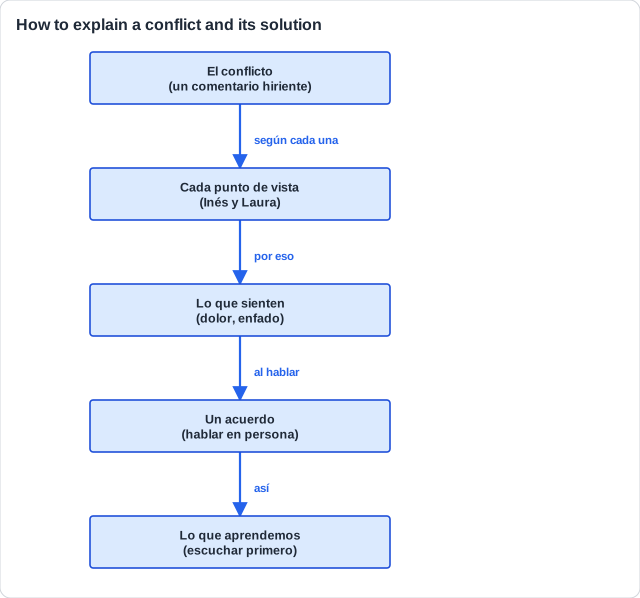
- un comentario hiriente en un grupo de mensajes
- la mediación entre compañeros
- hablar en persona en vez de discutir por el móvil
Building peace
- el Día Internacional de la Paz en el instituto
- el periodismo de paz
- una manifestación pacífica, el diálogo
Big questions behind this topic (IB guide, theme Sharing the planet)
- ¿Qué retos plantean los conflictos al mundo y cómo se pueden superar?
- ¿Cómo se resuelve un conflicto sin violencia?
- ¿Qué responsabilidad tienen los medios cuando cuentan una guerra?
Link your ideas: Connectors lift your answer from a list into an argument: además (besides), sin embargo (however), por lo tanto (therefore), aunque (although). Use at least two or three in any written answer.
Stop wasting time on topics you know
Our AI identifies your weak areas and focuses your study time where it matters. No more overstudying easy topics.
Read like Paper 2: Here is a short blog — the kind of text Paper 2 (Reading) gives you. Then we'll do one exam question together.
How to read it
Read once for the gist
Read it once just for the general idea; don't worry about every word.
Listen
Tap the audio button to hear it.
Stuck?
Tap Ver traducción if you get stuck.
Gist → Listen → Translate if stuck
Aprender a convivir: El año pasado, en mi instituto, dos grupos de alumnos discutían todos los días por el uso del patio. El ambiente era muy tenso y casi nadie se hablaba.
Por eso, unos profesores crearon un grupo de mediación entre compañeros. En lugar de castigar, nos enseñaron a escuchar al otro y a buscar una solución juntos.
Aprender a convivir (continuación)
Al principio me daba vergüenza, pero pronto entendí que dialogar es mejor que pelear. Ahora compartimos el patio por turnos y resolvemos los problemas hablando. No siempre estamos de acuerdo, pero hemos aprendido a convivir en paz y a respetar a los demás.
- discutir
- to argue
- el ambiente
- the atmosphere
- la mediación entre compañeros
- peer mediation
- dar(le) vergüenza
- to feel embarrassed
- convivir
- to live together
IB-style task — una pregunta de Paper 2
Una pregunta, paso a paso
- The question — Según el texto, ¿qué hicieron los profesores para mejorar el ambiente?
- Find it in the text. Look for profesores: Por eso, unos profesores crearon un grupo de mediación entre compañeros.
- The answer — Crearon un grupo de mediación entre compañeros.
Reading technique: For a según el texto (according to the text) question, find the exact line that proves your answer — don't rely on memory or general knowledge.
La tarea — your task: Tu colegio organiza una campaña sobre la convivencia. Escribe un folleto para los estudiantes: explica cómo resolver los conflictos en paz y dónde pedir ayuda.
Escribe entre 450 y 600 palabras.
Leaflet structure — 4 steps
Title
A catchy title, often a saying, and a subtitle. Hablando se entiende la gente
Sections with headings
A short opening section under a question. ¿Discutís a menudo?
Bullet points
Steps or tips, one per line, in the imperative. — Escuchad al otro sin interrumpir.
Practical info + call to action
Where and when to get help, and a last line. El equipo de mediación os espera…
Title → Headings → Bullets → Info + call
Modelo: los 4 pasos en ~100 palabras
El folleto, paso a paso
- Hablando se entiende la gente. Guía para resolver conflictos en paz
- ¿Discutís a menudo? Es normal tener conflictos; lo importante es cómo los resolvemos.
- Cuatro pasos para la paz: — Respirad y calmaos antes de hablar. — Escuchad al otro sin interrumpir. — Dialogad en vez de pelear. — Buscad una solución justa para los dos.
- ¿Necesitáis ayuda? El equipo de mediación os espera los martes y jueves en el aula 12, durante el recreo. ¡Convivir en paz es cosa de todos!
Por qué funciona — why it works: A strong leaflet does this for each of the three Paper 1 criteria:
A — Language /12
- Vosotros imperatives, incl. reflexive: calmaos, escuchad
- Topic vocabulary: conflicto, mediación, solución justa
- En vez de + infinitive
B — Message /12
- Task fully done: how to resolve conflicts AND where to get help
- Steps are concrete and in a sensible order
C — Conceptual /6
- Leaflet conventions: catchy title and subtitle
- Headings and bullet points
- Practical information and a call to action
Ready to ace Peace & conflict?
You've seen the preview. Here's what you'll unlock:
Bite-Sized Study Notes
Full syllabus broken into chunks that stick
Exam Practice
See exactly how to score full marks
AI Feedback
Know exactly what examiners want
Smart Study Plan
Know exactly what to study next