Community — HL extension: A moment of calm: the comunidad vocabulary about local community and belonging is taught the same way at SL and HL, so trust that you are revising correctly.
Same as SL
- Local community
- Belonging
What HL adds later
- These ideas appear in denser Paper 2 texts
- They appear in a longer essay that wants developed argument
- Build a warm, precise vocabulary of belonging here, and the extra HL length becomes room to say more, not a hurdle to clear
What 'la comunidad' covers: Community (la comunidad) is part of the theme Social organization. You need vocabulary to talk about your neighbourhood, neighbours, shared spaces, local projects and helping one another — and to give your opinion about them. Learn the words below as a deck, then use them in the reading and writing sections.
- la comunidad
- community
- el barrio
- neighbourhood / district
- el vecino / la vecina
- neighbour
- la asociación de vecinos
- neighbourhood / residents' association
- el espacio público
- public space
- el huerto comunitario
- community garden
- el voluntariado
- volunteering
- colaborar
- to collaborate / to work together
- convivir
- to live together / to coexist
- el lugar de encuentro
- meeting place
- echar una mano
- to lend a hand
- el bien común
- the common good
- integrarse
- to fit in / to become part of
| Useful expression (Spanish) | English |
|---|---|
| Me llevo muy bien con mis vecinos. | I get on very well with my neighbours. |
| En mi barrio faltan espacios para los jóvenes. | My neighbourhood lacks spaces for young people. |
| Participo como voluntaria en un proyecto del barrio. | I take part as a volunteer in a local project. |
| Si todos colaboramos, mejoramos la comunidad. | If we all work together, we improve the community. |
| Siempre intento echar una mano a quien lo necesita. | I always try to lend a hand to those who need it. |
Why this matters: This vocabulary turns up in every skill — a reading text about a local project, a listening interview with a neighbour, a Paper 1 blog or letter to the residents' association, or your oral. Reusing the right topic words is how you score Criterion A (Language).
Free preview
Reading it is one thing — hearing it is another
You're reading the free notes. Aimnova Pro unlocks the full study experience — and you can try it with your first topic free to keep:
- Audio on every wordTap any vocabulary word or example to hear it read aloud in natural Spanish.
- FlashcardsLock in vocabulary and key terms with spaced repetition.
- Practice questionsAnswer exam-style questions and get instant AI marking.
- Mock exams & past-paper vaultSit full mocks and see exactly how examiners award marks.
- Personalised study planA daily plan built around your exam date and weak areas.
Have something to say: Examiners reward developed ideas, not just vocabulary. Take a position and back it up.
The common debates around community
- The lack of public recreational spaces for young people
- Whether neighbours still help one another today
- How local projects (gardens, volunteering) bring people together
Opinion phrases (use these to introduce a view)
- En mi opinión… / Desde mi punto de vista… — In my opinion… / From my point of view…
- Me parece que… / Creo que… — It seems to me that… / I think that…
- Lo más importante es… — The most important thing is…
- Por un lado… por otro lado… — On the one hand… on the other hand…
- Estoy (totalmente) de acuerdo con… — I (completely) agree with…
Problemas del barrio (drawbacks)
- Faltan espacios públicos donde los jóvenes puedan reunirse.
- A veces los vecinos no se conocen y nadie colabora.
- Algunos espacios comunes están abandonados o descuidados.
Una comunidad fuerte (benefits)
- El voluntariado nos ayuda a sentirnos parte de algo.
- Un proyecto común convierte un barrio en un lugar de encuentro.
- Cuando los vecinos colaboran, todos vivimos mejor.
Spaces for people
- la falta de espacios de ocio para los jóvenes
- dar vida a las plazas y zonas verdes
- salvar los edificios antiguos de un barrio
Community projects
- una biblioteca de las cosas
- una nevera solidaria en la calle
- comprar entre todos el último bar del pueblo
Bringing people in
- un pueblo que atrae a familias nuevas
- la jornada de puertas abiertas del colegio
- una reunión de vecinos
Big questions behind this topic (IB guide, theme Social organization)
- ¿Cuál es el papel del individuo en la comunidad?
- ¿Qué convierte un barrio en una comunidad?
- ¿Cómo pueden los jóvenes mejorar su barrio?
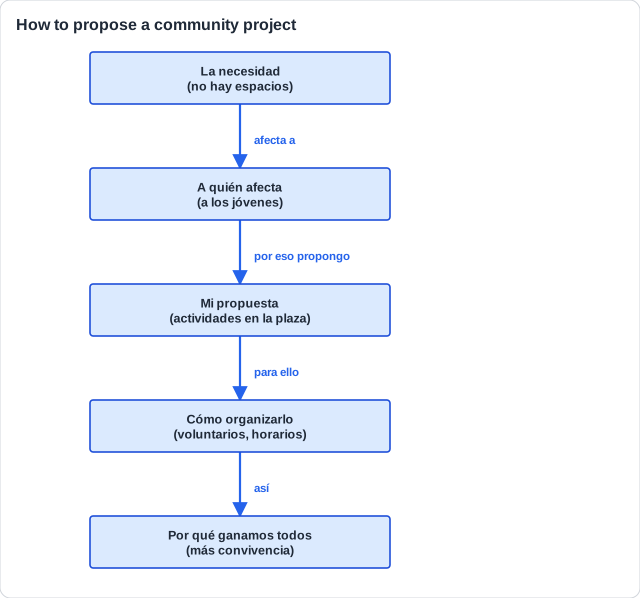
Link your ideas: Connectors lift your answer from a list into an argument: además (besides), sin embargo (however), por lo tanto (therefore), aunque (although). Use at least two or three in any written answer.
Stop wasting time on topics you know
Our AI identifies your weak areas and focuses your study time where it matters. No more overstudying easy topics.
Read like Paper 2: Here is a short blog — the kind of text Paper 2 (Reading) gives you. Then we'll do one exam question together.
How to read it
Read once for the gist
Read it once just for the general idea; don't worry about every word.
Listen
Tap the audio button to hear it.
Stuck?
Tap Ver traducción if you get stuck.
Gist → Listen → Translate if stuck
Un huerto que une al barrio: El año pasado, un grupo de vecinos transformamos un solar abandonado en un huerto comunitario. Al principio yo estaba un poco desanimada, porque en mi barrio casi no hay espacios para los jóvenes.
Sin embargo, todo cambió cuando empezamos a trabajar juntos. Cada sábado plantamos verduras, pintamos los bancos y organizamos meriendas para los vecinos mayores.
Un huerto que une al barrio (continuación)
Poco a poco, el huerto se convirtió en un lugar de encuentro donde la gente se conoce y se ayuda. Yo, que llegué tímida, ahora me siento parte de una comunidad. He aprendido que, cuando los vecinos colaboran, hasta un solar vacío puede convertirse en algo que une a todo el barrio.
- el solar (abandonado)
- an (abandoned) plot of land
- el huerto comunitario
- community garden
- desanimado/a
- discouraged / disheartened
- el lugar de encuentro
- meeting place
- unir
- to bring together / to unite
IB-style task — una pregunta de Paper 2
Una pregunta, paso a paso
- The question — Según el texto, ¿en qué transformaron los vecinos el solar abandonado?
- Find it in the text. Look for solar abandonado: un grupo de vecinos transformamos un solar abandonado en un huerto comunitario.
- The answer — Lo transformaron en un huerto comunitario.
Reading technique: For a según el texto (according to the text) question, find the exact line that proves your answer — don't rely on memory or general knowledge.
La tarea — your task: La asociación de vecinos de tu barrio busca ideas para mejorar la comunidad. Escribe una propuesta para la asociación: presenta un proyecto concreto, explica cómo se haría y por qué vale la pena.
Escribe entre 450 y 600 palabras.
Proposal structure — 3 steps
Objective
A title and one sentence on what you want to achieve. Propuesta: … Objetivo: crear…
Plan
How it would work, step by step, in the conditional. Primero, limpiaríamos…, después…
Justification
Why it is worth it, then a formal request. Un huerto daría vida al barrio… les pedimos que…
Objective → Plan → Justification
Modelo: los 3 pasos en ~100 palabras
La propuesta, paso a paso
- Propuesta: un huerto comunitario en el solar de la calle Olmo. Objetivo: crear un espacio verde donde jóvenes y mayores del barrio se conozcan y colaboren.
- Plan: primero, limpiaríamos el solar con voluntarios durante un fin de semana. Después, cada familia cuidaría una parcela y, los sábados, los mayores enseñarían a cultivar a los jóvenes. Solo necesitamos el permiso del ayuntamiento y unas herramientas básicas.
- Justificación: ahora faltan espacios para los jóvenes y muchos vecinos no se conocen. Un huerto daría vida al barrio, mejoraría la convivencia y ofrecería verduras frescas a todos. Por eso, les pedimos que apoyen esta propuesta.
Por qué funciona — why it works: A strong proposal does this for each of the three Paper 1 criteria:
A — Language /12
- Conditional for the plan: limpiaríamos, cuidaría, daría
- Subjunctive after a request: les pedimos que apoyen
- Sequencers: primero, después, por eso
B — Message /12
- Task fully done: project, how it works AND why it matters
- Benefits linked to real problems in the area
C — Conceptual /6
- Proposal conventions: a title and a stated objective
- A step-by-step plan, then the justification
- Formal register with a request to the decision-makers
Ready to ace Community?
You've seen the preview. Here's what you'll unlock:
Bite-Sized Study Notes
Full syllabus broken into chunks that stick
Exam Practice
See exactly how to score full marks
AI Feedback
Know exactly what examiners want
Smart Study Plan
Know exactly what to study next