Rites of passage, HL-bound: Mark this clearly: describing ritos de paso such as quinceañeras and graduations is the same syllabus at HL and SL, so you are revising exactly what you need.
Same as SL
- Ritos de paso
- Quinceañeras
- Graduations
What HL adds later
- This milestone vocabulary feeds a 450–600-word written piece
- It also feeds richer cultural comparison
- Learn to narrate these life events clearly here and the longer HL tasks become a comfortable step up rather than a leap
What 'los ritos de paso' covers: Rites of passage (los ritos de paso) is part of the theme Experiences. You need vocabulary to talk about the milestones that mark growing up — graduations, coming-of-age celebrations, leaving home, starting a new stage — and to give your opinion about them. Learn the words below as a deck, then use them in the reading and writing sections.
- el rito de paso
- rite of passage
- la etapa
- stage / phase of life
- crecer / hacerse mayor
- to grow up / to become an adult
- la infancia / la adolescencia
- childhood / adolescence
- la vida adulta / la madurez
- adult life / maturity
- la graduación
- graduation
- cumplir años / la mayoría de edad
- to have a birthday / coming of age
- la ceremonia / la celebración
- the ceremony / the celebration
- independizarse
- to become independent / to leave home
- un momento inolvidable
- an unforgettable moment
- marcar un antes y un después
- to mark a turning point
- despedirse (de)
- to say goodbye (to)
- dar la bienvenida (a)
- to welcome (in)
| Useful expression (Spanish) | English |
|---|---|
| Para mí, fue un verdadero rito de paso. | For me, it was a real rite of passage. |
| Ese día marcó un antes y un después. | That day marked a turning point. |
| Fue un momento inolvidable. | It was an unforgettable moment. |
| Aprendí a decidir por mí misma. | I learned to decide for myself. |
| Empecé una etapa completamente nueva. | I began a completely new stage. |
Why this matters: This vocabulary turns up in every skill — a reading text about someone's graduation, a listening interview about leaving home, a Paper 1 blog about growing up, or your oral. Reusing the right topic words is how you score Criterion A (Language).
Free preview
Reading it is one thing — hearing it is another
You're reading the free notes. Aimnova Pro unlocks the full study experience — and you can try it with your first topic free to keep:
- Audio on every wordTap any vocabulary word or example to hear it read aloud in natural Spanish.
- FlashcardsLock in vocabulary and key terms with spaced repetition.
- Practice questionsAnswer exam-style questions and get instant AI marking.
- Mock exams & past-paper vaultSit full mocks and see exactly how examiners award marks.
- Personalised study planA daily plan built around your exam date and weak areas.
Have something to say: Examiners reward developed ideas, not just vocabulary. Take a position and back it up, and stay respectful of traditions that differ from your own.
The common debates around rites of passage
- Do big ceremonies still matter today?
- The pressure to 'grow up' on time
- How different cultures mark the same milestones in their own way
Opinion phrases (use these to introduce a view)
- En mi opinión… / Desde mi punto de vista… — In my opinion… / From my point of view…
- Me parece que… / Creo que… — It seems to me that… / I think that…
- Lo más importante es… — The most important thing is…
- Por un lado… por otro lado… — On the one hand… on the other hand…
- Estoy (totalmente) de acuerdo con… — I (completely) agree with…
Posibles inconvenientes (drawbacks)
- A veces hay mucha presión por crecer demasiado rápido.
- Algunas celebraciones cuestan mucho dinero.
- Despedirse de una etapa puede dar miedo.
Ventajas (benefits)
- Los ritos de paso nos unen a nuestra familia y comunidad.
- Celebrar un logro nos da confianza para la siguiente etapa.
- Nos ayudan a recordar de dónde venimos.
Coming of age
- cumplir dieciocho años y heredar un reloj
- sacarse el carné de conducir (o no)
- el primer piso compartido
School milestones
- la graduación y el ensayo de la ceremonia
- la selectividad: más que un examen
- la fiesta de fin de curso
Ceremonies
- el bar mitzvá y el bat mitzvá
- una comida familiar por los dieciocho
- una tradición familiar que pasa de madres a hijas
Big questions behind this topic (IB guide, theme Experiences)
- ¿Cómo y por qué las distintas culturas marcan los momentos importantes de la vida?
- ¿Cuándo empezamos de verdad a ser adultos?
- ¿Siguen teniendo sentido los ritos de siempre?
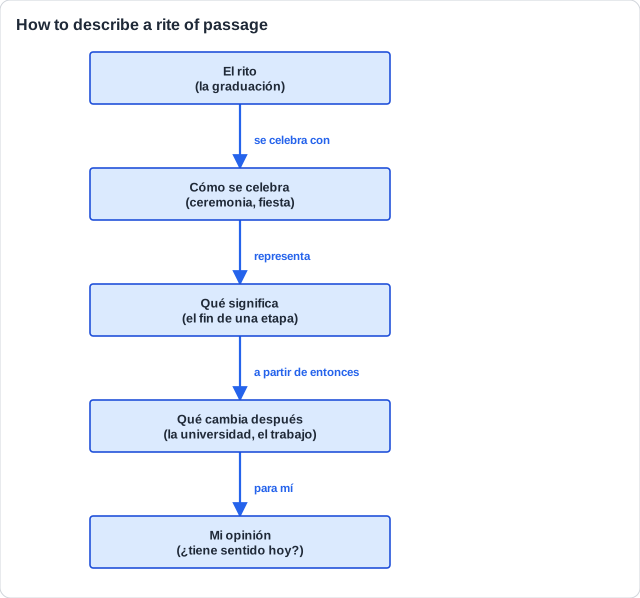
Link your ideas: Connectors lift your answer from a list into an argument: además (besides), sin embargo (however), por lo tanto (therefore), aunque (although). Use at least two or three in any written answer.
Get feedback like a real examiner
Submit your answers and get instant feedback — what you did well, what's missing, and exactly what to write to score full marks.
Read like Paper 2: Here is a short blog, the kind of text Paper 2 (Reading) gives you. Read it once just for the general idea; don't worry about every word.
How to use the text
- Tap the audio button to hear it.
- Tap Ver traducción if you get stuck.
- Then we'll do one exam question together.
El día de mi graduación: El año pasado celebré mi graduación del instituto, y para mí fue un verdadero rito de paso. Durante semanas estuve nerviosa, porque sabía que después empezaba una etapa muy distinta.
El día de mi graduación (continuación)
El día de la ceremonia me puse el vestido que había elegido con mi madre y recogí el diploma delante de toda mi familia. Mis abuelos vinieron desde el pueblo y mi hermano pequeño me grabó un vídeo.
El día de mi graduación (final)
Esa noche cenamos todos juntos y mis padres me regalaron un cuaderno de viaje. Más que una fiesta, fue una manera de despedirme de la infancia y de dar la bienvenida a la vida adulta. Aquel día entendí que crecer no es solo cumplir años, sino aprender a decidir por una misma.
- el diploma
- diploma / certificate
- el pueblo
- the village / hometown
- grabar (un vídeo)
- to film / record (a video)
- el cuaderno de viaje
- travel journal / travel notebook
- decidir por uno mismo
- to decide for yourself
IB-style task — una pregunta de Paper 2
Una pregunta, paso a paso
- The question — Según el texto, ¿qué le regalaron sus padres a la persona?
- Find it in the text. Look for me regalaron: mis padres me regalaron un cuaderno de viaje.
- The answer — Le regalaron un cuaderno de viaje.
Reading technique: For a según el texto (according to the text) question, find the exact line that proves your answer — don't rely on memory or general knowledge.
La tarea — your task: Tu prima pequeña va a celebrar su quinceañera y está nerviosa. Escríbele una carta personal: cuéntale un rito de paso que viviste y dale consejos para afrontar este gran cambio.
Escribe entre 450 y 600 palabras.
Personal letter structure — 4 steps
Place and date
Top right: where and when you write. Madrid, 3 de mayo
Warm greeting
Greet the person by name, with a colon. Querida Sofía:
Body
React to her news, tell your experience in the past, give advice with tú commands. Te entiendo…, disfruta…
Affectionate close
Ask her to write back, then sign off warmly. Escríbeme pronto. Un abrazo muy fuerte,
Place + date → Querida… → Body → Un abrazo
Modelo: los 4 pasos en ~100 palabras
La carta, paso a paso
- Madrid, 3 de mayo de 2026
- Querida Sofía:
- ¡Qué ilusión saber que vas a celebrar tu quinceañera! Te entiendo muy bien: el día de mi graduación yo también estaba nerviosísima. Pensaba que crecer era solo tener más libertad, pero aquel día descubrí que también significa responsabilidad. Por eso te doy tres consejos: disfruta de cada momento, comparte la fiesta con tu familia y no tengas miedo de los cambios. Un rito de paso no termina nada: lo empieza.
- Escríbeme pronto y cuéntamelo todo. Un abrazo muy fuerte, Elena
Por qué funciona — why it works: A strong personal letter does this for each of the three Paper 1 criteria:
A — Language /12
- Tú commands, positive and negative: disfruta, no tengas miedo
- Imperfect + preterite: pensaba, descubrí
- Exclamation: ¡Qué ilusión…!
B — Message /12
- Task fully done: tells an experience AND gives advice
- Advice fits the cousin's situation
C — Conceptual /6
- Letter conventions: place and date, Querida Sofía:
- Warm tú register all the way through
- Affectionate close: Un abrazo muy fuerte + name
Ready to ace Rites of passage?
You've seen the preview. Here's what you'll unlock:
Bite-Sized Study Notes
Full syllabus broken into chunks that stick
Exam Practice
See exactly how to score full marks
AI Feedback
Know exactly what examiners want
Smart Study Plan
Know exactly what to study next