Life stories & past tenses at HL: Take heart: narrating historias de vida and turning points with the past tenses is taught the same way at HL as at SL, so this is genuinely your ground.
Same as SL
- Narrating historias de vida
- Turning points
- The past tenses
What HL adds later
- The storytelling tenses become essential in a longer essay
- They matter in the individual oral built on a literary extract, where narrative is everything
- Drill the past tenses now: they carry the whole HL workload
What 'las historias de vida' covers: Life stories (las historias de vida) is part of the theme Experiences. You need vocabulary to narrate personal experiences — childhood, memorable moments, turning points, what you learned — and to give your opinion about them. Learn the words below as a deck, then use them in the reading and writing sections.
- la historia de vida
- life story
- una experiencia
- an experience
- un recuerdo
- a memory
- la infancia / la niñez
- childhood
- una etapa de la vida
- a stage of life
- un momento inolvidable
- an unforgettable moment
- una experiencia que marcó mi vida
- an experience that shaped my life
- un punto de inflexión
- a turning point
- superar una dificultad
- to overcome a difficulty
- aprender una lección
- to learn a lesson
- echar de menos
- to miss (someone/something)
- crecer / madurar
- to grow up / to mature
- estar orgulloso/a de
- to be proud of
| Useful expression (Spanish) | English |
|---|---|
| Nunca olvidaré aquel día. | I'll never forget that day. |
| Fue una experiencia que me marcó. | It was an experience that shaped me. |
| Aprendí mucho de aquella etapa. | I learned a lot from that stage. |
| Al principio fue difícil, pero al final mereció la pena. | At first it was hard, but in the end it was worth it. |
| Aquel momento cambió mi forma de ver la vida. | That moment changed the way I see life. |
Why this matters: This vocabulary turns up in every skill — a reading text telling someone's story, a listening interview about a memory, a Paper 1 diary or blog about an experience, or your oral. Reusing the right topic words is how you score Criterion A (Language).
Free preview
Reading it is one thing — hearing it is another
You're reading the free notes. Aimnova Pro unlocks the full study experience — and you can try it with your first topic free to keep:
- Audio on every wordTap any vocabulary word or example to hear it read aloud in natural Spanish.
- FlashcardsLock in vocabulary and key terms with spaced repetition.
- Practice questionsAnswer exam-style questions and get instant AI marking.
- Mock exams & past-paper vaultSit full mocks and see exactly how examiners award marks.
- Personalised study planA daily plan built around your exam date and weak areas.
Have something to say: Examiners reward developed ideas, not just vocabulary. Around life stories, the common debates are: whether difficult experiences make us stronger, how travel and time away change us, and what childhood memories teach us. Take a position and back it up.
Opinion phrases (use these to introduce a view)
- En mi opinión… / Desde mi punto de vista… — In my opinion… / From my point of view…
- Me parece que… / Creo que… — It seems to me that… / I think that…
- Lo más importante es… — The most important thing is…
- Por un lado… por otro lado… — On the one hand… on the other hand…
- Estoy (totalmente) de acuerdo con… — I (completely) agree with…
Lo difícil de una experiencia (drawbacks)
- Al principio echas de menos tu casa y a tu familia.
- Cometer errores en otro idioma da vergüenza.
- Salir de tu zona de confort cuesta mucho.
Lo que ganas (benefits)
- Superar una dificultad te hace más fuerte.
- Conoces otras culturas y haces amistades nuevas.
- Vuelves a casa más seguro de ti mismo.
Unusual childhoods
- crecer en un faro
- una infancia viajando por Latinoamérica
- leer a escondidas los libros del abuelo
Overcoming
- un nadador que perdió una pierna
- la primera mujer taxista de su ciudad
- una niña de familia agricultora que llegó a científica
Lives that leave a mark
- la maestra de un pueblo durante treinta y ocho años
- los recuerdos de una mujer mayor
- lo que aprendimos de nuestros abuelos
Big questions behind this topic (IB guide, theme Experiences)
- ¿Cómo da forma nuestro pasado a nuestro presente y a nuestro futuro?
- ¿Qué podemos aprender de la vida de otras personas?
- ¿Qué hace que una vida merezca ser contada?
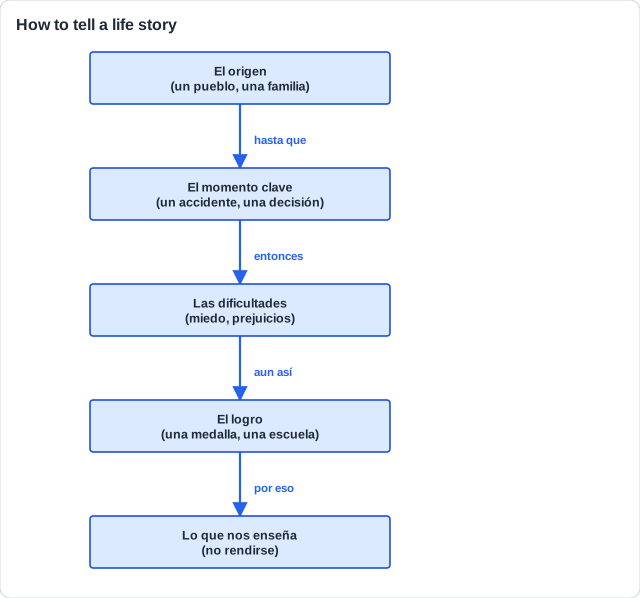
Link your ideas: Connectors lift your answer from a list into an argument: además (besides), sin embargo (however), por lo tanto (therefore), aunque (although). Use at least two or three in any written answer.
Stop wasting time on topics you know
Our AI identifies your weak areas and focuses your study time where it matters. No more overstudying easy topics.
Read like Paper 2: Here is a short blog — the kind of text Paper 2 (Reading) gives you. Then we'll do one exam question together.
How to read it
Read once for the gist
Read it once just for the general idea; don't worry about every word.
Listen
Tap the audio button to hear it.
Stuck?
Tap Ver traducción if you get stuck.
Gist → listen → translation if stuck
Un verano que cambió mi vida: Cuando tenía dieciséis años, pasé un verano con una familia de acogida en Sevilla. El primer día me sentí muy sola y perdida, porque apenas entendía el acento andaluz.
Una tarde me equivoqué de autobús y acabé en un barrio que no conocía. No sabía volver y se me había acabado la batería del móvil.
Un verano que cambió mi vida (continuación)
Entonces una señora mayor me ayudó: me invitó a un café y llamó a mi familia de acogida desde su teléfono. Aquel pequeño gesto lo cambió todo. Aquel verano aprendí que un error puede convertirse en el mejor recuerdo, y volví a casa más segura de mí misma y muy agradecida.
- una familia de acogida
- a host family
- perdido/a
- lost
- equivocarse de autobús
- to get on the wrong bus
- un gesto
- a gesture
- agradecido/a
- grateful
IB-style task — una pregunta de Paper 2
Una pregunta, paso a paso
- The question — Según el texto, ¿qué hizo la señora mayor para ayudar a la persona?
- Find it in the text. Look for una señora mayor: Entonces una señora mayor me ayudó: me invitó a un café y llamó a mi familia de acogida desde su teléfono.
- The answer — La invitó a un café y llamó a su familia de acogida desde su teléfono.
Reading technique: For a según el texto (according to the text) question, find the exact line that proves your answer — don't rely on memory or general knowledge.
La tarea — your task: Acabas de vivir una experiencia que marcó tu vida durante un viaje. Escribe una entrada de diario: cuenta qué pasó, cómo te sentiste y qué aprendiste.
Escribe entre 450 y 600 palabras.
Diary entry structure — 4 steps
Date + Querido diario
Place and date, then address the diary. Sevilla, 14 de julio. Querido diario:
What happened
Tell the event in the past: preterite for actions, imperfect for background. Me equivoqué de autobús…
Your feelings
Say how you felt, honestly. Estaba muerta de miedo…
Reflection + close
What you learned, and a short sign-off. Ahora pienso que…, Hasta mañana
Date + Querido diario → Event → Feelings → Reflection
Modelo: los 4 pasos en ~100 palabras
La entrada de diario, paso a paso
- Sevilla, 14 de julio. Querido diario:
- Hoy ha sido un día de locos. Por la mañana me equivoqué de autobús y acabé en un barrio desconocido. No entendía el acento de la gente y el móvil no tenía batería.
- Al principio estaba muerta de miedo y echaba de menos mi casa. Pero una señora mayor me vio llorando, me acompañó a la parada correcta y hasta me invitó a un zumo.
- Ahora, antes de dormir, pienso que los momentos difíciles también nos hacen crecer. Mañana saldré otra vez, ¡pero con el móvil cargado! Hasta mañana, Carmen
Por qué funciona — why it works: A strong diary entry does this for each of the three Paper 1 criteria:
A — Language /12
- Preterite vs imperfect: me equivoqué / no entendía
- Present perfect for today: hoy ha sido
- Feelings vocabulary: muerta de miedo, echaba de menos
B — Message /12
- Task fully done: what happened, feelings AND lesson learned
- Events told in a clear order with details
C — Conceptual /6
- Diary conventions: place, date and Querido diario:
- Intimate first-person voice, honest about feelings
- Reflection at the end and a short sign-off
Ready to ace Life stories?
You've seen the preview. Here's what you'll unlock:
Bite-Sized Study Notes
Full syllabus broken into chunks that stick
Exam Practice
See exactly how to score full marks
AI Feedback
Know exactly what examiners want
Smart Study Plan
Know exactly what to study next