Language & identity for HL: Ease up: the lengua e identidad content is shared exactly with SL, so you are revising the right material.
Same as SL
- Bilingualism
- Indigenous languages
- How speech shapes who we are
What HL adds later
- A longer essay
- The literary-based individual oral, where identity themes run deep
- Build this vocabulary thoroughly now and the HL-only demands become an easy extension
What 'la lengua y la identidad' covers: Language & identity (la lengua y la identidad) is part of the theme Identities. You need vocabulary to talk about mother tongues, multilingualism, minority and indigenous languages, and why learning a language matters — and to give your opinion about them. Learn the words below as a deck, then use them in the reading and writing sections.
- la lengua / el idioma
- language
- la lengua materna
- mother tongue
- ser bilingüe / multilingüe
- to be bilingual / multilingual
- el hablante
- speaker
- la lengua minoritaria
- minority language
- la lengua indígena
- indigenous language
- el dialecto
- dialect
- la pertenencia
- belonging
- preservar / proteger una lengua
- to preserve / protect a language
- estar en peligro de desaparecer
- to be at risk of disappearing
- transmitir (de generación en generación)
- to pass on (from generation to generation)
- aprender un idioma
- to learn a language
- sentirse orgulloso/a de
- to feel proud of
| Useful expression (Spanish) | English |
|---|---|
| Mi lengua materna es el español. | My mother tongue is Spanish. |
| Hablo tres idiomas con fluidez. | I speak three languages fluently. |
| Una lengua forma parte de nuestra identidad. | A language is part of our identity. |
| Muchas lenguas indígenas están en peligro. | Many indigenous languages are at risk. |
| Aprender idiomas abre la mente. | Learning languages opens your mind. |
Why this matters: This vocabulary turns up in every skill — a reading text on indigenous languages, a listening interview about being bilingual, a Paper 1 blog, or your oral. Reusing the right topic words is how you score Criterion A (Language).
Free preview
Reading it is one thing — hearing it is another
You're reading the free notes. Aimnova Pro unlocks the full study experience — and you can try it with your first topic free to keep:
- Audio on every wordTap any vocabulary word or example to hear it read aloud in natural Spanish.
- FlashcardsLock in vocabulary and key terms with spaced repetition.
- Practice questionsAnswer exam-style questions and get instant AI marking.
- Mock exams & past-paper vaultSit full mocks and see exactly how examiners award marks.
- Personalised study planA daily plan built around your exam date and weak areas.
Have something to say: Examiners reward developed ideas, not just vocabulary. Take a position and back it up.
Common debates about language & identity
- Why learn a foreign language
- The loss of minority and indigenous languages
- The link between the language you speak and who you are
Opinion phrases (use these to introduce a view)
- En mi opinión… / Desde mi punto de vista… — In my opinion… / From my point of view…
- Me parece que… / Creo que… — It seems to me that… / I think that…
- Lo más importante es… — The most important thing is…
- Por un lado… por otro lado… — On the one hand… on the other hand…
- Estoy (totalmente) de acuerdo con… — I (completely) agree with…
Riesgos para las lenguas (drawbacks)
- Muchas lenguas minoritarias están desapareciendo.
- A veces los jóvenes dejan de hablar la lengua de sus abuelos.
- Al perder una lengua, perdemos cultura e historia.
Ventajas de aprender idiomas (benefits)
- Hablar varios idiomas mejora la mente y la memoria.
- Abre puertas a nuevos trabajos y culturas.
- Nos ayuda a entender mejor a otras personas.
Learning languages
- qué idioma aprender: cultura o utilidad
- los beneficios de aprender una lengua nueva
- el Día Internacional de las Lenguas en el colegio
Languages at risk
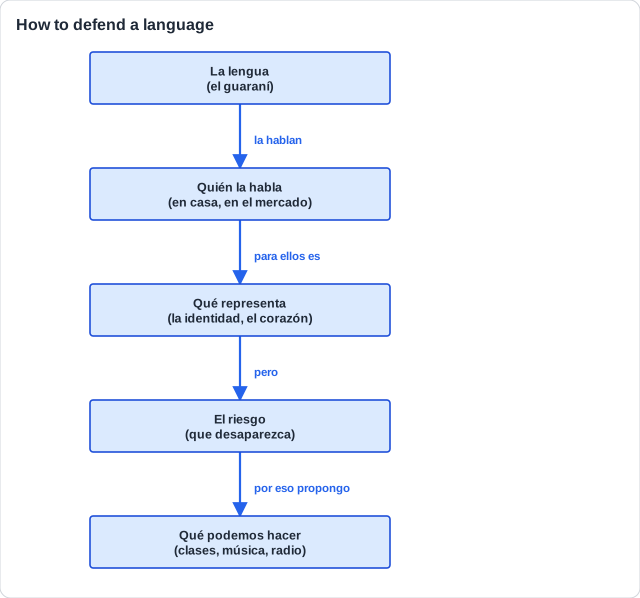
- las lenguas indígenas de México, el guaraní
- lenguas en peligro de desaparecer
- los hablantes de herencia que recuperan el español
Language and respect
- insultos por hablar una lengua minoritaria
- burlarse de un acento
- dos lenguas oficiales en un mismo país
Big questions behind this topic (IB guide, theme Identities)
- ¿Cómo contribuyen la lengua y la cultura a formar nuestra identidad?
- ¿Qué se pierde cuando desaparece una lengua?
- ¿Un acento es un defecto o una seña de identidad?
Link your ideas: Connectors lift your answer from a list into an argument: además (besides), sin embargo (however), por lo tanto (therefore), aunque (although). Use at least two or three in any written answer.
Learn what examiners really want
See exactly what to write to score full marks. Our AI shows you model answers and the key phrases examiners look for.
Read like Paper 2: Here is a short blog — the kind of text Paper 2 (Reading) gives you. Then we'll do one exam question together.
How to read it
Read once for the gist
Read it once just for the general idea; don't worry about every word.
Listen
Tap the audio button to hear it.
Stuck?
Tap Ver traducción if you get stuck.
Gist → listen → translation if stuck
La lengua de mi abuela: Mi abuela nació en un pueblo del sur de México y, de pequeña, hablaba zapoteco en casa. Cuando llegó a la ciudad, muchos le decían que esa lengua no servía para nada.
Durante años casi no la usó y a mí nunca me la enseñó.
La lengua de mi abuela (continuación)
Sin embargo, hace poco empezó a contarme cuentos en zapoteco, y de repente comprendí algo: una lengua no es solo un medio de comunicación, sino una parte de quiénes somos. Ahora estoy aprendiéndola con ella. No quiero que se pierda, porque al perder una lengua perdemos también una forma de ver el mundo.
- no servir para nada
- to be useless
- el cuento
- story, tale
- de repente
- suddenly
- el medio de comunicación
- means of communication
- perderse
- to be lost / to die out
IB-style task — una pregunta de Paper 2
Una pregunta, paso a paso
- The question — Según el texto, ¿qué comprendió la persona cuando su abuela empezó a contarle cuentos en zapoteco?
- Find it in the text. Look for comprendí: de repente comprendí algo: una lengua no es solo un medio de comunicación, sino una parte de quiénes somos.
- The answer — Comprendió que una lengua no es solo un medio de comunicación, sino una parte de la identidad.
Reading technique: For a según el texto (according to the text) question, find the exact line that proves your answer — don't rely on memory or general knowledge.
La tarea — your task: La revista de tu colegio celebra el Día Internacional de la Lengua Materna. Escribe un artículo: explica el valor de las lenguas que se hablan en tu entorno y por qué conviene mantenerlas y aprender otras.
Escribe entre 450 y 600 palabras.
Article structure — 4 steps
Title + standfirst
A title, then one or two lines under it that hook the reader. Una lengua, una forma de ver el mundo
Introduction
Present the topic and the issue. Muchos jóvenes crecen hablando dos lenguas…
Development
Two points in ordered paragraphs. En primer lugar…, En segundo lugar…
Conclusion
Sum up and leave the reader with an idea. En conclusión, cada lengua merece respeto.
Title + standfirst → Intro → Development → Conclusion
Modelo: los 4 pasos en ~100 palabras
El artículo, paso a paso
- Una lengua, una forma de ver el mundo. En nuestro colegio se hablan más de diez lenguas. ¿Las valoramos de verdad?
- Muchos jóvenes crecen hablando dos lenguas, como yo: español en el colegio y gallego en casa. Sin embargo, algunos dejan de usar su lengua materna porque les da vergüenza.
- En primer lugar, la lengua materna forma parte de nuestra identidad y nos une a nuestros mayores. En segundo lugar, aprender idiomas abre la mente y ofrece más oportunidades de trabajo.
- En conclusión, cada lengua merece respeto. Si la cuidamos hoy, mañana seguirá viva.
Por qué funciona — why it works: A strong article does this for each of the three Paper 1 criteria:
A — Language /12
- Impersonal se: se hablan más de diez lenguas
- Si-clause: Si la cuidamos hoy, mañana seguirá viva
- Connectors: sin embargo, en primer lugar, en conclusión
B — Message /12
- Task fully done: explains the value of languages AND why to keep and learn them
- Ideas developed with a personal example
C — Conceptual /6
- Article conventions: title and standfirst
- Ordered paragraphs with signposts
- Neutral voice for a wide readership, with a closing idea
Ready to ace Language & identity?
You've seen the preview. Here's what you'll unlock:
Bite-Sized Study Notes
Full syllabus broken into chunks that stick
Exam Practice
See exactly how to score full marks
AI Feedback
Know exactly what examiners want
Smart Study Plan
Know exactly what to study next