Start here: Questions on this topic are spread across the macronutrients, the minerals and the gut microbiome. Say what each nutrient does in the body, then what that means for the athlete.
1. Macronutrients
- Carbohydrate: the fast fuel, stored as glycogen in muscle and liver.
- Lipid: the big, slow store; also protects organs and makes hormones.
- Protein: builds and repairs; contains nitrogen; little used as fuel.
- The share of each depends on body composition, age, sex differences and activity level.
2. Fuelling strategies
- Proper meal 3-4 hours before; small carbohydrate snack about 1 hour before.
- Low fat, fibre and bulk leaves the stomach sooner: less discomfort.
- Practise the amount and the timing in training.
- Long events: carbohydrate during the event keeps blood glucose up.
3. Low energy availability
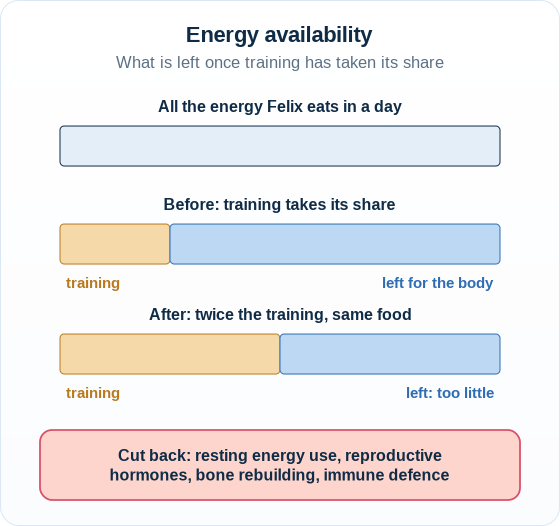
- Energy availability = what is left from food after training.
- Causes: too much training, wanting a lower body mass, disordered eating.
- The body cuts repair, growth, immune defence and hormones, so performance falls.
- Long-term LEA becomes RED-S: one hard week is not RED-S.
4. Micronutrients and the gut (HL)
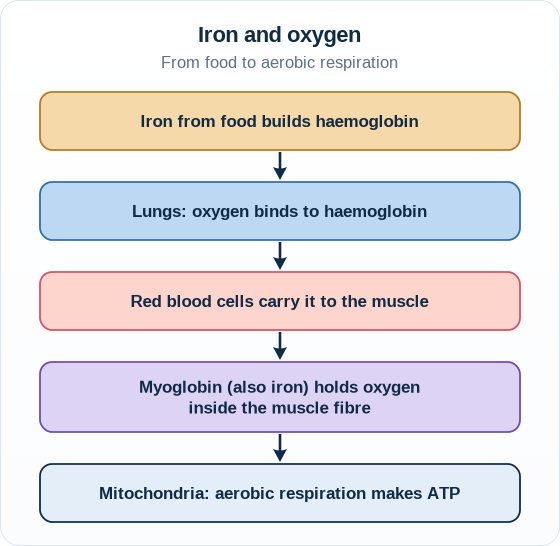
- Iron is in haemoglobin and myoglobin: low iron, less oxygen carried, aerobic work falls.
- Calcium: bone and connective tissue, and the trigger for contraction.
- Vitamins supply no energy: they regulate energy-releasing reactions and some reduce oxidants.
- Gut microbes ferment fibre into short-chain fatty acids; diet, genes, medication, lifestyle shape them.
Energy availability: what is left once training has taken its share.
From dietary iron to oxygen at the working muscle.
Key terms, one line each:
| Term | In one line |
|---|---|
| Micronutrient | mineral or vitamin needed in small amounts |
| Haemoglobin | iron-containing protein carrying oxygen in red cells |
| Myoglobin | iron-containing protein storing oxygen in muscle |
| Oxidant | a reactive molecule that can damage cells |
| Gut microbiome | the microbes living in the large intestine |
| Energy availability | energy from food left after training |
IB-style questionExplain[3 marks]
A vegetarian rower has low iron stores. Explain how this could affect her 2,000 m race.
Model answer plan
See the mark-by-mark plan — for / against / judgement, with marking guidance — in study mode.
Exam tips
- Iron is the mineral in both haemoglobin and myoglobin.
- Write what a mineral does, not just it keeps electrolyte balance.
- Say vitamins regulate energy-releasing reactions; never that they give energy.
- Individual vitamins are not needed: keep vitamin answers general.
- Link the microbiome to nutrient uptake first, then to health and performance.