aımnova
DashboardMy LearningCrash CoursesStudy Plan

Aimnova site navigation

Stay in the loop

Get the latest study resources and updates

New features, study tips and exam insights — straight to your inbox.

IB Diploma

  • IB Past Papers
  • IB Study Notes
  • IB Question Bank
  • IB Mock Exams
  • IB Revision

IB Subjects

  • IB Math AA
  • IB Math AI
  • IB Economics
  • IB Business Management
  • IB Physics
  • IB Biology
  • View all IB subjects→

IB Past Papers

  • IB Math AA HL Past Papers
  • IB Math AA SL Past Papers
  • IB Math AI HL Past Papers
  • IB Math AI SL Past Papers
  • IB Economics HL Past Papers
  • IB Economics SL Past Papers
  • IB ESS Past Papers
  • View all past papers→

Study Resources

  • Study Notes
  • Question Bank
  • Mock Exams
  • Crash Courses
  • Flashcards
  • Revision Guide
  • Exam Skills
  • Command Terms
  • Grade Calculator
  • Exam Timetable 2027

Aimnova

  • Features
  • Pricing
  • For Teachers
  • For Schools
  • For Parents
  • About Us
  • Blog
  • Contact
aımnova

IB study, practice and feedback built around the real exam.

TermsPrivacyCookies·© 2026 Aimnova. All rights reserved.d9e1c61

Aimnova is not affiliated with or endorsed by the International Baccalaureate Organization (IB).

NotesSports, Exercise and Health Science HLTopic 2.3
Unit 2 · Hydration and nutrition · Topic 2.3

IB Sports, Exercise and Health Science HL — Energy systems

Energy systems

Higher Level students should use this topic hub as a map: start with the shared sub-topics, then follow the HL-only extensions and exam-skill links where this topic asks for deeper analysis.

Exam technique guidePractice questions

Key concepts in Energy systems

Start here: This is the most-tested topic of unit 2: most of its questions are on VO2 max, then the continuum, the lactate inflection point and EPOC. Quote the numbers and define each point in full.

1. Three routes to ATP

  • ATP is the only energy a muscle can spend; it holds about two seconds' worth.
  • Phosphagen: phosphocreatine, about 10 s, refills in minutes.
  • Glycolytic: glucose without oxygen, lactate as a by-product, tens of seconds.
  • Oxidative: glucose or fat in the mitochondria, CO2 and water, about 38 ATP per glucose.

2. The energy continuum

  • All three systems run all the time; only the share changes.
  • Short and flat out: mostly phosphagen; several minutes or more: mostly oxidative.
  • A sprint finish raises the anaerobic share again.
  • Write becomes the main supplier, never switches to.

3. VO2 max

  • The most oxygen you can use per minute, best compared per kilogram (mL kg⁻¹ min⁻¹).
  • Moved by age, sex differences, body composition, lifestyle and training.
  • Falls with age mainly because maximum heart rate falls.
  • Running economy: the oxygen cost of a pace decides what VO2 max is worth.

4. Lactate and EPOC (HL)

  • Lactate inflection point: the highest intensity where clearance keeps pace with production.
  • Above it, lactate and hydrogen ions build up; training moves it to a faster pace.
  • EPOC: extra oxygen after exercise to restore ATP, PC, stored oxygen, pH, heat and glycogen.

One coin, spent and rebuilt: the three routes to ATP.

One coin, spent and rebuilt over and over. Watch the three routes at the bottom feed the same rebuild.

Interactive diagram

Explore the labelled diagram, charts and maps for this topic in study mode.

Claim your free topic →

Blood lactate against speed, before and after training.
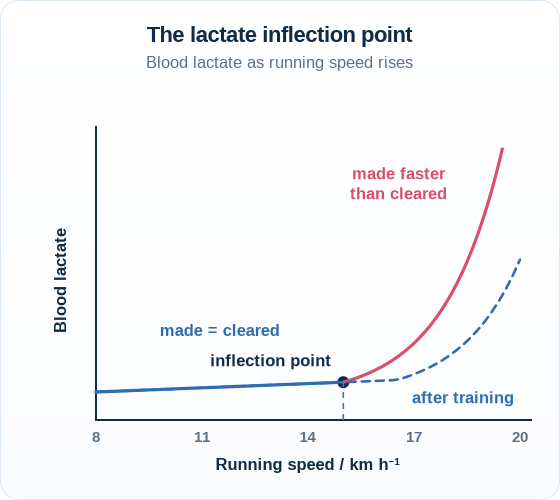
Blood lactate flat then rising steeply, with the trained curve shifted to a faster speed
Recap: the bend, and training moving it right.

The oxygen deficit at the start and EPOC after the effort.
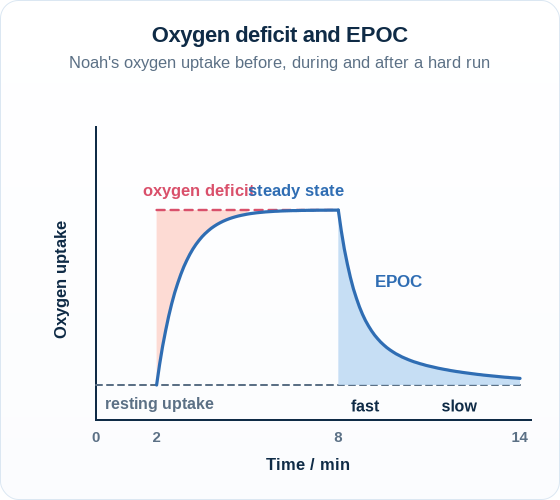
Oxygen uptake through exercise with the deficit and EPOC shaded
Recap: the deficit at the start, EPOC at the end.

Inside My Learning

Turn these notes into practice

Try each question, reveal a clear model answer, and learn how to build your response.

  • 1.Describe the energy systems used in a 400 m race. [3]
  • 2.Define the lactate inflection point. [1]
  • 3.Outline three reasons for EPOC. [3]
Claim your free topic

Key terms, one line each:

TermIn one line
Phosphocreatinethe phosphagen fuel; rebuilds ATP fast
Energy continuumthe changing share of the three systems
VO2 maxmaximal rate of oxygen use, mL kg⁻¹ min⁻¹
Lactate inflection pointintensity above which lactate builds up
Oxygen deficitoxygen not supplied at the start, covered anaerobically
EPOCexcess post-exercise oxygen consumption

Inside My Learning

Turn these notes into practice

Try each question, reveal a clear model answer, and learn how to build your response.

  • 1.Which part of EPOC rebuilds PC?
  • 2.Best pace for a long race?
  • 3.A bigger deficit means a bigger or smaller EPOC?
Claim your free topic
IB-style questionExplain[4 marks]

A 10 km runner trains for three months and can then race at a faster pace. Explain the role of the lactate inflection point.

Model answer plan

See the mark-by-mark plan — for / against / judgement, with marking guidance — in study mode.

Claim your free topic →

Exam tips

  • Define the lactate inflection point in full: clearance keeps up with production.
  • Above it, say lactate and hydrogen ions build up.
  • For EPOC, give named reasons: ATP and PC, oxygen stores, pH, lactate, heat, glycogen.
  • Link EPOC to the deficit: a bigger deficit means a bigger EPOC.
  • Compare people with relative VO2 max, in mL kg⁻¹ min⁻¹.

What you'll learn in Topic 2.3

  • 2.3.1 The three energy systems
  • 2.3.2 Fuel, recovery and limits
  • 2.3.3 The energy continuum
  • 2.3.4 VO2 max and endurance
  • 2.3.5 Lactate inflection point
  • 2.3.6 EPOC
Suggested study order: Read the notes for each sub-topic below → test yourself with flashcards → attempt practice questions → review exam technique.

Study resources — 2.3 Energy systems

2.3.1

The three energy systems

Notes
2.3.2

Fuel, recovery and limits

Notes
2.3.3

The energy continuum

Notes
2.3.4

VO2 max and endurance

Notes
2.3.5

Lactate inflection point

Notes
2.3.6

EPOC

Notes

Ready to study Energy systems?

Get expert practice questions with instant AI feedback, and a study planner tailored to your IB Sports, Exercise and Health Science HL exam date.

Start studying free

Topic 2.3 Energy systems forms a core part of Unit 2: Hydration and nutrition in IB Sports, Exercise and Health Science HL. Mastering these concepts will strengthen your understanding of connected topics across the syllabus and prepare you for exam questions that require analysis, evaluation, and real-world application.

Previous topic
2.2 Fuelling for performance
Next topic
3.1 Qualities of training
All Sports, Exercise and Health Science HL topics
Exam technique

Ready to practice?

Get AI-graded practice questions, mock exams, flashcards, and a personalised study plan — all aligned to your IB syllabus.

Start Studying Free

No credit card required · No time limit