aımnova
DashboardMy LearningCrash CoursesStudy Plan

Aimnova site navigation

Stay in the loop

Get the latest study resources and updates

New features, study tips and exam insights — straight to your inbox.

IB Diploma

  • IB Past Papers
  • IB Study Notes
  • IB Question Bank
  • IB Mock Exams
  • IB Revision

IB Subjects

  • IB Math AA
  • IB Math AI
  • IB Economics
  • IB Business Management
  • IB Physics
  • IB Biology
  • View all IB subjects→

IB Past Papers

  • IB Math AA HL Past Papers
  • IB Math AA SL Past Papers
  • IB Math AI HL Past Papers
  • IB Math AI SL Past Papers
  • IB Economics HL Past Papers
  • IB Economics SL Past Papers
  • IB ESS Past Papers
  • View all past papers→

Study Resources

  • Study Notes
  • Question Bank
  • Mock Exams
  • Crash Courses
  • Flashcards
  • Revision Guide
  • Exam Skills
  • Command Terms
  • Grade Calculator
  • Exam Timetable 2027

Aimnova

  • Features
  • Pricing
  • For Teachers
  • For Schools
  • For Parents
  • About Us
  • Blog
  • Contact
aımnova

IB study, practice and feedback built around the real exam.

TermsPrivacyCookies·© 2026 Aimnova. All rights reserved.d9e1c61

Aimnova is not affiliated with or endorsed by the International Baccalaureate Organization (IB).

NotesSports, Exercise and Health Science HLTopic 2.1
Unit 2 · Hydration and nutrition · Topic 2.1

IB Sports, Exercise and Health Science HL — Water and electrolyte balance

Water and electrolyte balance

Higher Level students should use this topic hub as a map: start with the shared sub-topics, then follow the HL-only extensions and exam-skill links where this topic asks for deeper analysis.

Exam technique guidePractice questions

Key concepts in Water and electrolyte balance

Start here: Questions on this topic split between how water balance is regulated and what dehydration does to the heart. Give the direction of every change and link each step to the next.

1. In and out

  • Most water is taken in along the intestines; for the exam, name the large intestine.
  • Out: evaporation through the skin, evaporation from the respiratory tract, and urine.
  • Endurance athletes need more water: a high metabolic rate for longer, and more sweat.

2. Regulation and checks

  • Three organs regulate it: hypothalamus, pituitary gland, kidneys.
  • Saltier blood: more ADH, so the kidneys return more water to the blood.
  • Checks: body mass before and after, urine colour, thirst.
  • Fluid lost ≈ body mass lost + fluid drunk during the session.

3. Dehydration and drift

  • Dehydration: more water out than in. Hyponatremia: blood sodium too low, often from too much plain water.
  • Cardiovascular drift: in a long steady effort heart rate climbs while stroke volume falls.
  • Sweat comes from plasma, so less blood returns to the heart.
  • Heart rate rises to keep cardiac output (Q = HR × SV) up.

The whole balance sheet: one way in, three ways out.

The whole balance sheet: one way in, three ways out, three organs holding it level, three ways to check it.

Interactive diagram

Explore the labelled diagram, charts and maps for this topic in study mode.

Claim your free topic →

Cardiovascular drift: heart rate up, stroke volume down.
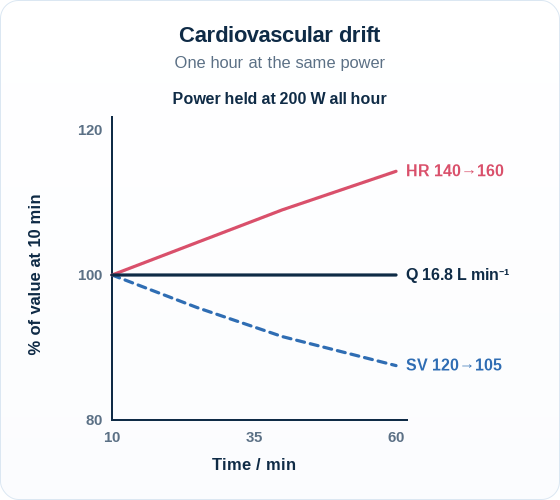
Graph of stroke volume falling, heart rate rising and cardiac output held over one hour
Recap: the three lines of drift.

Inside My Learning

Turn these notes into practice

Try each question, reveal a clear model answer, and learn how to build your response.

  • 1.Explain cardiovascular drift during an hour of steady running in the heat. [3]
  • 2.Outline how ADH helps keep water balance in a hot match. [2]
  • 3.A player weighs 70.0 kg before and 68.8 kg after training and drank 0.5 L. Estimate her sweat loss. [2]
Claim your free topic

Key terms, one line each:

TermIn one line
Electrolytea dissolved mineral such as sodium or potassium
ADHhormone that makes the kidneys keep water
Dehydrationwater loss greater than intake
Hyponatremiablood sodium concentration too low
Cardiovascular driftheart rate rising and stroke volume falling at a steady load

Inside My Learning

Turn these notes into practice

Try each question, reveal a clear model answer, and learn how to build your response.

  • 1.Which three organs regulate water balance?
  • 2.Where are water and electrolytes taken in?
  • 3.Which sign shows enough fluid?
Claim your free topic
IB-style questionDiscuss[4 marks]

A cyclist rides for two hours in hot, humid weather. Discuss the effect of dehydration on her performance and how she could limit it.

Model answer plan

See the mark-by-mark plan — for / against / judgement, with marking guidance — in study mode.

Claim your free topic →

Exam tips

  • Name all three organs in order: hypothalamus, pituitary, kidneys.
  • Give every change its direction: saltier blood, more ADH, more water kept.
  • Link each step of drift: plasma, blood volume, stroke volume, heart rate.
  • Hyponatremia comes from too much plain water, not too little.
  • In a body-mass calculation, show the working and add back what was drunk.

What you'll learn in Topic 2.1

  • 2.1.1 Water and electrolyte balance
  • 2.1.2 Dehydration and cardiac drift
Suggested study order: Read the notes for each sub-topic below → test yourself with flashcards → attempt practice questions → review exam technique.

Study resources — 2.1 Water and electrolyte balance

2.1.1

Water and electrolyte balance

Notes
2.1.2

Dehydration and cardiac drift

Notes

Ready to study Water and electrolyte balance?

Get expert practice questions with instant AI feedback, and a study planner tailored to your IB Sports, Exercise and Health Science HL exam date.

Start studying free

Topic 2.1 Water and electrolyte balance forms a core part of Unit 2: Hydration and nutrition in IB Sports, Exercise and Health Science HL. Mastering these concepts will strengthen your understanding of connected topics across the syllabus and prepare you for exam questions that require analysis, evaluation, and real-world application.

Previous topic
1.3 Transport
Next topic
2.2 Fuelling for performance
All Sports, Exercise and Health Science HL topics
Exam technique

Ready to practice?

Get AI-graded practice questions, mock exams, flashcards, and a personalised study plan — all aligned to your IB syllabus.

Start Studying Free

No credit card required · No time limit