Key idea: The environment, such as the words of a question, can change what people remember.
How the environment changes memory
1
Leading questions
The words of a question can add information to a memory.
2
Context
The place where we learned acts as a cue that helps recall.
3
Result
What we recall depends on how and where we are asked, not only on what happened.
Question · Place · Recall
Loftus and Palmer (1974) showed people film of a car crash. Asked how fast the cars 'smashed', they estimated higher speeds, and more said a week later that they had seen broken glass.
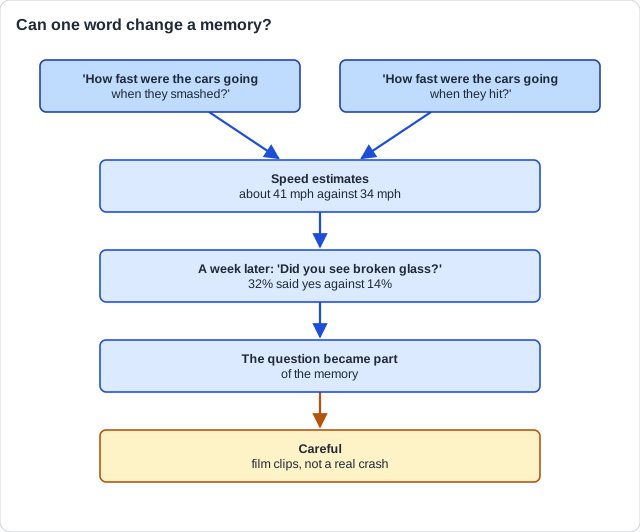
Go further: higher-level insight: The new information was added after the event, so the memory changed at recall, not at the crash.
Free preview
This is the free notes preview
You're reading the free notes. Aimnova Pro unlocks the full study experience — and you can try it with your first topic free to keep:
- FlashcardsLock in vocabulary and key terms with spaced repetition.
- Practice questionsAnswer exam-style questions and get instant AI marking.
- Mock exams & past-paper vaultSit full mocks and see exactly how examiners award marks.
- Personalised study planA daily plan built around your exam date and weak areas.
Start Studying Free Full access to Aimnova Pro · cancel anytime
Key idea: Environmental factors change what people recall, which matters for witnesses; lab studies may overstate the effect.
Strengths
- Controlled experiments show cause
- Direct use for police interviews
- Replicated many times
Limitations
- Film clips lack real emotion
- Students as participants
- Real witnesses may resist
Field studies of real witnesses show that some memories resist misleading questions, especially central details.
Watch out: Name the environmental factor. Say what in the environment changed the memory.