Key idea: Schemas guide what we notice, store and retrieve. Changing the active schema can change what is remembered.
How schemas work
1
Schemas
Mental frameworks built from experience, such as what usually happens in a restaurant.
2
They help
They let us understand and predict quickly, filling gaps with what usually happens.
3
They distort
They can add expected details, or drop ones that do not fit: a source of bias.
Organise · Predict · Distort
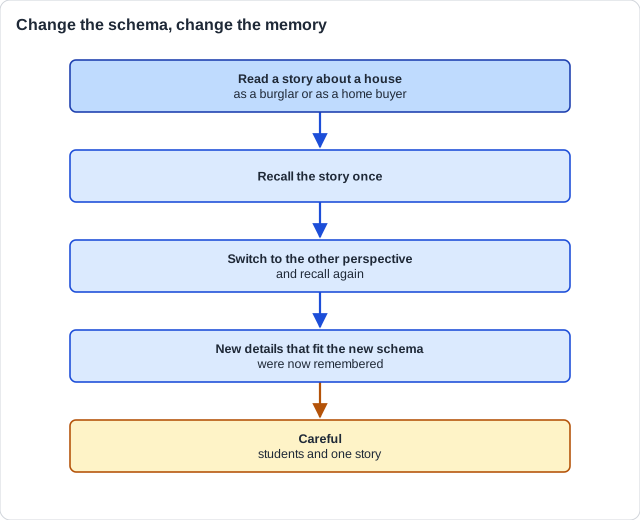
Anderson and Pichert (1978) asked students to read a story about a house as a burglar or a home buyer. When they switched perspective and recalled again, they remembered details that fitted the new schema.
What HL adds: The culture extension: schemas are learned in a culture, so people from different cultures can understand and remember the same story differently.
Free preview
This is the free notes preview
You're reading the free notes. Aimnova Pro unlocks the full study experience — and you can try it with your first topic free to keep:
- FlashcardsLock in vocabulary and key terms with spaced repetition.
- Practice questionsAnswer exam-style questions and get instant AI marking.
- Mock exams & past-paper vaultSit full mocks and see exactly how examiners award marks.
- Personalised study planA daily plan built around your exam date and weak areas.
Start Studying Free Full access to Aimnova Pro · cancel anytime
Key idea: Schema theory explains both good understanding and predictable errors, but schemas cannot be seen directly.
Strengths
- Explains understanding and errors
- Supported by experiments
- Applies to stereotypes, witnesses
Limitations
- Schemas are inferred, not observed
- Vague on how schemas form
- Short lab passages
Schema theory is strongest as an explanation of why memory fills gaps with what usually happens.
Watch out: Show the schema at work. Say which schema was active and what it added or dropped.