Key idea: The cognitive interview uses what is known about memory, such as context cues, to help witnesses recall more.
Ways to improve memory
1
Retrieval practice
Testing yourself strengthens the path back to a memory.
2
Spacing
Spreading study over days works better than cramming.
3
Context cues
Going back in mind to the place and feelings of an event helps recall.
Recall · Space · Cue
Köhnken and colleagues (1999) combined over 40 studies of the cognitive interview. It produced far more correct details than a standard interview, with a small rise in errors.
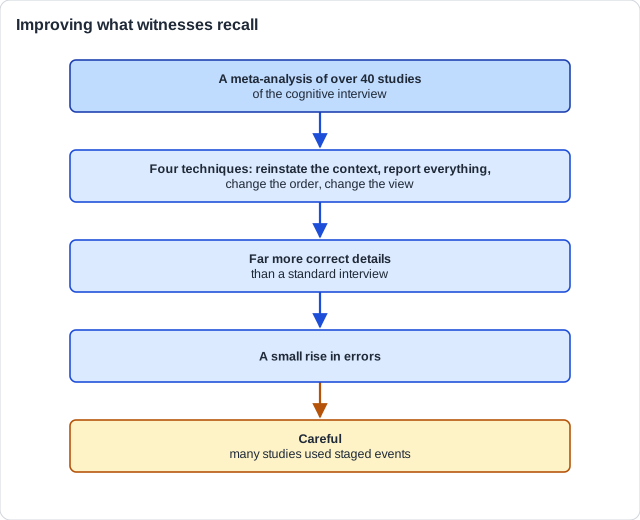
What HL adds: A meta-analysis combines many studies, so one odd result matters less. Say what that adds, and what it cannot fix, such as staged events in most studies.
Free preview
This is the free notes preview
You're reading the free notes. Aimnova Pro unlocks the full study experience — and you can try it with your first topic free to keep:
- FlashcardsLock in vocabulary and key terms with spaced repetition.
- Practice questionsAnswer exam-style questions and get instant AI marking.
- Mock exams & past-paper vaultSit full mocks and see exactly how examiners award marks.
- Personalised study planA daily plan built around your exam date and weak areas.
Start Studying Free Full access to Aimnova Pro · cancel anytime
Key idea: Strategies based on how memory works can improve it, and some are tested in real settings.
Strengths
- Large, repeated effects
- Cheap and easy to use
- Based on memory research
Limitations
- Lab passages and staged events
- Needs effort and practice
- Some strategies raise errors
A strategy is strongest when it has been tested outside the laboratory, with the people who will use it.
Watch out: Explain why it works. Link the strategy to how memory works, not only to the result.