What 'der künstlerische Ausdruck' covers: Artistic expression (der künstlerische Ausdruck) is part of the theme Human Ingenuity. Learn the words below as a deck, then use them in the reading and writing sections.
What you need words for
- Painting and literature.
- Theatre, cinema and music.
- Describing and reacting to a work of art.
- Your opinion about it.
- der künstlerische Ausdruck
- artistic expression
- das (Kunst)werk
- the work (of art)
- das Gemälde / das Bild
- the painting / picture
- der/die Künstler/in
- the artist
- die Ausstellung
- the exhibition
- das Museum / die Galerie
- the museum / the gallery
- der Roman / die Lektüre
- the novel / reading
- das Theaterstück
- the play (theatre)
- der Film
- the film
- berühren / bewegen
- to move (emotionally)
- eine Botschaft vermitteln
- to convey a message
- ein beeindruckendes Werk
- an impressive work
- Kunst deuten / schätzen
- to interpret / to appreciate art
| Useful expression (German) | English |
|---|---|
| Ich besuche sehr gern Malereiausstellungen. | I really like visiting painting exhibitions. |
| Dieser Roman hat mich wirklich berührt. | This novel really moved me. |
| Das Theaterstück vermittelt eine wichtige Botschaft. | The play conveys an important message. |
| Das Gemälde fand ich beeindruckend. | I found the painting impressive. |
| Die Kunst hilft uns, die Welt mit anderen Augen zu sehen. | Art helps us see the world with different eyes. |
Why this matters: This vocabulary turns up in every skill — a reading text about an exhibition, a listening review of a film, a Paper 1 review or blog about a work of art, or your oral. Reusing the right topic words is how you score Criterion A (Language).
Free preview
Reading it is one thing — hearing it is another
You're reading the free notes. Aimnova Pro unlocks the full study experience — and you can try it with your first topic free to keep:
- Audio on every wordTap any vocabulary word or example to hear it read aloud in natural German.
- FlashcardsLock in vocabulary and key terms with spaced repetition.
- Practice questionsAnswer exam-style questions and get instant AI marking.
- Mock exams & past-paper vaultSit full mocks and see exactly how examiners award marks.
- Personalised study planA daily plan built around your exam date and weak areas.
Have something to say: Examiners reward developed ideas, not just vocabulary. Take a position and back it up.
The common debates
- Is art useful, or just decoration?
- Does classical art still matter to young people?
- Do films and series count as 'real' art?
Opinion phrases (use these to introduce a view)
- Meiner Meinung nach… / Aus meiner Sicht… — In my opinion… / From my point of view…
- Mir scheint, dass… / Ich glaube, dass… — It seems to me that… / I think that…
- Das Wichtigste ist… — The most important thing is…
- Einerseits… andererseits… — On the one hand… on the other hand…
- Ich bin (völlig) einverstanden mit… — I (completely) agree with…
Kritik an der Kunst (drawbacks)
- Für manche Jugendliche sind Museen langweilig.
- Klassische Kunst wirkt fern und schwer verständlich.
- Eintrittskarten für Ausstellungen sind oft teuer.
Der Wert der Kunst (benefits)
- Ein Kunstwerk kann uns berühren und zum Nachdenken bringen.
- Die Kunst vermittelt die Kultur und Geschichte eines Volkes.
- Etwas zu schaffen hilft uns, auszudrücken, was wir fühlen.
Reading and stories
- ein internationales Lesefest in der Schulbibliothek
- Comics: echte Literatur oder nicht?
- ein Schauspieler spricht Hörbücher
Music
- das erste Instrument für ein Kind
- ein Musikpreis für die Schule: Was tun mit dem Geld?
- eine junge Pianistin unter Druck
Art in public
- ein neues Museum entdecken
- ein Straßenkunstfestival in Salzburg
- legale Graffiti-Wände in der Stadt
Big questions behind this topic (IB guide, theme Human ingenuity)
- Was macht etwas zu Kunst?
- Wie kann Kunst unser Leben verändern?
- Sollen Museen und Konzerte für alle kostenlos sein?
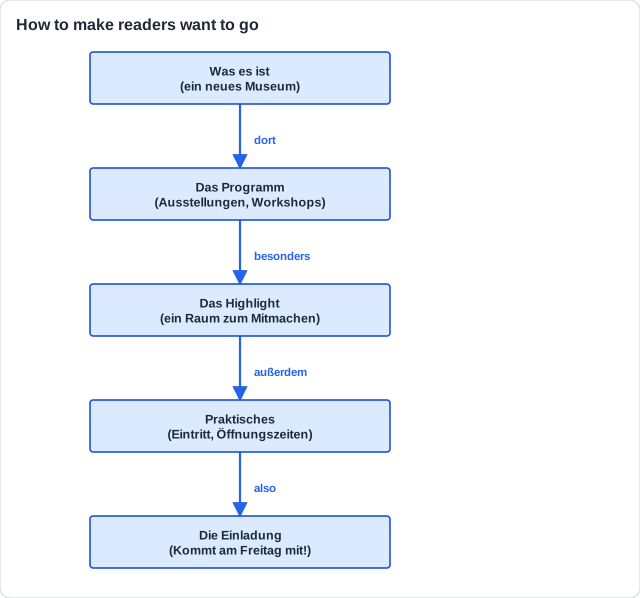
Link your ideas: Connectors lift your answer from a list into an argument: außerdem (besides), jedoch / aber (however), deshalb (therefore), obwohl (although). Use at least two or three in any written answer.
Learn what examiners really want
See exactly what to write to score full marks. Our AI shows you model answers and the key phrases examiners look for.
Read like Paper 2: Here is a short blog — the kind of text Paper 2 (Reading) gives you.
How to read it
- Read it once just for the general idea; don't worry about every word.
- Tap the audio button to hear it.
- Tap Übersetzung anzeigen if you get stuck.
- Then we'll do one exam question together.
Ein Nachmittag zwischen Gemälden: Letztes Wochenende habe ich eine Ausstellung mit impressionistischer Malerei im Museum meiner Stadt besucht.
Beim Eintreten war ich fasziniert: Die Gemälde waren leuchtend, und aus der Nähe sah man nur kleine Farbstriche.
Ein Nachmittag zwischen Gemälden (Fortsetzung)
Mein Lieblingsbild war eine Landschaft mit einem Garten voller Blumen, weil es so aussah, als würde sich das Licht über dem Wasser bewegen.
Ein Nachmittag zwischen Gemälden (Fortsetzung)
Früher dachte ich, Kunst sei langweilig, aber diesmal habe ich echte Gefühle gespürt. Ich verließ das Museum mit Lust, selbst etwas zu malen, und überzeugt davon, dass die Kunst uns hilft, die Welt mit anderen Augen zu sehen.
- der Pinselstrich / der Farbstrich
- the brushstroke
- leuchtend
- luminous / bright
- die Landschaft
- the landscape
- aus der Nähe
- up close
- sich mitreißen lassen
- to let yourself be carried away
IB-style task — eine Frage aus Paper 2
Eine Frage, Schritt für Schritt
- The question — „Welches Bild war dem Text zufolge das Lieblingsbild der Person, und warum?“
- Find it in the text. Look for „Mein Lieblingsbild“: „Mein Lieblingsbild war eine Landschaft mit einem Garten voller Blumen, weil es so aussah, als würde sich das Licht über dem Wasser bewegen.“
- The answer — Eine Landschaft mit einem Garten voller Blumen, weil das Licht sich über dem Wasser zu bewegen schien.
Reading technique: For a „dem Text zufolge“ (according to the text) question, find the exact line that proves your answer — don't rely on memory or general knowledge.
Die Aufgabe — your task: Deine Schule organisiert eine Kulturwoche über die Kunst. Schreibe einen Blog für andere Schülerinnen und Schüler.
Was du tun musst — what to do
- Beschreibe ein Werk oder eine Ausstellung, das/die dich berührt hat.
- Gib Tipps, wie man die Kunst mehr schätzen kann.
- Schreibe zwischen 250 und 400 Wörtern.
Blog structure — 5 steps
Catchy title
A title, often a question. „Findest du Kunst langweilig?“
Greeting + topic
Greet the reader and say what the post is about. „Hallo zusammen! Heute möchte ich euch von einer Ausstellung erzählen…“
Your experience
Describe what you used to think and how the work moved you (Präteritum/Perfekt). „Früher dachte ich, Kunst sei langweilig, aber ich war fasziniert…“
Two or three tips
Give advice using the imperative. „Besucht eine Ausstellung“, „geht nah an die Bilder heran“, „wählt ein Lieblingswerk“.
Motivating close
Finish with an encouraging line. „Besucht dieses Wochenende ein Museum! Die Kunst lohnt sich.“
Title → Greeting → Experience → Tips → Close
Modell: die 5 Schritte in ~130 Wörtern
Der fertige Blog, Schritt für Schritt
- Findest du Kunst langweilig? Das dachte ich auch — bis zu einem Nachmittag im Museum.
- Hallo zusammen! Ich bin Marta, und heute möchte ich euch von etwas erzählen, das mich überrascht hat: eine Ausstellung mit impressionistischer Malerei.
- Früher dachte ich, Kunst sei langweilig, und ging nie ins Museum. An jenem Nachmittag war ich jedoch fasziniert: Die Gemälde waren leuchtend, und ich habe echte Gefühle gespürt.
- Deshalb gebe ich euch drei Tipps: Erstens, besucht eine Ausstellung ohne Vorurteile; zweitens, geht nah an die Bilder heran, um die Pinselstriche zu sehen; und drittens, wählt ein Lieblingswerk und fragt euch, warum es euch gefällt.
- Vor allem aber ist das Wichtigste, sich von den Gefühlen mitreißen zu lassen. Besucht dieses Wochenende ein Museum, und ihr werdet entdecken, dass sich die Kunst lohnt!
Warum es funktioniert — what makes it strong: A strong blog does these things for each of the three Paper 1 criteria:
A — Language /12
- Range of tenses: Präteritum „dachte“, Perfekt „habe gespürt“, Imperativ „besucht“
- Connectors: „jedoch“, „deshalb“
- Topic vocabulary, used accurately
B — Message /12
- Task fully done: describes a work/exhibition AND gives advice
- Ideas developed with concrete examples
C — Conceptual /6
- Blog conventions: a catchy title
- Direct address: „ich gebe euch“, „besucht“
- A persuasive, personal tone
Never wonder what to study next
Get a personalized daily plan based on your exam date, progress, and weak areas. We'll tell you exactly what to review each day.
Hör zu wie in Paper 2: Paper 2 also tests listening (25 marks): you hear short clips and answer questions — but you never see the words. Here's one, simplified. Play it, answer, then reveal the transcript to check.
Hörverstehen — Lucias Lieblingsfilm
Listen to Lucia recommend a film. Try to answer before you reveal the transcript — that's how Paper 2 Listening works.
Du hörst Lucia einen Film empfehlen, der sie sehr bewegt hat.
- Was hat Lucia dem Audio zufolge am besten an dem Film gefallen? (What did Lucia like best about the film?)
Hallo, ich heiße Lucia. Letztes Wochenende habe ich einen Film gesehen, der mir sehr gefallen hat. Er erzählt die Geschichte einer jungen Malerin, die darum kämpft, ihre Bilder auszustellen. Die Filmmusik ist wunderschön, und die Farben sind beeindruckend. Am besten gefiel mir die Botschaft: Wir sollten unsere Träume niemals aufgeben. Ich empfehle ihn euch, weil er mich sehr berührt und zum Nachdenken gebracht hat.
Hi, I'm Lucia. Last weekend I watched a film I really liked. It tells the story of a young (female) painter who fights to exhibit her paintings. The soundtrack is beautiful and the colours are impressive. What I liked best was the message: we should never give up on our dreams. I recommend it to you, because it moved me a great deal and made me think.
- Die Botschaft: dass wir unsere Träume niemals aufgeben sollten.
Listening technique: Read the question first, then listen for that one detail — you don't need to catch every word. In the real exam you hear each clip twice.