What 'Menschenrechte' covers: Human rights (die Menschenrechte) belongs to the theme Sharing the Planet. Learn the words below as a deck, then reuse them in the reading and writing sections.
What you need words for
- Rights
- Equality
- Justice
- Discrimination
- Giving your opinion on them
- die Menschenrechte
- human rights
- das Recht (auf etwas)
- the right (to something)
- die Freiheit
- freedom
- die Gleichheit / die Gleichberechtigung
- equality / equal rights
- die Gerechtigkeit — die Ungerechtigkeit
- justice — injustice
- die Diskriminierung
- discrimination
- die Würde
- dignity
- der Respekt — respektieren
- respect — to respect
- etwas verteidigen / sich für etwas einsetzen
- to defend / to stand up for something
- die Demonstration / die Kundgebung
- the demonstration / rally
- die Petition unterschreiben
- to sign the petition
- der Verein / die Organisation
- the association / organisation
- die Meinungsfreiheit
- freedom of speech
| Useful expression (German) | English |
|---|---|
| Jeder Mensch hat das Recht auf Bildung. | Everyone has the right to education. |
| Ich setze mich für eine gerechte Sache ein. | I stand up for a just cause. |
| Wir müssen die Diskriminierung bekämpfen. | We must fight discrimination. |
| Alle Menschen sind gleich an Würde. | All people are equal in dignity. |
| Ich habe die Petition unterschrieben. | I signed the petition. |
Why this matters: This vocabulary turns up in every skill — a reading text on equality, a listening interview about a campaign, a Paper 1 blog, or your oral. Reusing the right topic words is how you score Criterion A (Language).
Free preview
Reading it is one thing — hearing it is another
You're reading the free notes. Aimnova Pro unlocks the full study experience — and you can try it with your first topic free to keep:
- Audio on every wordTap any vocabulary word or example to hear it read aloud in natural German.
- FlashcardsLock in vocabulary and key terms with spaced repetition.
- Practice questionsAnswer exam-style questions and get instant AI marking.
- Mock exams & past-paper vaultSit full mocks and see exactly how examiners award marks.
- Personalised study planA daily plan built around your exam date and weak areas.
Have something to say: Examiners reward developed ideas, not just vocabulary. Around human rights the common debates are: equality vs discrimination, freedom of speech and its limits, and how young people can defend a cause peacefully. Take a position and back it up.
Opinion phrases (use these to introduce a view)
- Meiner Meinung nach… / Aus meiner Sicht… — In my opinion… / From my point of view…
- Ich bin der Meinung, dass… / Ich glaube, dass… — I'm of the opinion that… / I think that…
- Das Wichtigste ist… — The most important thing is…
- Einerseits… andererseits… — On the one hand… on the other hand…
- Ich bin (völlig) einverstanden mit… — I (completely) agree with…
Probleme (problems)
- Viele Menschen erleben jeden Tag Diskriminierung.
- Nicht alle Kinder haben das Recht auf Bildung.
- Manche Menschen schweigen aus Angst vor Unrecht.
Lösungen (solutions)
- Wir können friedlich demonstrieren und Petitionen unterschreiben.
- Bildung hilft, gegen Vorurteile zu kämpfen.
- Jede Stimme zählt, wenn wir uns einsetzen.
Children’s rights
- Kinderrechte ins Grundgesetz?
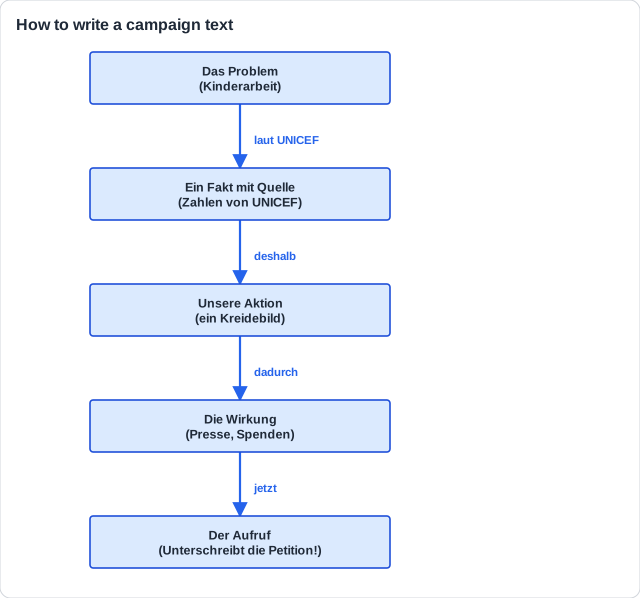
- ein riesiges Kreidebild gegen Kinderarbeit
- Klassenräte: in der Schule mitbestimmen
Speaking up
- ein Projekttag zu den Menschenrechten
- Meinungsfreiheit und Pressefreiheit
- ein Geflüchteter erzählt von seiner Flucht
Dignity in everyday life
- die Tafel: Essen für Menschen mit wenig Geld
- Armut in einem reichen Land
- das Recht auf Bildung für alle
Big questions behind this topic (IB guide, theme Sharing the planet)
- Gelten die Menschenrechte wirklich für alle?
- Was können junge Menschen gegen Ungerechtigkeit tun?
- Sollten Kinder bei politischen Entscheidungen mitreden?
Link your ideas: Connectors lift your answer from a list into an argument: außerdem (besides), jedoch / aber (however), deshalb (therefore), obwohl (although). Use at least two or three in any written answer.
Practice with exam-style questions
Answer exam-style questions and get AI feedback that shows you exactly what examiners want to see in a full-marks response.
Read like Paper 2: Here is a short blog — the kind of text Paper 2 (Reading) gives you. Read it once just for the general idea.
How to read it
- Don't worry about every word.
- Tap the audio button to hear it, or Übersetzung anzeigen if you get stuck.
- Then we'll do one exam question together.
Eine Aktion für die Menschenrechte (1 of 2): Letzten Monat habe ich an meiner Schule eine friedliche Aktion für die Menschenrechte organisiert. Ich wollte, dass meine Mitschülerinnen und Mitschüler das Recht jedes Kindes auf Bildung kennenlernen.
Ich machte Plakate, lud einen örtlichen Verein ein und reservierte den Schulhof für den Freitag. Es kamen jedoch nur sechs Personen, und am Anfang war ich sehr enttäuscht.
Eine Aktion für die Menschenrechte (2 of 2)
Trotzdem hörten diese sechs Personen aufmerksam zu, stellten Fragen und unterschrieben eine Petition. Mir wurde klar, dass Veränderung Schritt für Schritt beginnt, nicht mit einer Menschenmenge. Ich habe es nicht geschafft, den Schulhof zu füllen, aber ich habe gelernt, dass es sich immer lohnt, für eine gerechte Sache einzutreten. Heute bin ich stolz, dass ich es versucht habe.
- eine Aktion organisieren
- to organise an event/action
- ein Plakat machen
- to make a poster
- enttäuscht sein
- to be disappointed
- für eine Sache eintreten
- to stand up for a cause
- stolz sein, dass…
- to be proud that…
IB-style task — eine Frage aus Paper 2
Eine Frage, Schritt für Schritt
- The question — „Wie viele Personen kamen dem Text zufolge zu der Aktion?“
- Find it in the text. Look for „es kamen“: „Es kamen jedoch nur sechs Personen, und am Anfang war ich sehr enttäuscht.“
- The answer — Es kamen nur sechs Personen.
Reading technique: For a „dem Text zufolge“ (according to the text) question, find the exact line that proves your answer — don't rely on memory or general knowledge.
Die Aufgabe — your task: Deine Schule veranstaltet eine Woche der Menschenrechte. Schreibe einen Artikel für die Schülerzeitung.
| Teil | Auf Deutsch | English |
|---|---|---|
| Inhalt 1 | Stelle eine Sache vor, die dir wichtig ist. | Present a cause that matters to you. |
| Inhalt 2 | Erkläre, wie man sie friedlich unterstützen kann. | Explain how people can support it peacefully. |
| Länge | Schreibe zwischen 450 und 600 Wörtern. | Write 450–600 words. |
Article structure — 4 steps
Headline + standfirst
A headline, then one sentence that says what the article is about. „Süß für uns, bitter für sie“
Introduction: the facts
Give the key fact and its source. „Laut UNICEF arbeiten weltweit rund 160 Millionen Kinder…“
Development: details + a quotation
Explain the problem and quote a real person. „Lena (17) sagt: „Früher dachte ich, das gehe mich nichts an.““
Conclusion
Sum up and show what readers can do. „Menschenrechte verteidigt man also nicht nur auf Demonstrationen…“
Headline + standfirst → Introduction → Development → Conclusion
Modell: die 4 Schritte in ~100 Wörtern
Der fertige Artikel, Schritt für Schritt
- Süß für uns, bitter für sie – Hinter vielen Tafeln Schokolade steckt Kinderarbeit. Was können wir tun?
- Laut UNICEF arbeiten weltweit rund 160 Millionen Kinder, viele davon auf Kakaoplantagen in Westafrika.
- Diese Kinder gehen oft nicht zur Schule, obwohl Bildung ein Menschenrecht ist. Lena (17) aus der 12a sagt: „Früher dachte ich, das gehe mich nichts an. Dann habe ich einen Dokumentarfilm gesehen.“ Seitdem kauft sie nur noch fair gehandelte Schokolade und hat eine Petition an die Schulkantine gestartet.
- Menschenrechte verteidigt man also nicht nur auf Demonstrationen, sondern auch beim Einkaufen. Jeder Kauf ist eine Entscheidung.
Warum es funktioniert — what makes it strong: A strong article does these things for each of the three Paper 1 criteria:
A — Language /12
- Konjunktiv I in reported thought: „das gehe mich nichts an“
- Connectors: „obwohl“, „seitdem“, „nicht nur … sondern auch“
- Rights vocabulary: „die Kinderarbeit“, „fair gehandelt“
B — Message /12
- Task fully done: presents the cause AND shows how to support it peacefully
- Developed with a figure, a quotation and an example
C — Conceptual /6
- Article conventions: a headline and a standfirst
- A fact with its source (UNICEF) and a quotation
- A neutral tone and a conclusion that sums up
Feeling unprepared for exams?
Get a clear study plan, practice with real questions, and know exactly where you stand before exam day. No more guessing.
Hörverstehen — Jasmin und der Briefmarathon
Paper 2 tests listening (25 marks): you hear 3 short clips, each played twice, and you never see the words. Read the questions first, then listen and reveal the answers.
Du hörst Jasmin darüber, wie sie sich mit Briefen für Menschen einsetzt, die zu Unrecht im Gefängnis sitzen.
- Warum wurde die Journalistin verhaftet? (Why was the journalist arrested?)
- Welchen Rat gibt Jasmin? (What advice does Jasmin give?)
Hallo, ich heiße Jasmin. Jedes Jahr im Dezember mache ich beim Briefmarathon einer Menschenrechtsorganisation mit. Dabei schreiben Tausende von Menschen Briefe an Regierungen, um Menschen zu helfen, die zu Unrecht im Gefängnis sitzen. Letztes Jahr habe ich für eine junge Journalistin geschrieben, die verhaftet wurde, weil sie über Korruption berichtet hatte. Ein paar Monate später wurde sie freigelassen. Natürlich war das nicht nur mein Verdienst, aber ich habe gelernt, dass ein einfacher Brief etwas bewirken kann. Mein Rat: Nehmt euch eine halbe Stunde Zeit und schreibt selbst einen Brief.
Hi, I'm Jasmin. Every year in December I take part in a human rights organisation's letter-writing marathon. Thousands of people write letters to governments to help people who are wrongly in prison. Last year I wrote for a young journalist who was arrested because she had reported on corruption. A few months later she was released. Of course that wasn't only thanks to me, but I've learned that a simple letter can make a difference. My advice: take half an hour and write a letter yourselves.
- Weil sie über Korruption berichtet hatte.
- Sich eine halbe Stunde Zeit zu nehmen und selbst einen Brief zu schreiben.