What 'die Umwelt' covers: The environment (die Umwelt) is part of the theme Sharing the planet. Learn the words below as a deck, then use them in the reading and writing sections.
What you need words for
- Pollution
- Climate change
- Recycling
- Protecting nature
- Giving your opinion about them
- die Umwelt
- the environment
- der Klimawandel
- climate change
- die Erderwärmung
- global warming
- die Umweltverschmutzung
- pollution
- der Abfall / der Müll
- waste / rubbish
- recyceln
- to recycle
- das (Einweg-)Plastik
- (single-use) plastic
- (Wasser / Energie) sparen
- to save (water / energy)
- verschmutzen
- to pollute
- die Natur schützen
- to protect nature
- die erneuerbaren Energien
- renewable energy
- nachhaltig — die Nachhaltigkeit
- sustainable — sustainability
- der bewusste Konsum
- responsible consumption
| Useful expression (German) | English |
|---|---|
| Wir müssen die Umwelt schützen. | We must look after the environment. |
| Zu Hause trenne ich Plastik und Papier. | At home I separate plastic and paper. |
| Man muss die Umweltverschmutzung verringern. | We need to reduce pollution. |
| Ich versuche, Wasser und Energie zu sparen. | I try to save water and energy. |
| Der Klimawandel ist ein globales Problem. | Climate change is a global problem. |
Why this matters: This vocabulary turns up in every skill — a reading text on recycling, a listening interview about a green project, a Paper 1 blog about a school campaign, or your oral. Reusing the right topic words is how you score Criterion A (Language).
Free preview
Reading it is one thing — hearing it is another
You're reading the free notes. Aimnova Pro unlocks the full study experience — and you can try it with your first topic free to keep:
- Audio on every wordTap any vocabulary word or example to hear it read aloud in natural German.
- FlashcardsLock in vocabulary and key terms with spaced repetition.
- Practice questionsAnswer exam-style questions and get instant AI marking.
- Mock exams & past-paper vaultSit full mocks and see exactly how examiners award marks.
- Personalised study planA daily plan built around your exam date and weak areas.
Have something to say: Examiners reward developed ideas, not just vocabulary. Take a position and back it up.
The common debates around the environment
- Individual action vs the responsibility of governments and companies
- Whether small changes really help
- The cost of living sustainably
Opinion phrases (use these to introduce a view)
- Meiner Meinung nach… / Aus meiner Sicht… — In my opinion… / From my point of view…
- Mir scheint, dass… / Ich glaube, dass… — It seems to me that… / I think that…
- Das Wichtigste ist… — The most important thing is…
- Einerseits… andererseits… — On the one hand… on the other hand…
- Ich bin (völlig) einverstanden mit… — I (completely) agree with…
Das Problem (drawbacks)
- Wir produzieren zu viel Müll und Einwegplastik.
- Die Umweltverschmutzung schadet der Gesundheit und der Natur.
- Viele Menschen glauben, dass eine einzelne Person nichts ändern kann.
Die Lösungen (benefits)
- Recyceln und weniger zu konsumieren ist für alle möglich.
- Die erneuerbaren Energien sind sauberer und nachhaltiger.
- Kleine Gewohnheiten machen zusammen den Unterschied.
Waste and plastic
- Plastikmüll in den Mülleimern der Schule
- Repair-Cafés: reparieren statt wegwerfen
- eine Schul-AG gegen Elektroschrott
Energy and climate
- ein Windpark in der Nähe: Chance oder Problem?
- Gründächer gegen Hitze und Starkregen
- ein Energiesparwettbewerb für Schulen
Everyday choices
- nachhaltige Mode: tauschen statt kaufen
- Lebensmittel retten mit einer App
- mit dem Rad statt mit dem Auto
Big questions behind this topic (IB guide, theme Sharing the planet)
- Welche Umweltprobleme betreffen uns alle?
- Kann ein Einzelner etwas für das Klima tun?
- Wer trägt mehr Verantwortung: Politik, Firmen oder wir selbst?
Link your ideas: Connectors lift your answer from a list into an argument: außerdem (besides), jedoch / aber (however), deshalb (therefore), obwohl (although). Use at least two or three in any written answer.
Feeling unprepared for exams?
Get a clear study plan, practice with real questions, and know exactly where you stand before exam day. No more guessing.
Read like Paper 2: Here is a short blog — the kind of text Paper 2 (Reading) gives you. Read it once just for the general idea.
How to read it
- Don't worry about every word.
- Tap the audio button to hear it, or Übersetzung anzeigen if you get stuck.
- Then we'll do one exam question together.
Unser grünes Projekt in der Schule (1 of 3): Letztes Schuljahr produzierte meine Schule unglaublich viel Müll: Niemand trennte den Abfall, und die Flure waren voller Plastikflaschen.
Deshalb haben wir, eine Gruppe von Schülerinnen und Schülern, ein grünes Projekt gestartet. Zuerst stellten wir in jedem Klassenzimmer bunte Mülltonnen auf und organisierten Vorträge, um zu erklären, wie man den Abfall trennt.
Unser grünes Projekt in der Schule (2 of 3)
Am Anfang war es schwer, die Leute zu überzeugen, aber nach und nach machten immer mehr Mitschüler mit. Jetzt recyceln wir fast alles, in der Cafeteria kaufen wir regionale Produkte, und auf dem Schulhof haben wir einen kleinen Garten angelegt.
Unser grünes Projekt in der Schule (3 of 3)
Die Umwelt schon in der Schule zu schützen lohnt sich: Ich bin stolz auf das, was wir alle zusammen geschafft haben.
- ein Projekt starten
- to set up / to launch a project
- die Mülltonne
- bin / container
- den Abfall trennen
- to separate waste
- mitmachen (bei)
- to join in (with)
- einen Garten anlegen
- to lay out a garden
IB-style task — eine Frage aus Paper 2
Eine Frage, Schritt für Schritt
- The question — „Was haben die Schülerinnen und Schüler dem Text zufolge als Erstes im Projekt gemacht?“
- Find it in the text. Look for „Zuerst“: „Zuerst stellten wir bunte Mülltonnen in jedem Klassenzimmer auf und organisierten Vorträge, um zu erklären, wie man den Abfall trennt.“
- The answer — Sie stellten bunte Mülltonnen in jedem Klassenzimmer auf (und organisierten Vorträge).
Reading technique: For a „dem Text zufolge“ (according to the text) question, find the exact line that proves your answer — don't rely on memory or general knowledge.
Die Aufgabe — your task: Du leitest die Umwelt-AG deiner Schule, die eine Kampagne gegen Müll startet. Halte eine Rede in der Schulversammlung.
| Teil | Auf Deutsch | English |
|---|---|---|
| Inhalt 1 | Erkläre das Müllproblem an deiner Schule. | Explain the waste problem at your school. |
| Inhalt 2 | Schlage konkrete Maßnahmen vor und ruf zum Mitmachen auf. | Propose concrete measures and call on people to take part. |
| Länge | Schreibe zwischen 450 und 600 Wörtern. | Write 450–600 words. |
Speech structure — 5 steps
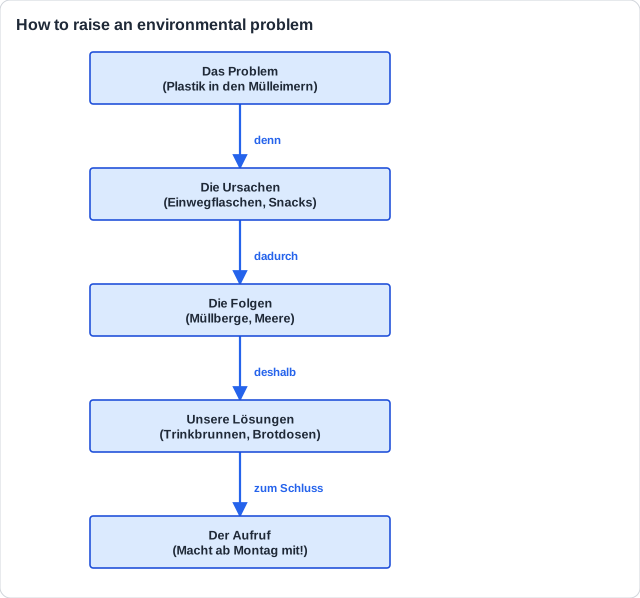
Greet the audience
Open by greeting the people in the room. „Liebe Mitschülerinnen und Mitschüler, liebe Lehrerinnen und Lehrer,“
Introduce yourself + the topic
Say who you are and name the problem. „Ich möchte heute über den Müll auf unserem Schulhof sprechen.“
Arguments with examples
Facts, your own example and the measures. „Jede Woche werfen wir über 300 Plastikflaschen weg…“
Call to action
Tell the audience what to do, with the ihr-imperative. „Bringt ab Montag eure eigene Flasche mit!“
Memorable close + thanks
End with a line people remember, then thank them. „Unser Planet hat keinen Ersatz… Danke fürs Zuhören!“
Greet the audience → Topic → Arguments → Call to action → Close + thanks
Modell: die 5 Schritte in ~100 Wörtern
Die fertige Rede, Schritt für Schritt
- Liebe Mitschülerinnen und Mitschüler, liebe Lehrerinnen und Lehrer,
- ich bin Lena, die Sprecherin der Umwelt-AG, und ich möchte heute über etwas sprechen, das wir jeden Tag sehen: den Müll auf unserem Schulhof.
- Jede Woche werfen wir über 300 Plastikflaschen weg. Auch ich war nicht besser: Ich kaufte jeden Tag eine Flasche und ließ das Licht im Klassenzimmer brennen. Deshalb schlägt die AG zwei Maßnahmen vor: Trinkbrunnen in jedem Stockwerk und einen Licht-Dienst in jeder Klasse.
- Ich bitte euch: Bringt ab Montag eure eigene Flasche mit und macht beim Licht-Dienst mit!
- Unser Planet hat keinen Ersatz – fangen wir in unserer Schule an. Danke fürs Zuhören!
Warum es funktioniert — what makes it strong: A strong speech does these things for each of the three Paper 1 criteria:
A — Language /12
- Präteritum: „kaufte“, „ließ brennen“
- Connectors: „auch“, „deshalb“
- Environment vocabulary: „der Müll“, „der Trinkbrunnen“, „wegwerfen“
B — Message /12
- Task fully done: explains the problem AND proposes measures
- Developed with a figure (300 bottles) and her own example
C — Conceptual /6
- Speech conventions: greets the audience and introduces the speaker
- Speaks to the audience directly: „Ich bitte euch“, „fangen wir an“
- A strong last line and „Danke fürs Zuhören!“
Memorize terms 3x faster
Smart flashcards show you cards right before you forget them. Perfect for definitions and key concepts.
Hör zu wie in Paper 2: Paper 2 also tests listening (25 marks): you hear short clips and answer questions — but you never see the words. Here's one, simplified. Play it, answer, then reveal the transcript to check.
Hörverstehen — Janas plastikfreier Monat
Listen to Jana describe her family's month without plastic. Try to answer before you reveal the transcript — that's how Paper 2 Listening works.
Du hörst Jana darüber, wie ihre Familie einen Monat lang ohne Plastik gelebt hat.
- Wo kaufte die Familie während des Experiments ein? (Where did the family shop during the experiment?)
- Was war für Jana am schwierigsten? (What was hardest for Jana?)
Hallo, ich heiße Jana. Im Mai hat meine Familie ein Experiment gemacht: einen Monat lang ohne Plastik leben. Statt im Supermarkt kauften wir in einem Unverpackt-Laden ein, wo man Nudeln und Reis in eigene Gläser füllt. Mein Vater backte am Wochenende Brot, und ich nähte aus alten T-Shirts Einkaufstaschen. Am schwierigsten war es bei Süßigkeiten, denn fast alle sind in Plastik verpackt. Am Ende hatten wir nur eine kleine Tüte Müll statt fünf großer Säcke. Für mich ist das Wichtigste, dass jede Familie zu Hause etwas für die Umwelt tun kann.
Hi, I'm Jana. In May my family did an experiment: living without plastic for a month. Instead of at the supermarket, we shopped at a zero-waste shop, where you fill pasta and rice into your own jars. My father baked bread at the weekend, and I sewed shopping bags out of old T-shirts. The hardest thing was sweets, because almost all of them are wrapped in plastic. In the end we had just one small bag of rubbish instead of five big sacks. For me, the most important thing is that every family can do something for the environment at home.
- In einem Unverpackt-Laden, wo man Nudeln und Reis in eigene Gläser füllt.
- Die Süßigkeiten, denn fast alle sind in Plastik verpackt.