What 'la paix et le conflit' covers: Peace & conflict (la paix et le conflit) is part of the theme Sharing the Planet. Learn the words below as a deck, then use them in the reading and writing sections.
You need vocabulary to talk about
- disagreements and wars
- resolving conflict
- solidarity and humanitarian aid
- your opinion about them
- la paix — pacifique
- peace — peaceful
- un conflit / une dispute
- a conflict / an argument
- la guerre
- war
- la violence — sans violence
- violence — without violence
- résoudre / régler un conflit
- to resolve / settle a conflict
- le dialogue — dialoguer
- dialogue — to engage in dialogue
- un accord / se mettre d'accord
- an agreement / to come to an agreement
- la réconciliation / se réconcilier
- reconciliation / to make peace
- un médiateur — la médiation
- a mediator — mediation
- la solidarité — solidaire
- solidarity — supportive
- l'aide humanitaire — un(e) réfugié(e)
- humanitarian aid — a refugee
- le respect (mutuel) — respecter
- (mutual) respect — to respect
- construire la paix
- to build peace
| Useful expression (French) | English |
|---|---|
| Il faut résoudre les conflits par le dialogue. | We must resolve conflicts through dialogue. |
| La paix se construit, un geste après l'autre. | Peace is built, one gesture at a time. |
| Nous cherchons ensemble un accord. | We look together for an agreement. |
| Il faut écouter l'autre avec respect. | You have to listen to the other person with respect. |
| L'aide humanitaire sauve des vies. | Humanitarian aid saves lives. |
Why this matters: This vocabulary turns up in every skill — a reading text on a peace project, a listening interview with a mediator, a Paper 1 opinion article, or your oral. Reusing the right topic words is how you score Criterion A (Language).
Free preview
Reading it is one thing — hearing it is another
You're reading the free notes. Aimnova Pro unlocks the full study experience — and you can try it with your first topic free to keep:
- Audio on every wordTap any vocabulary word or example to hear it read aloud in natural French.
- FlashcardsLock in vocabulary and key terms with spaced repetition.
- Practice questionsAnswer exam-style questions and get instant AI marking.
- Mock exams & past-paper vaultSit full mocks and see exactly how examiners award marks.
- Personalised study planA daily plan built around your exam date and weak areas.
Have something to say: Examiners reward developed ideas, not just vocabulary. Take a position and back it up.
The common debates (around peace and conflict)
- whether dialogue is always better than force
- how young people can build peace at school
- the role of solidarity and humanitarian aid
Opinion phrases (use these to introduce a view)
- À mon avis… / De mon point de vue… — In my opinion… / From my point of view…
- Il me semble que… / Je pense que… — It seems to me that… / I think that…
- Le plus important, c'est… — The most important thing is…
- D'un côté… de l'autre côté… — On the one hand… on the other hand…
- Je suis (tout à fait) d'accord avec… — I (completely) agree with…
La violence et le silence (drawbacks)
- La violence ne règle rien et crée de nouvelles blessures.
- Se taire laisse les tensions grandir.
- Vouloir **gagner** à tout prix empêche tout accord.
Le dialogue et la solidarité (benefits)
- Le dialogue permet de se comprendre et de se réconcilier.
- La solidarité aide les victimes des conflits.
- Un médiateur aide à trouver un accord juste.
After war
- les mines antipersonnel, les rats démineurs
- les enfants soldats et leur retour
- le journal d'un jeune soldat (1914)
Building peace
- la diplomatie du ping-pong
- la médiation, la réconciliation
- le sport qui rapproche les peuples
Conflict close to home
- gérer sa colère, éviter les bagarres
- le harcèlement à l'école
- la médiation entre élèves
Big questions behind this topic (IB guide, theme Sharing the planet)
- Quels problèmes sociaux posent des défis au monde, et comment les surmonter ?
- Un petit geste peut-il changer les relations entre deux pays ?
- Comment apprendre à régler un conflit sans violence ?
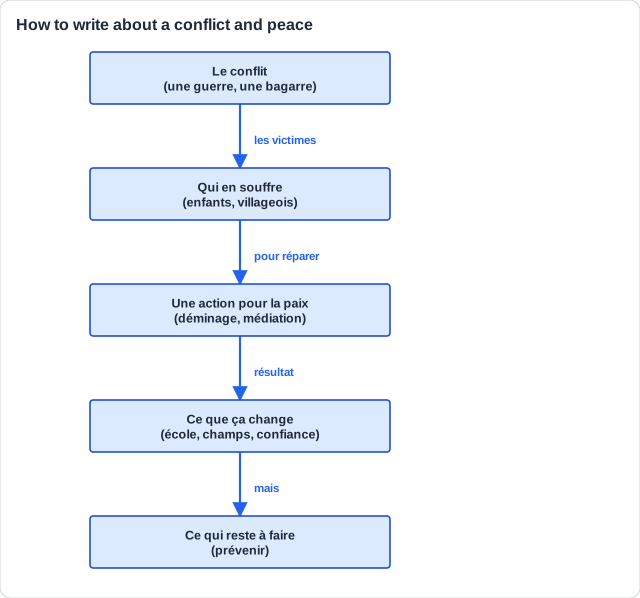
Link your ideas: Connectors lift your answer from a list into an argument: de plus (besides), cependant (however), par conséquent (therefore), bien que (although). Use at least two or three in any written answer.
Stop wasting time on topics you know
Our AI identifies your weak areas and focuses your study time where it matters. No more overstudying easy topics.
Read like Paper 2: Here is a short blog, the kind of text Paper 2 (Reading) gives you. Read it once just for the general idea; don't worry about every word.
How to work through it
- Tap the audio button to hear it.
- Tap Voir la traduction if you get stuck.
- Then we'll do one exam question together.
Notre club de médiateurs pour la paix (1/2): L'année dernière, il y avait beaucoup de disputes et de tensions dans mon lycée. C'est pourquoi, avec quelques camarades, nous avons créé un club de médiateurs pour la paix.
Au début, je pensais qu'un conflit se réglait seulement par la force ou en se taisant. Mais très vite, j'ai compris que le dialogue était bien plus efficace.
Notre club de médiateurs pour la paix (2/2)
Quand deux élèves se disputent, nous les écoutons chacun à leur tour, puis nous cherchons ensemble un accord. La plupart du temps, ils finissent par se réconcilier. Aujourd'hui, l'ambiance est beaucoup plus calme. Pour moi, la paix ne tombe pas du ciel : elle se construit, un geste après l'autre.
- une dispute / un conflit
- an argument / a conflict
- un médiateur / la médiation
- a mediator / mediation
- le dialogue
- dialogue
- chercher un accord
- to look for an agreement
- se réconcilier
- to make peace / be reconciled
- construire la paix
- to build peace
IB-style task — Vrai ou Faux, et justifie
Une question, étape par étape
- The statement — Au début, la narratrice pensait que le dialogue était la meilleure solution. Vrai ou Faux ?
- Decide, then hunt for proof. Scan for what she thought at first: Au début, je pensais qu'un conflit se réglait seulement par la force ou en se taisant.
- The answer — Faux. Justification : Au début, je pensais qu'un conflit se réglait seulement par la force ou en se taisant. Copy the exact words that prove it — that quote is what earns the mark, not the word 'Faux' on its own.
Reading technique: For Vrai/Faux + justifiez, a tick alone scores zero — you must quote the exact words from the text that prove it. The same rule applies to selon le texte questions: find the line, don't rely on memory.
La tâche — your task: Le club de médiation de ton lycée lance une campagne Vivre ensemble en paix.
Ce que tu écris — what you write: Écris un dépliant pour les élèves : explique comment régler une dispute sans violence et présente le club de médiation.
Écris entre 250 et 400 mots.
Brochure (dépliant) structure — 4 steps
Titre accrocheur
A big title or slogan that grabs attention. VIVRE ENSEMBLE EN PAIX — Un conflit ? Parlons-en !
Sections avec sous-titres
Break the leaflet into short labelled sections. LE CLUB DE MÉDIATION, C'EST QUOI ?
Puces (infos clés)
List the advice as bullet points, with the tu imperative. • respire avant de répondre ; • écoute l'autre jusqu'au bout.
Infos pratiques + appel à l'action
End with where and when to find the club, and a call to act. Salle 104, le lundi et le jeudi à midi. Viens nous voir !
Titre → Sections → Puces → Infos + appel
Modèle : les 4 étapes en ~75 mots
Le dépliant rédigé, étape par étape
- VIVRE ENSEMBLE EN PAIX — Un conflit ? Parlons-en !
- LE CLUB DE MÉDIATION, C'EST QUOI ? Des élèves formés qui t'aident à résoudre un conflit avec un camarade, sans juger et sans punir.
- EN CAS DE DISPUTE : • respire et calme-toi avant de répondre ; • écoute l'autre jusqu'au bout ; • cherche un accord plutôt qu'un gagnant.
- OÙ NOUS TROUVER ? Salle 104, le lundi et le jeudi à midi. C'est gratuit et confidentiel. Viens nous voir : ensemble, on trouve toujours une solution !
Why it works: A strong leaflet does this for each of the three Paper 1 criteria:
A — Language /12
- Persuasive structures: impératif respire, écoute, viens; plutôt que
- Layout cues instead of long connectors: EN CAS DE DISPUTE, OÙ NOUS TROUVER ?
- Topic vocabulary, used accurately
B — Message /12
- Task fully done: explains how to settle a dispute peacefully AND presents the club
- Ideas developed with concrete details (room 104, free and confidential)
C — Conceptual /6
- Brochure conventions: a catchy title or slogan
- Sub-headings and bullet points: a layout readers can scan
- Practical information + a call to action at the end
Ready to ace Peace & conflict?
You've seen the preview. Here's what you'll unlock:
Bite-Sized Study Notes
Full syllabus broken into chunks that stick
Exam Practice
See exactly how to score full marks
AI Feedback
Know exactly what examiners want
Smart Study Plan
Know exactly what to study next