What 'relations sociales' covers: Social relationships (relations sociales) is part of the theme Social Organization. Learn the words below as a deck, then use them in the reading and writing sections.
You need vocabulary to talk about
- friendship
- family ties
- trust and belonging
- your opinion about them
- une relation (amicale / familiale)
- a (friendly / family) relationship
- l'amitié (f)
- friendship
- un(e) ami(e) proche / un(e) meilleur(e) ami(e)
- a close friend / a best friend
- une simple connaissance
- a mere acquaintance
- un(e) ami(e) virtuel(le) / en ligne
- an online friend
- avoir confiance en quelqu'un
- to trust someone
- se confier à quelqu'un
- to confide in someone
- s'entendre (bien / mal) avec
- to get on (well / badly) with
- se disputer (avec) / se réconcilier
- to argue (with) / to make up
- le soutien — soutenir quelqu'un
- support — to support someone
- partager des valeurs / des moments
- to share values / moments
- appartenir à un groupe
- to belong to a group
- être fidèle / loyal(e)
- to be faithful / loyal
| Useful expression (French) | English |
|---|---|
| Je m'entends bien avec mes amis. | I get on well with my friends. |
| Je peux me confier à elle. | I can confide in her. |
| On se dispute parfois, mais on se réconcilie. | We argue sometimes, but we make up. |
| Un vrai ami me soutient quand je vais mal. | A real friend supports me when I feel low. |
| L'amitié se construit avec le temps. | Friendship is built over time. |
Why this matters: This vocabulary turns up in every skill — a reading text on friendship, a listening interview about family, a Paper 1 blog, or your oral. Reusing the right topic words is how you score Criterion A (Language).
Free preview
Reading it is one thing — hearing it is another
You're reading the free notes. Aimnova Pro unlocks the full study experience — and you can try it with your first topic free to keep:
- Audio on every wordTap any vocabulary word or example to hear it read aloud in natural French.
- FlashcardsLock in vocabulary and key terms with spaced repetition.
- Practice questionsAnswer exam-style questions and get instant AI marking.
- Mock exams & past-paper vaultSit full mocks and see exactly how examiners award marks.
- Personalised study planA daily plan built around your exam date and weak areas.
Have something to say: Examiners reward developed ideas, not just vocabulary. Around social relationships, the common debates are: online 'friends' vs real friends, quality vs quantity of friendships, and the role of family. Take a position and back it up.
Opinion phrases (use these to introduce a view)
- À mon avis… / De mon point de vue… — In my opinion… / From my point of view…
- Il me semble que… / Je pense que… — It seems to me that… / I think that…
- Le plus important, c'est… — The most important thing is…
- D'un côté… de l'autre côté… — On the one hand… on the other hand…
- Je suis (tout à fait) d'accord avec… — I (completely) agree with…
Limites des amis en ligne (drawbacks)
- On a parfois des centaines de contacts, mais peu de vrais amis.
- Derrière un écran, on peut cacher qui on est vraiment.
- Ces relations restent souvent superficielles.
Force des vrais amis (benefits)
- Un vrai ami nous soutient dans les moments difficiles.
- On peut se confier à lui en toute confiance.
- L'amitié se construit avec le temps et la sincérité.
Family
- les règles des parents (portable, sorties)
- vivre encore chez ses parents à 30 ans
- une grand-mère qui vient habiter chez vous
Friendship
- vrais amis, copains, amis en ligne
- se réconcilier après une dispute
- une génération seule avec son smartphone
Meeting others
- accueillir des élèves étrangers
- des voisins qui se parlent enfin
- loger chez une personne âgée
Big questions behind this topic (IB guide, theme Social organization)
- Quel est le rôle de l'individu dans sa famille et sa communauté ?
- Quel rôle les règles jouent-elles dans une famille ?
- Peut-on être vraiment ami avec quelqu'un qu'on n'a jamais vu ?
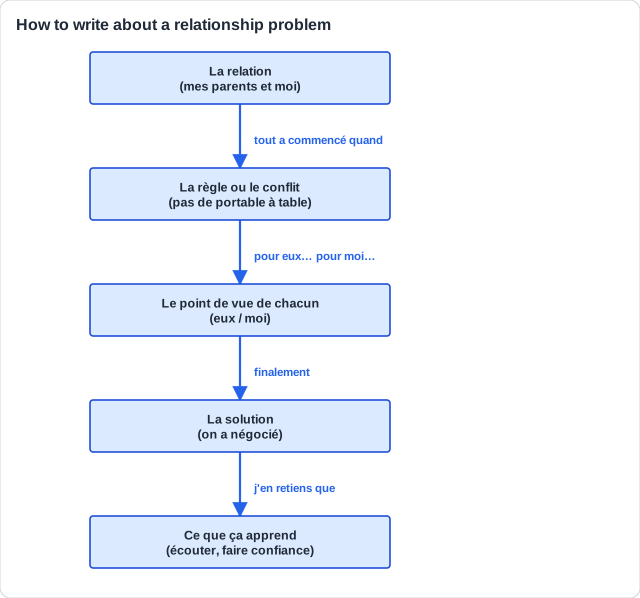
Link your ideas: Connectors lift your answer from a list into an argument: de plus (besides), cependant (however), par conséquent (therefore), bien que (although). Use at least two or three in any written answer.
Memorize terms 3x faster
Smart flashcards show you cards right before you forget them. Perfect for definitions and key concepts.
Read like Paper 2: Here is a short blog, the kind of text Paper 2 (Reading) gives you. Read it once just for the general idea; don't worry about every word.
How to work through it
- Tap the audio button to hear it.
- Tap Voir la traduction if you get stuck.
- Then we'll do one exam question together.
Trois cents amis, et après ? (1/4): Sur mon téléphone, j'ai presque trois cents amis. Pourtant, quand j'ai un vrai problème, je n'en appelle que deux ou trois.
Trois cents amis, et après ? (2/4)
Pour moi, un ami en ligne et un ami proche, ce n'est pas la même chose. Derrière un écran, il est facile de montrer une vie parfaite et de cacher ses soucis.
Trois cents amis, et après ? (3/4)
Un véritable ami, lui, me connaît vraiment : je peux me confier à lui, il me soutient quand je vais mal et il me dit la vérité, même quand ça ne me plaît pas.
Trois cents amis, et après ? (4/4)
Bien sûr, il nous arrive de nous disputer, mais on se réconcilie toujours. L'amitié, ça ne se compte pas : ça se construit avec le temps.
- un(e) ami(e) en ligne / proche
- an online / close friend
- se confier à quelqu'un
- to confide in someone
- soutenir quelqu'un / le soutien
- to support someone / support
- cacher ses soucis
- to hide one's worries
- se disputer / se réconcilier
- to argue / to make up
- se construire avec le temps
- to be built over time
IB-style task — Vrai ou Faux, et justifie
Une question, étape par étape
- The statement — La narratrice a beaucoup d'amis vraiment proches. Vrai ou Faux ?
- Decide, then hunt for proof. Scan for how many she really relies on: « j'ai presque trois cents « amis ». Pourtant, quand j'ai un vrai problème, je n'en appelle que deux ou trois. »
- The answer — Faux. Justification : quand j'ai un vrai problème, je n'en appelle que deux ou trois. Copy the exact words that prove it — that quote is what earns the mark, not the word 'Faux' on its own.
Reading technique: For Vrai/Faux + justifiez, a tick alone scores zero — you must quote the exact words from the text that prove it. The same rule applies to selon le texte questions: find the line, don't rely on memory.
La tâche — your task: Ta correspondante Chloé t'écrit : elle s'est disputée avec sa meilleure amie, Emma, et elle se sent seule.
Ce que tu écris — what you write: Réponds-lui par un courriel : explique ce qu'est pour toi un vrai ami et donne-lui des conseils pour sauver son amitié.
Écris entre 250 et 400 mots.
Courriel (informal email) structure — 5 steps
Objet + formule d'appel
A reply keeps Re : in the subject line, then a friendly greeting. Objet : Re : ma dispute avec Emma — Salut Chloé,
Raison du courriel
React to her message first. Merci pour ton message. Je suis désolée que tu te sentes seule.
Ton avis + ton expérience
Say what a real friend is, then share a similar moment in the past. Pour moi, une vraie amie, c'est… L'an dernier, je me suis fâchée avec Léa…
Conseils + demande
Advise with the tu imperative, then ask for news. Appelle Emma, explique-lui ce que tu ressens. Tu me raconteras ?
Clôture amicale + signature
End warmly and sign with your first name. Je pense fort à toi. Bises, Manon
Objet + Salut → Why I'm writing → My experience → Tips + question → Friendly sign-off
Modèle : les 5 étapes en ~95 mots
Le courriel rédigé, étape par étape
- Objet : Re : ma dispute avec Emma Salut Chloé,
- Merci pour ton message. Je suis désolée que tu te sentes seule en ce moment.
- Pour moi, une vraie amie, c'est quelqu'un qui t'écoute et qui te dit la vérité, même quand c'est difficile. L'an dernier, je me suis fâchée avec Léa pour une bêtise. Nous ne nous parlions plus, mais elle me manquait beaucoup.
- Alors, ne reste pas fâchée : appelle Emma, explique-lui ce que tu ressens et écoute sa version. Tu me raconteras comment ça s'est passé ?
- Je pense fort à toi. Bises, Manon
Why it works: A strong informal email does this for each of the three Paper 1 criteria:
A — Language /12
- Range of tenses: subjonctif que tu te sentes, passé composé je me suis fâchée, imparfait nous ne nous parlions plus
- Connectors: même quand, mais, alors
- Topic vocabulary, used accurately
B — Message /12
- Task fully done: explains what a real friend is AND gives advice
- Ideas developed with a personal example (the quarrel with Léa)
C — Conceptual /6
- Email conventions: Objet : Re : … + Salut Chloé, + Bises, Manon
- Informal register (tu) to one friend, reacting to her message
- A question that invites a reply: Tu me raconteras comment ça s'est passé ?
Ready to ace Social relationships?
You've seen the preview. Here's what you'll unlock:
Bite-Sized Study Notes
Full syllabus broken into chunks that stick
Exam Practice
See exactly how to score full marks
AI Feedback
Know exactly what examiners want
Smart Study Plan
Know exactly what to study next