Soils and forests: On land, acid rain harms plants twice: directly, through their leaves, and indirectly, by changing the soil they grow in.
Acid rain on land
- Leaching: acid washes nutrients (calcium, magnesium, potassium) out of the soil, so it is less fertile.
- Toxification: acid releases aluminium and other metals from soil particles; they damage roots.
- Soil organisms and decomposers are harmed, so dead matter rots slowly and nutrients cycle slowly.
- Direct damage to leaves: acid strips the waxy cuticle; needles yellow and fall; less photosynthesis.
- Weakened trees die from frost, drought, pests and disease (forest dieback); lichens die first.
- Fewer plants mean less food for herbivores, more soil erosion and lower crop yields.
Remember it as: Leaves burnt, soil robbed, roots poisoned.
Real example: in the 1970s and 1980s the Black Triangle had some of the worst acid rain in Europe. Large areas of spruce forest in its mountains turned brown and died.
Link the acid to the harm: 'Acid deposition' alone, or 'trees die' alone, is not enough. Say how: acid leaches nutrients, so trees grow less.
Free preview
This is the free notes preview
You're reading the free notes. Aimnova Pro unlocks the full study experience — and you can try it with your first topic free to keep:
- FlashcardsLock in vocabulary and key terms with spaced repetition.
- Practice questionsAnswer exam-style questions and get instant AI marking.
- Mock exams & past-paper vaultSit full mocks and see exactly how examiners award marks.
- Personalised study planA daily plan built around your exam date and weak areas.
Most acid that falls on a forest ends up in its streams and lakes, carrying aluminium from the soil with it.
Acid rain in lakes and rivers
- Acid run-off and snowmelt lower the pH of lakes and rivers.
- Acid soils release aluminium, which washes into the water and becomes toxic there.
- Aluminium damages fish gills: they clog with mucus, so less oxygen is taken in.
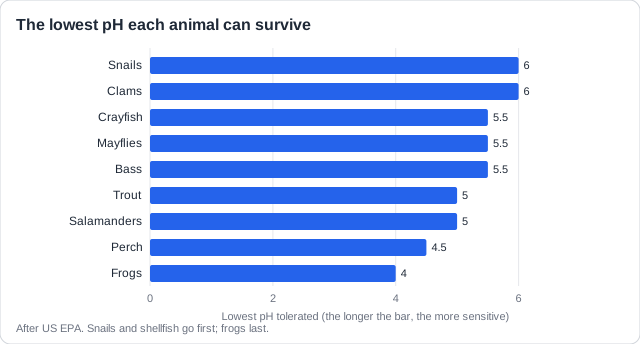
- Snails, crayfish and mayflies cannot build shells and exoskeletons in acid water; eggs fail.
- Sensitive species die out first; acid-tolerant ones (some mosses, midges) increase.
- Food webs get shorter, biodiversity and productivity fall; extra nitrate can over-fertilise.
Rain
- 1970s-80s: rain and snow on southern Norway were often about pH 4.3
Soil
- Thin soils on hard rock could not neutralise it; aluminium was washed out
River
- Spring snowmelt sent a pulse of acid and aluminium down the rivers
Fish
- Salmon disappeared from many rivers in the south of Norway
Shells and gills: Two words to use: aluminium damages fish gills; acid water stops invertebrates building shells and exoskeletons.
See how examiners mark answers
Answer exam-style questions with model answers. Learn exactly what earns marks and what doesn't.
Stone and metal: Acid deposition corrodes the materials cities are built from, above all stone made of calcium carbonate.
Buildings and materials
- Marble and limestone are calcium carbonate: acid dissolves them.
- The reaction makes gypsum, which traps soot as a black crust, then flakes off.
- Carved detail, inscriptions and statues are slowly worn away.
- Acid corrodes steel and iron (rust), bronze and copper, and paint.
- Repairs, cleaning and replacing stone and metal cost money.
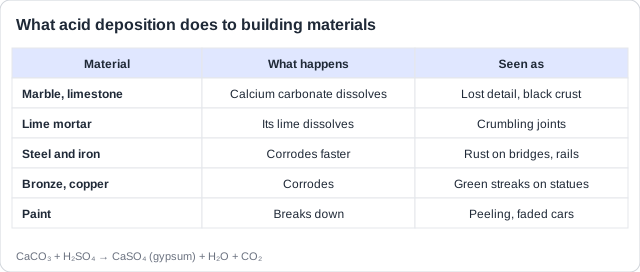
Real example: the white marble of the Taj Mahal has been yellowed and pitted by air pollution. Sulfur dioxide from a nearby oil refinery and coal-burning foundries forms acid that attacks the marble.
Before it falls as rain, the acid is already in the air we breathe, as tiny particles.
Acid in the air we breathe
- SO₂ and NOₓ form tiny sulfate and nitrate particles: part of PM2.5.
- PM2.5 reaches deep into the lungs: tissue damage and lung inflammation.
- It causes coughing, asthma attacks, bronchitis and reduced lung function.
- The finest particles enter the blood: more heart disease and early deaths.
- Acid fog and SO₂ irritate the eyes and airways directly.
- Children, older people and those already ill suffer most.
Sulfate and nitrate particles
- Formed from SO₂ and NOₓ
- Part of PM2.5
- Deep in the lungs, into the blood
- Inflammation, asthma, heart disease
Acid gases and fog
- SO₂, NOₓ, acid droplets
- Breathed in near the source
- Irritate eyes, nose, throat
- Coughing, wheezing
Real example: in July 1990 Hong Kong allowed only low-sulfur fuel in power stations and vehicles. Sulfur dioxide fell sharply, and in the following year deaths from lung and heart disease fell.
Study smarter, not longer
Most students waste 40% of study time on topics they already know. Our AI tracks your progress and optimizes every minute.
Pollution costs money: Every impact on ecosystems, people and buildings has a price, paid by health services, businesses and governments.
The economic cost
- Disease raises healthcare costs.
- Sick workers mean lost workdays and lower productivity; early deaths shrink the workforce.
- Lower crop, timber and fish yields raise food prices and cost jobs.
- Repairs to buildings, monuments, bridges and equipment.
- Paying for clean-up technology, monitoring and education campaigns.
- Tourists stay away and property values fall in polluted places.
Polluted air costs
- Hospital visits, early deaths
- Lost workdays
- Smaller harvests, dead fish
- Corroded monuments
Cleaner air brings
- Less asthma, sore eyes, heart disease
- Lower health costs, longer lives
- Healthier plants, more species
- Clearer views, cleaner buildings
Real example: the World Bank estimated that in 2013 air pollution cost the world about 225 billion US dollars in lost income, because people who fell ill or died early could not work.
One cost per point: Name the impact AND the cost it causes: 'asthma raises healthcare costs', not just 'health'. 'Improved health' alone is not enough either.
How this comes up: Paper 2: a Section B (b) on how acid deposition affects a forest and its river, and short Section A parts on one or two impacts.
Spruce forest covers the hills above a river in southern Sweden, and acid rain has fallen on it for decades.
Explain how acid deposition may impact the biotic components of this forest-river ecosystem.
Model answer plan
See the mark-by-mark plan — for / against / judgement, with marking guidance — in study mode.
A Section A part asks for one impact in one line.
A coal power station releases high concentrations of sulfur dioxide close to a pine forest.
Describe one impact of high sulfur dioxide concentrations on forest systems.
Model answer plan
See the mark-by-mark plan — for / against / judgement, with marking guidance — in study mode.