Stop it, catch it, fix it: Acid deposition is managed with the pollution management model.
Three levels of management
- Alter human activity: make less SO₂ and NOₓ in the first place.
- Control the release: catch the gases at the chimney or exhaust, by technology and by law.
- Clean up and restore: repair the soils, lakes, forests and people already harmed.
- The higher the level, the more it tackles the root cause; clean-up treats only the effects.
- The best plans use all three levels at once.
Remember it as: Stop it, catch it, fix it.
Alter human activity
- Renewables instead of coal
- Low-sulfur fuel
- Public transport
Control the release
- Scrubbers
- Catalytic converters
- Laws, cap-and-trade, treaties
Clean up and restore
- Lime lakes and soils
- Restock fish, replant trees
- Healthcare
Real example: in the 1980s West Germany fought its dying forests at every level. A 1983 law forced large power stations to fit scrubbers, cleaner fuels replaced brown coal, and foresters spread lime on forest soils.
Free preview
This is the free notes preview
You're reading the free notes. Aimnova Pro unlocks the full study experience — and you can try it with your first topic free to keep:
- FlashcardsLock in vocabulary and key terms with spaced repetition.
- Practice questionsAnswer exam-style questions and get instant AI marking.
- Mock exams & past-paper vaultSit full mocks and see exactly how examiners award marks.
- Personalised study planA daily plan built around your exam date and weak areas.
The surest way to stop acid rain is to stop making the gases. That means changing the fuel, or burning less of it, before anything reaches the chimney.
Before burning: alter human activity
- Switch to alternative energy: wind, solar, hydro, nuclear, or gas instead of coal.
- Use low-sulfur coal and oil, or wash the coal to remove sulfur before burning.
- Save energy: efficient buildings and machines burn less fuel.
- Fewer cars: public transport, cycling, walking, car-sharing.
- Education campaigns change what people choose and value.
Strengths
- Tackles the root cause
- Cuts SO₂, NOₓ and CO₂ together
- No damage to repair later
Limitations
- Big, costly changes
- Needs political will
- People may resist changing habits
Real example: in 2012 about 40% of the UK's electricity came from coal. As wind, gas and solar replaced it, the last coal power station, Ratcliffe-on-Soar, closed on 30 September 2024.
Memorize terms 3x faster
Smart flashcards show you cards right before you forget them. Perfect for definitions and key concepts.
Catch it at the source: If the fuel is still burnt, the gases can be removed before they escape: in the furnace, the chimney or the exhaust pipe.
Controlling the release
- Scrubbers (flue-gas desulfurisation): limestone slurry absorbs SO₂ from the smoke; about 90% removed.
- The scrubber turns SO₂ into gypsum, which is sold to make plasterboard.
- Catalytic converters on vehicles turn NOₓ back into nitrogen and oxygen.
- Low-NOₓ burners and cooler furnaces make less NOₓ in power stations.
- Catalytic converters are for exhausts: they do not clean a smelter's or power station's SO₂.
Strengths
- Very effective: most SO₂ or NOₓ removed
- Keeps existing power and cars running
- Easy to require by law
Limitations
- Expensive to fit and run
- CO₂ still released
- Converters need mined platinum metals
Real example: Drax, the UK's largest coal power station, fitted scrubbers in the 1990s. They removed most of its sulfur dioxide and turned it into gypsum for plasterboard.
Technology works only if someone makes polluters use it. That is the job of laws, and of agreements between countries.
Laws and agreements
- Emission limits set by law, with monitoring and fines.
- Cap-and-trade: a cap on total SO₂; firms that cut more can sell their spare permits.
- Acid rain crosses borders, so countries need international agreements.
- CLRTAP (1979) was the first; its 1985 Helsinki Protocol cut sulfur by at least 30% of 1980 levels by 1993.
- Later protocols added NOₓ (Sofia, 1988) and more cuts (Gothenburg, 1999).
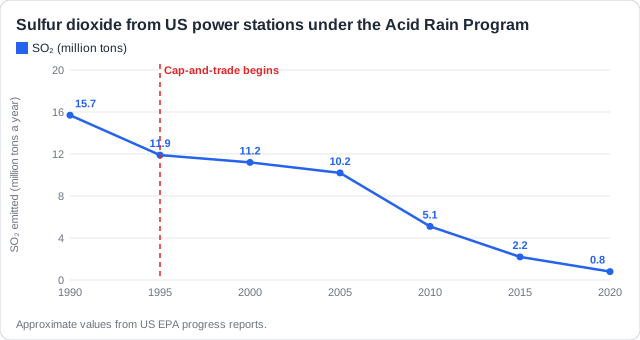
Real example: the USA's 1990 Clean Air Act set up the Acid Rain Program. By 2020 power stations emitted about 95% less sulfur dioxide than in 1990.
Know your predicted grade
Take timed mock exams and get detailed feedback on every answer. See exactly where you're losing marks.
Repair the damage: Even when emissions fall, acid soils and lakes take decades to recover. Restoration speeds this up, but it treats the symptoms.
Clean-up and restoration
- Liming: add powdered limestone to lakes, rivers or soils to neutralise the acid.
- CaCO₃ + H₂SO₄ → CaSO₄ + H₂O + CO₂: the acid is used up, so the pH rises.
- Add fertiliser or wood ash to replace leached nutrients.
- Restock fish; replant forests, using acid-tolerant plants to bind the soil.
- Healthcare treats people with asthma and bronchitis.
- Cheap and quick, but short-term: it must be repeated and does not stop the acid.
Real example: Sweden began a national liming programme in 1982. About 7,500 lakes have been limed again and again, so that fish and snails can survive in them.
Not a cure: Liming must be repeated every few years, costs money, and quarrying the limestone damages other land. It works best once emissions have been cut.
How this comes up: Paper 2: a Section B (b) evaluating strategies with the management model, and one-mark parts on a graph or a restoration method.
Acid deposition from power stations in central Europe damaged forests and lakes across several countries in the 1980s.
Evaluate strategies to manage regional acid deposition using the pollution management model.
Model answer plan
See the mark-by-mark plan — for / against / judgement, with marking guidance — in study mode.
A Paper 1 part asks for one strategy behind a falling trend.
A graph shows that sulfur dioxide emissions from a copper smelter have fallen steadily since 1990, while the smelter has kept working.
Identify one strategy that might have been used to achieve this trend.
Model answer plan
See the mark-by-mark plan — for / against / judgement, with marking guidance — in study mode.