Two gases from burning: Acid rain starts with two gases: sulfur dioxide and nitrogen oxides.
Where the gases come from
- Sulfur dioxide (SO₂) comes from burning coal and oil, which contain sulfur, and from smelting metal ores.
- Nitrogen oxides (NOₓ) form in the heat of vehicle engines and power stations, from the nitrogen and oxygen in air.
- The main sources: coal-burning industry, electricity generation and transport.
- Farming adds nitrogen gases too: making and using fertilisers, and livestock.
- Natural sources: volcanoes (SO₂), lightning and soil microbes (NOₓ).
- SO₂ and NOₓ are primary pollutants: they come straight out of the source.
Remember it as: Sulfur from the fuel, nitrogen from the air.
Real example: China burns more coal than any other country. By about 2005 its coal power stations had made it the world's largest emitter of sulfur dioxide, and acid rain fell over much of southern China.
Sulfur v nitrogen: SO₂ depends on the fuel: low-sulfur fuel makes little. NOₓ depends on the heat: any very hot burning makes it, even of clean fuel.
Free preview
This is the free notes preview
You're reading the free notes. Aimnova Pro unlocks the full study experience — and you can try it with your first topic free to keep:
- FlashcardsLock in vocabulary and key terms with spaced repetition.
- Practice questionsAnswer exam-style questions and get instant AI marking.
- Mock exams & past-paper vaultSit full mocks and see exactly how examiners award marks.
- Personalised study planA daily plan built around your exam date and weak areas.
In the air the two gases take in more oxygen and dissolve in water droplets. That turns them into strong acids.
The chemistry of acid rain
- SO₂ and NOₓ react with water and oxygen in the air.
- Sulfur dioxide becomes sulfuric acid (H₂SO₄); nitrogen oxides become nitric acid (HNO₃).
- These acids are secondary pollutants: they form in the air, not at the chimney.
- Unpolluted rain is already slightly acidic, about pH 5.6, because CO₂ dissolves in it.
- Acid rain has a pH below 5.6; polluted rain often falls to about pH 4.
- Each step down the pH scale is 10 times more acidic.
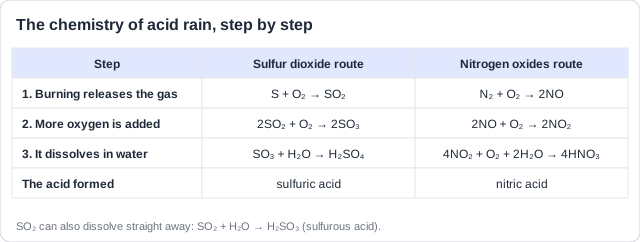
In words: sulfur dioxide + oxygen + water → sulfuric acid; nitrogen dioxide + oxygen + water → nitric acid.
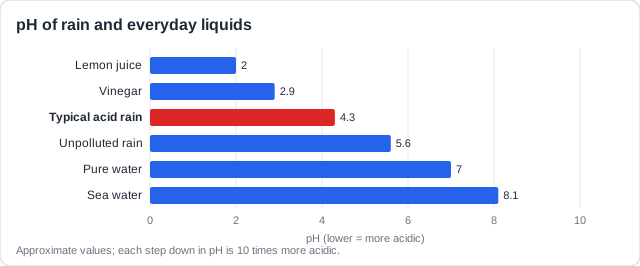
Real example: in 1963 scientists at the Hubbard Brook forest in New Hampshire, USA, measured rain with a pH of about 4: more than 10 times more acidic than unpolluted rain. It was the first clear proof of acid rain in North America.
Never wonder what to study next
Get a personalized daily plan based on your exam date, progress, and weak areas. We'll tell you exactly what to review each day.
Wet or dry, it still lands: Acid deposition is the full name. Acid rain is only one part of it.
Wet and dry deposition
- Acid deposition is every way the acids reach the ground.
- Wet deposition: acids dissolved in rain, snow, fog and mist.
- Dry deposition: SO₂, NOₓ and acid particles settle out of the air, mostly near the source.
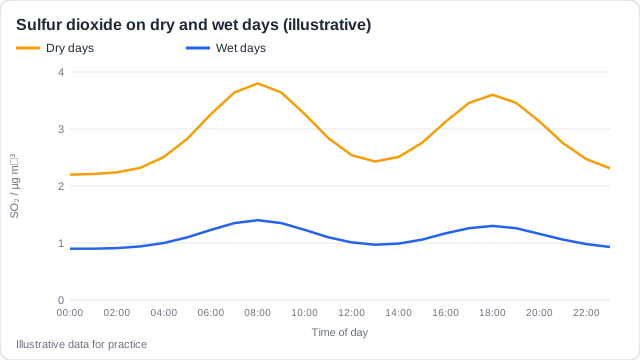
- Rain washes SO₂ out of the air: it dissolves in the drops, so SO₂ is lower on wet days.
- Dry deposition left on leaves and soil turns to acid when it next gets wet.
Real example: in southern Norway acid builds up in the winter snow. When it melts in spring, the acid reaches the rivers in one rush, and young salmon and trout die in large numbers.
Acid deposition rarely stays where it was made. A map of damage around a source shows where the wind took it.
Carried by the wind
- Prevailing winds carry SO₂ and NOₓ downwind, often hundreds of kilometres.
- So acid deposition crosses borders: one country's smoke falls on another.
- Deposition and damage are greatest near the source and fall with distance.
- Further away the gases are diluted, so there is less damage.
- Valleys channel the wind, so pollution travels along them; rivers and lakes spread it.
- Tall chimneys reduce local pollution but send the gases further.
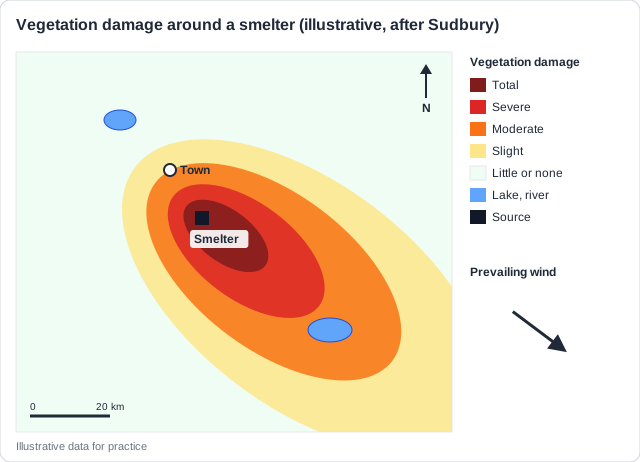
Real example: the nickel smelters at Sudbury left about 20,000 hectares of bare, dead land around them. In 1972 the 381 m Superstack was built to send the gases high into the wind: the town's air improved, but acid fell over a much wider area.
Explain, do not describe: When a map shows damage, describing the zones scores nothing. Explain them: the wind direction, the distance from the source, the dilution, the valleys.
Stop wasting time on topics you know
Our AI identifies your weak areas and focuses your study time where it matters. No more overstudying easy topics.
How this comes up: Paper 2: a Section B (b) asking for the causes and effects of acid deposition, and short Section A parts on a graph of SO₂.
In the 1970s and 1980s, lakes and forests in southern Norway were badly damaged by acid deposition.
Explain the causes and effects of acid deposition on natural ecosystems.
Model answer plan
See the mark-by-mark plan — for / against / judgement, with marking guidance — in study mode.
A Section A part asks you to read a graph of SO₂ in one line.
A graph shows that sulfur dioxide in a city's air is lower on wet days than on dry days.
Outline why sulfur dioxide levels are lower on wet days.
Model answer plan
See the mark-by-mark plan — for / against / judgement, with marking guidance — in study mode.