People move, land changes: Urbanization changes both where people live and what the land is used for.
The points to remember
- Urbanization is the shift of population from rural to urban areas.
- So the proportion (share) of people living in towns and cities rises.
- Land use changes: more built-up, more industrialized.
- Settlement becomes dense and continuous, with more infrastructure.
- Urban growth is different: a rise in the number of people in urban areas.
Urbanization
- A rising SHARE in urban areas
- Rural to urban shift
- Land becomes built-up
Urban growth
- A rising NUMBER in urban areas
- Can happen with no shift
- Can stop while share rises
Real example: in 1960 about 14% of Nigerians lived in urban areas; by 2025 about 64% did. In Lagos, wetlands by the lagoon were filled in and Eko Atlantic, a new district, was built on land reclaimed from the Atlantic.
Remember it as: Share up, land built up.
Free preview
This is the free notes preview
You're reading the free notes. Aimnova Pro unlocks the full study experience — and you can try it with your first topic free to keep:
- FlashcardsLock in vocabulary and key terms with spaced repetition.
- Practice questionsAnswer exam-style questions and get instant AI marking.
- Mock exams & past-paper vaultSit full mocks and see exactly how examiners award marks.
- Personalised study planA daily plan built around your exam date and weak areas.
Urbanization is one of the biggest changes of the last century, and it is still happening fastest in the poorer countries of Africa and Asia.
The global trend
- About 14% of people lived in urban areas in 1900, and about 30% in 1950.
- In 2007 the world's urban population overtook its rural population.
- By 2025 about 58% lived in urban areas; UN projections expect about two-thirds by 2050.
- Fastest growth now: sub-Saharan Africa and South Asia.
- Megacities (over 10 million people): 8 in 1975, 33 in 2025; the largest are Jakarta, Dhaka and Tokyo.
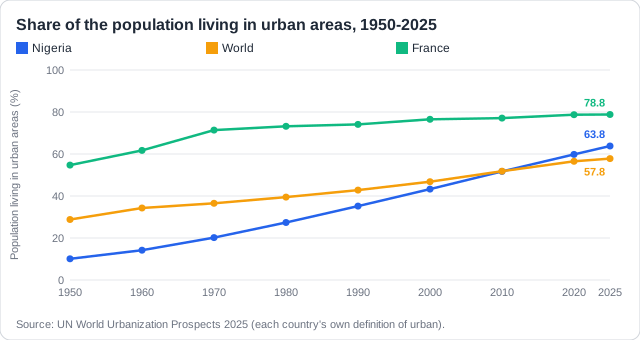
Real example: Nigeria became mostly urban around 2009. France was already more than half urban in 1950, so its curve is flat: urbanization slows once most people live in towns.
Proportion, not number: Describe urbanization as a rising share (%), with years and values from the graph: 'from 28.8% in 1950 to 57.8% in 2025'.
Study smarter, not longer
Most students waste 40% of study time on topics they already know. Our AI tracks your progress and optimizes every minute.
Why do urban populations grow faster than the country as a whole? Cities gain people in ways the whole country does not.
Why urban populations grow
- Rural-urban migration: people move from the countryside into towns and cities.
- Immigration from other countries, mostly into cities.
- Natural increase: young migrants have children; better healthcare lowers death rates.
- Reclassification: growing villages are counted as towns, or city boundaries expand.
- Economic development: industry and services gather jobs in cities.
Moving in
- Rural-urban migration
- Immigration from abroad
Births and deaths
- Young migrants, more births
- Healthcare, fewer deaths
Counting and jobs
- Reclassified places
- Industry draws workers
How fast will it double?: Doubling time = 70 ÷ growth rate (%). A city growing at 3.5% a year doubles in 70 ÷ 3.5 = 20 years. Divide by 3.5, not by 0.035.
Real example: Lagos grew from under 1 million people in 1960 to over 15 million: migrants came from all over Nigeria and from neighbouring countries for work, and had their children in the city.
When people arrive faster than homes, pipes and jobs can be provided, rapid urbanization causes problems.
Challenges of rapid urbanization
- Housing: not enough homes, so informal settlements (slums) and overcrowding.
- Infrastructure strain: water, sanitation, power and transport overloaded.
- Jobs: many work in the informal economy, with low and insecure pay.
- Pollution: air, water, noise and solid waste.
- Health: diseases spread in crowded areas with poor sanitation.
- Social issues: crime, inequality.
Remember it as: Homes, pipes, jobs, fumes, germs, gaps.
Real example: Makoko, in Lagos, is an informal settlement of wooden houses on stilts over the lagoon. Tens of thousands of people live there with little clean water or sanitation, and parts have been demolished by the government.
Link the problem to the growth: Say why the problem comes from urbanization: 'people arrived faster than housing was built, so informal settlements grew'. A list of city problems on its own explains nothing.
Practice with exam-style questions
Answer exam-style questions and get AI feedback that shows you exactly what examiners want to see in a full-marks response.
Cities are not only problems. Well-managed cities can be more sustainable than the same number of people spread across the countryside.
Opportunities of urbanization
- Efficiency: many people share pipes, roads and power lines.
- Services: schools, hospitals and utilities are easier to provide to dense populations.
- Innovation: cities are centres of education, new ideas and economic growth.
- Lower emissions per person in dense cities than in sprawl.
- Social mobility and cultural exchange: more chances to learn and earn.
Challenges
- Slums, overcrowding
- Overloaded services
- Pollution, disease
Opportunities
- Shared infrastructure
- Services, education
- Jobs, ideas, lower emissions per person
Cities in numbers: Cities cover only about 3% of Earth's land, but hold most of its people, use about three-quarters of its resources and produce about 70% of its CO₂ emissions. How cities grow decides how sustainable the world is.
Real example: in Lagos's Yaba district, technology firms and start-ups cluster near the universities, so young people find jobs and ideas they could not find in a village.
How this comes up: Paper 1, from a demographic fact file: outline two reasons why the urban population grows faster than the whole population [2] (specimen paper).
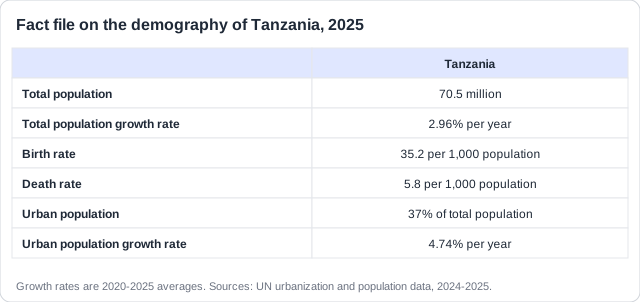
Figure 1 is a fact file on the demography of Tanzania.
Outline two possible reasons why the urban population growth rate is higher than Tanzania's total population growth rate.
Model answer plan
See the mark-by-mark plan — for / against / judgement, with marking guidance — in study mode.