aimnova.
DashboardMy LearningPaper MasteryStudy Plan

Aimnova site navigation

Stay in the loop

Get the latest study resources and updates

New features, study tips and exam insights — straight to your inbox.

IB Diploma

  • IB Past Papers
  • IB Study Notes
  • IB Question Bank
  • IB Mock Exams
  • IB Revision

IB Subjects

  • IB Math AA
  • IB Math AI
  • IB Economics
  • IB Business Management
  • IB Physics
  • IB Biology
  • View all IB subjects→

IB Past Papers

  • IB Math AA HL Past Papers
  • IB Math AA SL Past Papers
  • IB Math AI HL Past Papers
  • IB Math AI SL Past Papers
  • IB Economics HL Past Papers
  • IB Economics SL Past Papers
  • IB ESS Past Papers
  • View all past papers→

Study Resources

  • Study Notes
  • Question Bank
  • Mock Exams
  • Flashcards
  • Revision Guide
  • Exam Skills
  • Command Terms
  • Grade Calculator
  • Exam Timetable 2026

Aimnova

  • Features
  • Pricing
  • For Teachers
  • For Schools
  • For Parents
  • About Us
  • Blog
  • Contact
aimnova.

AI-powered study platform for smarter revision, past-paper analysis and examiner-style feedback.

TermsPrivacyCookies·© 2026 Aimnova. All rights reserved.4d879c2

Aimnova is not affiliated with or endorsed by the International Baccalaureate Organization (IB).

NotesESSTopic 7.3What is in solid domestic waste
Back to ESS Topics
7.3.24 min read

What is in solid domestic waste

IB Environmental Systems and Societies • Unit 7

Smart study tools

Turn reading into results

Move beyond passive notes. Answer exam-style questions, get AI feedback, and build the skills that earn top marks.

Get Started Free

Contents

  • What is in household waste
  • Biodegradable or not
  • Packaging, clothing and debris
  • Exam-style question
A bit of everything: Solid domestic waste is never one thing. Open any bin and you find many materials.

What is in household waste

  • Solid domestic waste (SDW) is the solid waste thrown away by homes.
  • With waste from shops, offices and schools it is called municipal solid waste.
  • It is very mixed: paper, cardboard, glass, metal, plastics and organic waste.
  • Organic waste comes from the kitchen (peel, leftovers) and the garden (grass, leaves).
  • It also holds packaging, clothing and construction debris from home repairs.
  • Food and green waste is the biggest part worldwide: about 44%.
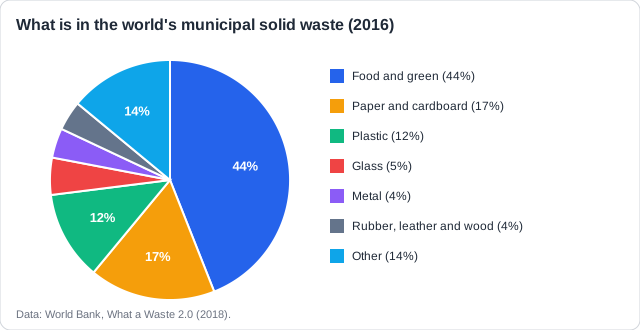
Pie chart of the world's municipal solid waste in 2016: food and green 44%, paper and cardboard 17%, plastic 12%, glass 5%, metal 4%, rubber, leather and wood 4%, other 14%
The world's waste in 2016: 2.01 billion tonnes, mostly food and garden waste.

Real example: the World Bank found that in 2016 the world's waste was 44% food and green waste, 17% paper and cardboard and 12% plastic: 242 million tonnes of plastic in one year.

Remember it as: Paper, plastic, glass, metal, food and garden, plus packs, clothes and rubble.

Free preview

This is the free notes preview

You're reading the free notes. Aimnova Pro unlocks the full study experience — and you can try it with your first topic free to keep:

  • FlashcardsLock in vocabulary and key terms with spaced repetition.
  • Practice questionsAnswer exam-style questions and get instant AI marking.
  • Mock exams & past-paper vaultSit full mocks and see exactly how examiners award marks.
  • Personalised study planA daily plan built around your exam date and weak areas.
Start Studying Free Full access to Aimnova Pro · cancel anytime

The contents split into two groups: what living things can break down and what they cannot. This decides what happens to each item in a landfill or the sea.

Biodegradable or not

  • Biodegradable: broken down by living things such as bacteria and fungi.
  • Biodegradable SDW: food, garden waste, paper, cardboard, wood, cotton.
  • Non-biodegradable: plastics (PET bottles, polystyrene), glass, metals (aluminium, steel).
  • Also non-biodegradable: e-waste, batteries, synthetic textiles (polyester, nylon), rubble.
  • Paper and food are not non-biodegradable: they rot.

Biodegradable

  • Food: peel, leftovers
  • Garden: grass, leaves
  • Paper and cardboard
  • Cotton, wool, wood

Non-biodegradable

  • Plastics: PET, polystyrene
  • Glass
  • Metals: aluminium, steel
  • E-waste, batteries, polyester, rubble

Real example: two T-shirts in the same bin: a cotton one is made from a plant and rots; a polyester one is plastic and does not.

Two materials, one mark: Asked to state two non-biodegradable materials? Both must be right for the mark. Food, garden waste and paper score nothing: they rot.

Get feedback like a real examiner

Submit your answers and get instant feedback — what you did well, what's missing, and exactly what to write to score full marks.

Try AI Tutor FreeYour first topic is free to keep • No credit card required
The parts people forget: Packaging, clothes and rubble from home repairs are also in the guide's list. They are made of several materials at once.

Packaging, clothing and debris

  • Packaging is not one material: paper, plastic, glass, wood and metal.
  • The EU made 186.5 kg of packaging waste per person in 2022.
  • Clothing is cotton or wool (biodegradable) or polyester and nylon (plastic fibres).
  • Construction debris from home repairs: bricks, tiles, plaster, old sinks.
  • Mixed items, such as a paper cup lined with plastic, are hard to sort.
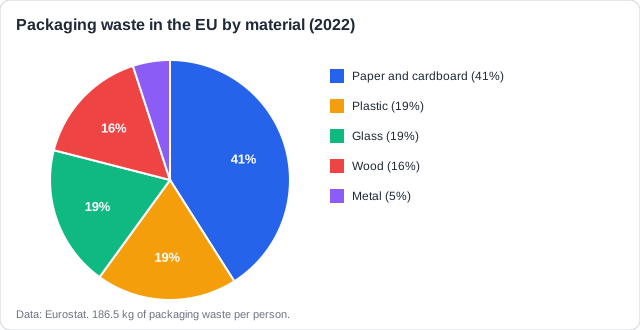
Pie chart of packaging waste in the EU in 2022 by material: paper and cardboard 41%, plastic 19%, glass 19%, wood 16%, metal 5%
Packaging alone is five different materials.

Real example: in 2022 the European Union threw away 83.4 million tonnes of packaging: 186.5 kg for every person, up 31.7 kg per person since 2012.

How this comes up: Paper 2, Section A: one mark for two materials in household waste that do not biodegrade.
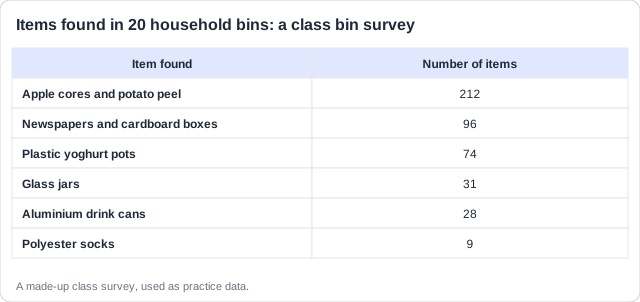
Table of items found in household bins by a class survey: apple cores and potato peel, newspapers and cardboard boxes, plastic yoghurt pots, glass jars, aluminium drink cans, polyester socks
Figure 1: a class bin survey (made-up practice data).
IB-style questionState[1 mark]

A class sorted the contents of household bins (Figure 1).

State two non-biodegradable materials present in the solid domestic waste.

Model answer plan

See the mark-by-mark plan — for / against / judgement, with marking guidance — in study mode.

Claim your free topic

Try an IB Exam Question — Free AI Feedback

Test yourself on What is in solid domestic waste. Write your answer and get instant AI feedback — just like a real IB examiner.

A city council collects bins from homes, shops and offices every week.

the term municipal solid waste (MSW).
[2 marks]

Related ESS Topics

Continue learning with these related topics from the same unit:

7.1.1Natural resources
7.1.2Natural capital
7.1.3Natural income
7.1.4Natural capital as a perspective
View all ESS topics

Practice with flashcards

Spaced repetition flashcards for What is in solid domestic waste

Improve your exam technique

Command terms, paper structure, and mark-scheme tips for ESS

Previous
7.3.1Types of waste
Next
How waste varies7.3.3

6 practice questions on What is in solid domestic waste

Students who practiced this topic on Aimnova scored 82% on average. Try free practice questions and get instant AI feedback.

Try 3 Free QuestionsView All ESS Topics