Everything we use starts in nature: Natural resources are the raw materials and sources of energy used and consumed by society.
The points to remember
- A natural resource comes from nature and is used by people.
- It is a raw material (to make things) or a source of energy (to power things).
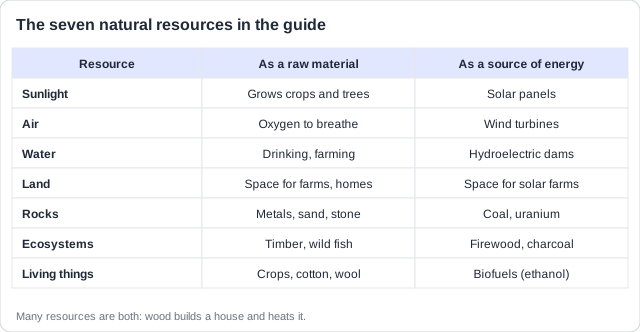
- The guide lists sunlight, air, water, land, rocks, ecosystems and living things.
- Society uses and consumes them: oil burned in a car is gone; land can be used again.
Remember it as: Seven to learn: sun, air, water, land, rocks, ecosystems, living things.
Real example: a smartphone needs copper for its wires, lithium and cobalt for its battery, gold for its circuits and sand for its glass screen. Its plastic is made from oil. Charging it uses electricity made from coal, gas, wind or sunlight.
Define it in two halves: A definition needs both halves: it comes from nature, and it is used by society as a raw material or a source of energy.
Free preview
This is the free notes preview
You're reading the free notes. Aimnova Pro unlocks the full study experience — and you can try it with your first topic free to keep:
- FlashcardsLock in vocabulary and key terms with spaced repetition.
- Practice questionsAnswer exam-style questions and get instant AI marking.
- Mock exams & past-paper vaultSit full mocks and see exactly how examiners award marks.
- Personalised study planA daily plan built around your exam date and weak areas.
Sort every resource by what society does with it: makes things from it, or gets energy from it.
Raw material or source of energy?
- Raw materials are made into goods: timber, metals, cotton, sand for glass and concrete.
- Sources of energy power society: sunlight, wind, falling water, coal, oil, gas, uranium.
- Ecosystems and living things give food, timber, fibres and fuel.
- Many resources are both: wood builds a house and heats it; water is drunk and turns turbines.
- Freshwater is scarce: only about 2.5% of Earth's water is fresh, and most of that is ice.
Real example: Sweden's forests cover about two thirds of the country. They give timber for houses and furniture and pulp for paper, and the leftover branches and sawdust are burned to heat homes. One ecosystem gives raw materials and energy.
Name the resource, not the product: Electricity, petrol and steel are made by people. The natural resources are the falling water, the crude oil and the iron ore they come from.
Know your predicted grade
Take timed mock exams and get detailed feedback on every answer. See exactly where you're losing marks.
Used and consumed: Society is using more natural resources every year, and some places use far more than others.
How much we use
- World extraction of materials tripled: about 31 billion tonnes in 1970, about 95 billion in 2020.
- Why: more people, higher living standards, growing cities and industry.
- Use is uneven: high-income countries use about six times more materials per person than low-income ones.
- Using a resource can use it up (coal burned) or wear it down (soil, fish stocks).
Real example: in 1970 the world extracted about 8.4 tonnes of materials for every person on Earth. By 2020 it was about 13.2 tonnes per person, while the number of people had also doubled. That is why total use tripled.
Use the data: When a figure shows resource use, quote two numbers and give a cause: more people, richer people, or bigger cities.
How this comes up: Paper 1 or Paper 2 Section A: short questions that ask you to name resources and say how society uses them.
A family in Lagos, Nigeria, cooks on charcoal, drinks water from a well, eats fish from the lagoon and lives in a concrete house.
Outline four natural resources the family uses, stating whether each is a raw material or a source of energy.
Model answer plan
See the mark-by-mark plan — for / against / judgement, with marking guidance — in study mode.