Nature's bank account: Natural capital is the stock of natural resources available on Earth.
The points to remember
- Natural capital is the stock of natural resources on Earth: what is there now.
- It works like money in a bank: a stock that can give an income each year.
- It can be living (a forest, a fish population) or non-living (groundwater, ice, metal ores).
- It is measured as an amount: hectares of forest, tonnes of fish, cubic metres of water.
- If the stock shrinks, there is less to use in the future.
Remember it as: Capital is the stock; income is what the stock gives each year.
Real example: about 1,400 glaciers in the Swiss Alps store fresh water as ice. Their meltwater feeds the Rhine and the Rhône. In 2022 and 2023 alone they lost about 10% of their volume: this natural capital is shrinking.
Free preview
This is the free notes preview
You're reading the free notes. Aimnova Pro unlocks the full study experience — and you can try it with your first topic free to keep:
- FlashcardsLock in vocabulary and key terms with spaced repetition.
- Practice questionsAnswer exam-style questions and get instant AI marking.
- Mock exams & past-paper vaultSit full mocks and see exactly how examiners award marks.
- Personalised study planA daily plan built around your exam date and weak areas.
The guide asks for local examples of three types of natural capital. Sort them by whether, and how, the stock renews.
Three types of natural capital
- Living natural capital grows and reproduces: forests, fish stocks, farm soils' life, wild plants.
- Non-living capital renewed by natural cycles: fresh water in rivers and aquifers, the ozone layer.
- Non-living capital that does not renew in a human lifetime: oil, coal, metal ores, sand and gravel.
- Find all three locally: a wood or park, a river or aquifer, a quarry or mine.
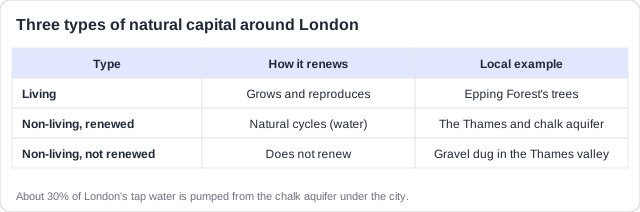
Real example: about 30% of London's tap water is pumped from the chalk aquifer under the city; the rest comes from the Thames and the Lee. Rain refills it each winter.
Three different types: Three examples of the same type, such as three forests, show only one type. Pick one living, one renewed by cycles, one that does not renew.
Feeling unprepared for exams?
Get a clear study plan, practice with real questions, and know exactly where you stand before exam day. No more guessing.
Stock or flow?: Questions often give a fact file and ask for natural capital. Separate the stock from what it yields.
Capital or income?
- Capital = the stock in the place: ice, water, nutrients, sediment, soil, trees, the fish population.
- Income = what flows from it: the fish caught, the timber cut, the electricity made, the tourism money.
- Asked for natural capital? Name the stock, never the income.
- Mentioning a use is fine: 'water, used for hydropower' still names the capital, the water.
Natural capital (the stock)
- Corals that build the reef
- Fish populations on the reef
- Sand and sediment
Natural income (the yield)
- Fish caught and sold
- Money from diving tourists
- Coast protected from waves
Real example: on the Great Barrier Reef the corals and the fish populations are the capital; the fish caught and the money tourists spend are the income.
Not income: Tourism, hydroelectric power and money earned are income, not capital. They score nothing when the question asks for natural capital.
How this comes up: Paper 1, from the resource booklet: identify forms of natural capital in a fact file.
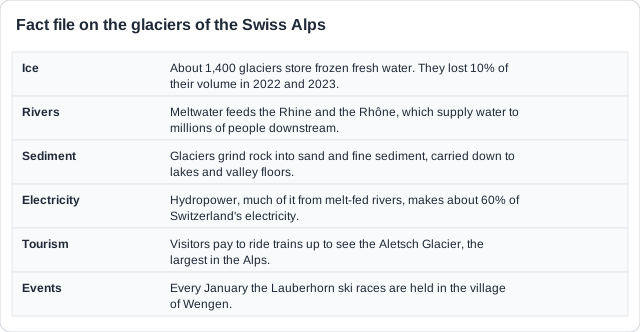
Figure 1 is a fact file on the glaciers of the Swiss Alps.
With reference to Figure 1, identify two forms of natural capital provided by the glaciers.
Model answer plan
See the mark-by-mark plan — for / against / judgement, with marking guidance — in study mode.