Living with a changing climate: Even if every emission stopped today, the climate would keep changing for decades. Adaptation prepares people for that.
The points to remember
- Adaptation: reducing the harmful effects of climate change and making the most of any positive ones.
- It is needed because some warming is locked in: CO2 stays in the air for centuries.
- The oceans have stored heat that will keep warming the climate, and impacts are already happening.
- Reactive adaptation responds to impacts already felt; anticipatory prepares for expected ones.
- Planned adaptation is decided by governments; autonomous is done by people on their own.
- Positive effects can be used too: longer growing seasons, new crops, new sea routes.
Remember it as: Mitigation stops the fire; adaptation is the smoke alarm and the sprinklers.
Real example: warmer summers have helped wine growing spread across southern England, where the vineyard area has grown several times over since 2000. Farmers are using a positive consequence of climate change: grapes now ripen where they rarely did before.
Free preview
This is the free notes preview
You're reading the free notes. Aimnova Pro unlocks the full study experience — and you can try it with your first topic free to keep:
- FlashcardsLock in vocabulary and key terms with spaced repetition.
- Practice questionsAnswer exam-style questions and get instant AI marking.
- Mock exams & past-paper vaultSit full mocks and see exactly how examiners award marks.
- Personalised study planA daily plan built around your exam date and weak areas.
The guide splits adaptation into two kinds. The first is to build something.
Structural adaptation
- Structural adaptation = building physical infrastructure.
- Flood defences: sea walls, levees, dykes and storm-surge barriers hold back the water.
- Desalination plants turn seawater into fresh water where droughts cut supplies.
- Movable infrastructure: barriers that rise only in storms, floating or movable buildings.
- Also: reservoirs and rainwater tanks, green roofs and shaded streets against heat.
- Usually expensive, so richer places build more of it.

Real example: London's Thames Barrier has closed over 220 times since 1982 to stop surge tides flooding the city. In Singapore, five desalination plants can supply up to 30% of the country's water, so a drought cannot leave it without water.
Learn what examiners really want
See exactly what to write to score full marks. Our AI shows you model answers and the key phrases examiners look for.
Change what people do: The second kind builds nothing big. It changes farming, health care, laws and plans, and is often much cheaper.
Non-structural adaptation
- Non-structural adaptation = changing how people act: practices, rules and knowledge.
- Farming practices: drought-resistant crops, new planting dates, drip irrigation, mixed crops, agroforestry.
- Vaccination against diseases that spread as the climate warms, e.g. dengue and malaria.
- Land zoning: rules that stop homes being built on floodplains or eroding coasts.
- Building codes: new buildings must resist storms, floods and heat.
- Also: early warning systems, heat alerts, managed retreat, wetland restoration.
Real example: in Kenya, many smallholder farmers now plant drought-tolerant maize varieties bred to give a harvest even when the rains are short, and use drip irrigation to put water straight onto the roots.
Adaptation or mitigation?: A green roof can be both. In an adaptation answer, say how it reduces the impact: it cools the building in a heatwave. Saying it saves energy makes it mitigation.
Adaptation can protect some people and harm others. Judge each strategy against five tests.
Is it a good adaptation?
- Effectiveness: does it reduce the harm, and for how long?
- Cost: can the place afford it? Poorer countries often cannot.
- Equity: does it protect everyone, or only those who can pay? (environmental justice)
- Sustainability: will it still work as the climate keeps changing?
- Maladaptation: does it cause new problems, here or somewhere else?
Fair adaptation
- Flood defences protect a poor neighbourhood
- Desalination: more water, lower prices
- Drought crops: food for everyone
- Vaccines: health for the whole population
Unfair or harmful
- Defences only for rich districts
- Water priced out of reach
- A sea wall moves erosion next door
- Poor countries cannot afford it
Real example: in 1991 rock groynes were built to protect the village of Mappleton on the Yorkshire coast. They trapped sand there, but the coast just to the south, at Cowden, lost its beach and began eroding faster: maladaptation.
Environmental justice: Name the strategy, then say who it helps and how: 'Drought-resistant crops give food security to the whole population, including the poorest farmers.'
Never wonder what to study next
Get a personalized daily plan based on your exam date, progress, and weak areas. We'll tell you exactly what to review each day.
What do people think?: Before a school or town spends money on a climate solution, it can find out what people think with a survey.
Designing a survey on a proposed solution
- Start with a clear question about one proposed solution, e.g. solar panels on the school roof.
- Choose a representative sample: enough people, from every group (year groups, staff, parents).
- Use closed questions (a five-point scale from 'strongly agree' to 'strongly disagree') to count.
- Add one open question ('Why?') to learn the reasons behind the views.
- Word questions neutrally, and test them on a few people first (a pilot).
- Show the results as a bar chart or percentages, and say what they suggest.
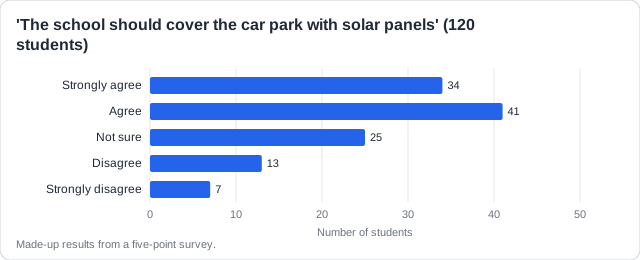
Real example: the UN Development Programme's Peoples' Climate Vote of 2021 asked 1.2 million people in 50 countries the same questions, many through mobile phone games. 64% said climate change is a global emergency.
How this comes up: Paper 2, Section A: a 2-mark outline, one mark for a named strategy, one for how it is fair.
In the Sahel region of Africa, rains have become less reliable, and the poorest families suffer most when harvests fail.
Outline how a named adaptation strategy contributes to the achievement of environmental justice.
Model answer plan
See the mark-by-mark plan — for / against / judgement, with marking guidance — in study mode.