The edge of our world: The atmosphere is a thin skin of gases wrapped round the Earth. It is where the planet ends and space begins, and it is the outer edge of the biosphere.
The points to remember
- The atmosphere is the layer of gases around the Earth, held in place by gravity.
- It is the boundary between Earth and space: the air thins with height until almost none is left.
- Space is usually said to begin about 100 km up.
- It is the outer limit of the biosphere: almost all life lives in the lowest few kilometres.
- Troposphere (0 to about 12 km): our weather, about 75% of the air, almost all the water vapour.
- In the troposphere air gets colder with height, about 6.5 °C per km, because the ground warms it.
- Stratosphere (12 to 50 km): the ozone layer; it gets warmer with height, as ozone absorbs UV; no weather.
Remember it as: Weather down low, ozone up high: troposphere, then stratosphere.
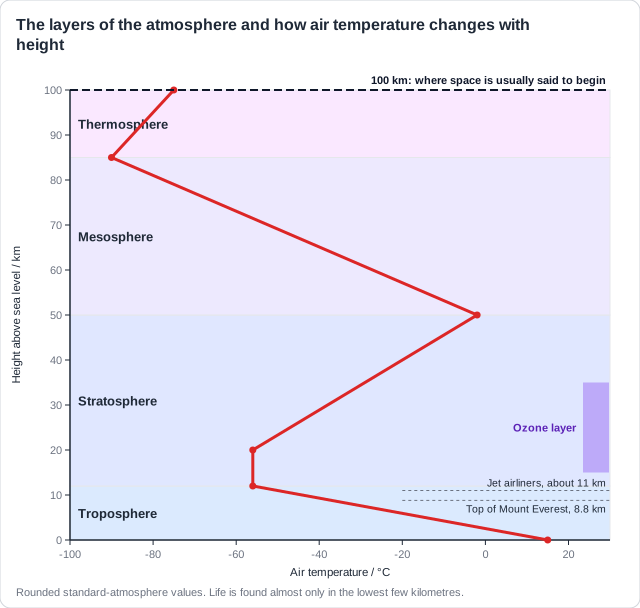
Higher up
- Mesosphere (50 to 85 km): colder again; meteors burn up here
- Thermosphere (above 85 km): auroras; satellites orbit in it
Do not mix them up
- Greenhouse effect: works in the troposphere, keeps Earth warm
- Ozone layer: in the stratosphere, blocks UV
Real example: in 1973 a Rüppell's vulture hit a passenger plane flying at 11.3 km over Abidjan, Côte d'Ivoire: the highest bird ever recorded. That is near the top of the troposphere, the edge of life. Climbers on Mount Everest (8.8 km) carry bottled oxygen, because each breath there holds only about a third of the oxygen it would at sea level.
Free preview
This is the free notes preview
You're reading the free notes. Aimnova Pro unlocks the full study experience — and you can try it with your first topic free to keep:
- FlashcardsLock in vocabulary and key terms with spaced repetition.
- Practice questionsAnswer exam-style questions and get instant AI marking.
- Mock exams & past-paper vaultSit full mocks and see exactly how examiners award marks.
- Personalised study planA daily plan built around your exam date and weak areas.
The air is not one gas but a mixture. Two gases make up almost all of it; a few others are there in tiny amounts but still matter a great deal for life.
What the air is made of
- The atmosphere is a mixture of gases, not one gas.
- Nitrogen about 78% and oxygen about 21%: together about 99% of dry air.
- Argon about 0.9%; carbon dioxide about 0.04%; tiny traces of others, such as methane and ozone.
- Water vapour varies from almost 0 to about 4%, so it is left out of 'dry air'.
- Tiny amounts still matter: carbon dioxide and water vapour keep Earth warm; ozone blocks UV.
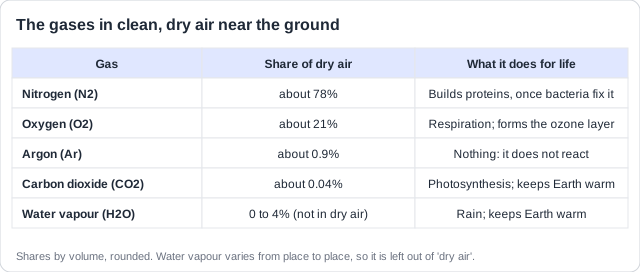
Real example: over the Atacama Desert the air holds almost no water vapour, while the steamy air over the Amazon rainforest holds about 3 to 4%. The nitrogen and oxygen are the same in both places: only the water vapour changes.
Learn two numbers: Nitrogen about 78%, oxygen about 21%. An answer that names a gas with its share, 'oxygen, about 21%', shows you know the composition, not just the names.
Feeling unprepared for exams?
Get a clear study plan, practice with real questions, and know exactly where you stand before exam day. No more guessing.
A life-support system: Without its atmosphere the Earth would be a frozen, lifeless rock. The gases it holds, and what they do, keep living things alive.
How the atmosphere supports life
- Oxygen for respiration; carbon dioxide for photosynthesis.
- Nitrogen, once bacteria or lightning fix it, builds proteins.
- Greenhouse gases keep the surface about 15 °C on average, instead of about -18 °C.
- The ozone layer absorbs most of the Sun's harmful UV, which damages DNA.
- Air pressure keeps water liquid; the air carries water vapour that falls as rain.
- Most rocks from space burn up in the air before they reach the ground.
- Link each one to its outcome: 'ozone absorbs UV, so less DNA damage and skin cancer'.
Remember it as: Breathe, grow, warm, shield, water: five jobs of the air.
Gases to use
- Oxygen for respiration
- Carbon dioxide for photosynthesis
- Nitrogen for proteins
Protection
- Ozone absorbs UV
- Rocks from space burn up
- Greenhouse gases keep it warm
Water
- Pressure keeps water liquid
- Water vapour falls as rain
- Winds carry it inland
Real example: in February 2013 a rock about 20 m wide entered the air over Chelyabinsk, Russia. Friction with the air heated it until it exploded about 30 km up. Its shock wave broke windows, but almost all of the rock had broken up in the atmosphere.
Function, then outcome: 'The atmosphere protects us' is too vague. Name the part and what it does: 'the ozone layer absorbs UV, so less of it reaches the ground to damage DNA'.
The gases do not stay where they are released. Convection and wind keep stirring the air, so it is shared by the whole planet.
Wind shares out the air
- The gases are redistributed by physical processes: wind and convection (warm air rising).
- Winds mix the lower air, so its make-up is almost the same everywhere on Earth.
- Wind also carries water vapour, heat, dust and pollution far from where they started.
- A gas released in one place, such as carbon dioxide from a power station, spreads round the planet within about a year.
Remember it as: One air for the whole planet: the wind shares it out.
Real example: in June 2023, smoke from hundreds of wildfires in Quebec, Canada, blew south on the wind. New York's sky turned orange, and for a day its air was among the most polluted of any big city in the world, hundreds of kilometres from the fires.
Use the guide's words: Say that gases are redistributed by physical processes such as wind, then name what was moved and how far.
Memorize terms 3x faster
Smart flashcards show you cards right before you forget them. Perfect for definitions and key concepts.
How this comes up: Paper 2, Section B (a): four separate ways the atmosphere supports life, each linked to its outcome.
The International Space Station orbits about 400 km up, above almost all of the atmosphere. Its crew must take their own air, water and protection with them.
Outline four ways in which the atmosphere supports life on Earth.
Model answer plan
See the mark-by-mark plan — for / against / judgement, with marking guidance — in study mode.