Catch and throw back: Some gases in the air let sunlight through but catch the heat rising from the ground and send part of it back down. They are the greenhouse gases.
The points to remember
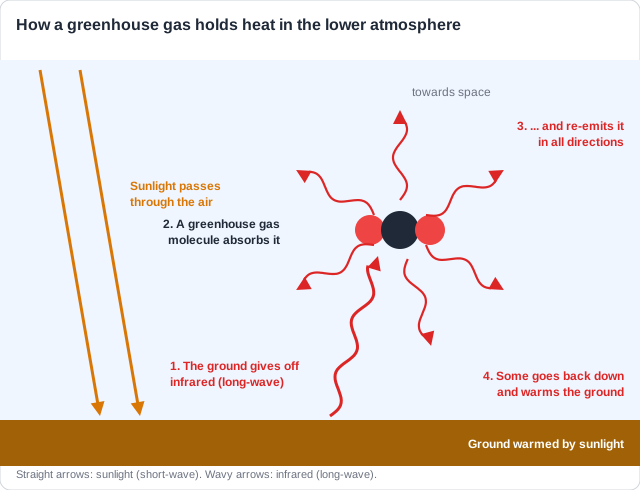
- Sunlight passes through the air and warms the ground.
- The warm ground gives off infrared (long-wave) radiation: heat you cannot see.
- Greenhouse gases (GHGs) and some aerosols absorb some of this outgoing infrared ...
- ... then re-emit it in all directions, some of it back down towards the ground.
- So less infrared escapes to space, and heat is held in the lower atmosphere.
- Evidence CO2 is a GHG: it absorbs outgoing infrared, and rising CO2 matches rising global temperature.
Remember it as: Light in, infrared out: the gases catch it and throw some back.
Real example: in 1859 John Tyndall shone heat through tubes of different gases in his London laboratory. Nitrogen and oxygen let it straight through, but carbon dioxide and water vapour absorbed it: the first proof that these gases trap heat.
Absorb, not reflect: GHGs absorb outgoing infrared and re-emit it. They do not 'reflect' heat, and they let most incoming sunlight pass.
Free preview
This is the free notes preview
You're reading the free notes. Aimnova Pro unlocks the full study experience — and you can try it with your first topic free to keep:
- FlashcardsLock in vocabulary and key terms with spaced repetition.
- Practice questionsAnswer exam-style questions and get instant AI marking.
- Mock exams & past-paper vaultSit full mocks and see exactly how examiners award marks.
- Personalised study planA daily plan built around your exam date and weak areas.
Several gases do this job. Some are common, some are rare but very strong, and people have added more of each. Each one adds to radiative forcing.
The greenhouse gases
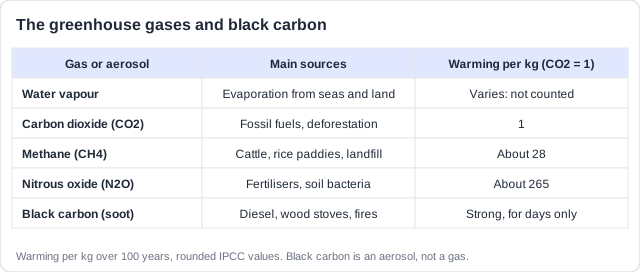
- The four GHGs to learn: water vapour, carbon dioxide, methane and nitrous oxide (N2O).
- Carbon dioxide and water vapour are the most abundant GHGs.
- Methane is scarce but warms a lot: each kg traps about 28 times as much heat as CO2 over 100 years.
- Nitrous oxide traps about 265 times as much per kg; it comes from fertilisers and soil bacteria.
- Other gases add warming too (radiative forcing): ozone near the ground, CFCs and HFCs.
- Asked for 'a greenhouse gas'? Write one: only the first gas you name is marked.
Real example: a dairy cow burps out about 100 kg of methane a year. Microbes in its stomach make the gas as they break down grass. The world's 1.5 billion cattle are one of the biggest human sources of methane.
Name the main four: When a question asks for the main greenhouse gases, give water vapour, carbon dioxide, methane and nitrous oxide. CFCs and ozone near the ground are human-made extras.
Learn what examiners really want
See exactly what to write to score full marks. Our AI shows you model answers and the key phrases examiners look for.
Water vapour: strong but different: Water vapour absorbs more of the outgoing infrared than any other gas, yet it is treated differently from carbon dioxide and methane. The reason: the temperature controls how much there is.
Why water vapour is a special case
- Water vapour is a significant GHG: it absorbs a large share of the outgoing infrared.
- Its amount depends on temperature: warmer air can hold more water vapour.
- It is dynamic: water evaporates and falls as rain within days.
- So it changes as a result of warming, and climate models usually leave it out as a cause.
- It is essential for life and people cannot cut it, so it cannot be mitigated.
Remember it as: Water vapour follows the warming; it does not lead it.
Real example: in winter in Yakutsk, Siberia, at about -40 °C, the air can hold almost no water vapour. Over the Red Sea in summer, at about 35 °C, the air holds about 4%. The warmer the air, the more water vapour it can carry.
Do not say 'cut water vapour': Water vapour cannot be mitigated: it is part of the water cycle and essential for life. Cuts aim at carbon dioxide, methane, nitrous oxide and black carbon.
Not everything that holds heat is a gas. An aerosol can do it too, and the guide names one: black carbon, the soot from smoky fires and engines.
Aerosols and black carbon
- An aerosol is a mass of tiny solid or liquid particles floating in the air.
- Black carbon (soot) comes from burning diesel, wood, coal or forests incompletely.
- It absorbs sunlight and infrared, warming the air around it.
- When it settles on snow and ice, it darkens them: they reflect less and melt faster.
- It stays in the air for only days to weeks, so cutting it slows warming quickly.
- Other aerosols, such as sulfate from volcanoes, reflect sunlight and cool the Earth.
Black carbon (soot)
- Absorbs sunlight and infrared
- Warms the air
- Darkens snow and ice
Sulfate (from volcanoes)
- Reflects sunlight
- Cools the surface
- Lasts a year or two high up
Real example: soot from cooking fires, brick kilns and diesel engines in South Asia blows onto Himalayan glaciers. The darkened ice absorbs more sunlight and melts faster, and these glaciers feed rivers that hundreds of millions of people depend on.
Never wonder what to study next
Get a personalized daily plan based on your exam date, progress, and weak areas. We'll tell you exactly what to review each day.
How this comes up: Paper 2, Section A: short parts of one or two marks, often beside a figure about climate change.
At the Sleipner gas field in the North Sea, Norway has pumped about a million tonnes of carbon dioxide a year back underground since 1996, to keep it out of the atmosphere.
Outline two pieces of evidence that carbon dioxide acts as a greenhouse gas.
Model answer plan
See the mark-by-mark plan — for / against / judgement, with marking guidance — in study mode.