Treat the cause, or live with the effects: Mitigation tackles the cause; adaptation copes with the effects.
The points to remember
- Mitigation reduces the cause of climate change: it cuts greenhouse gases or removes CO2 from the air.
- Adaptation reduces the negative impacts, or makes the most of the positive ones: it deals with effects.
- Mitigation benefits everyone and needs global cooperation; adaptation mostly helps one place.
- Both are needed: some warming is already locked in.
- A strategy can do both, e.g. a green roof cools a building (adaptation) and cuts energy use (mitigation).
Remember it as: Mitigation fixes the cause; adaptation copes with the effects.
Real example: at Norway's Sleipner gas field, about a million tonnes of carbon dioxide a year has been pumped under the North Sea since 1996: mitigation, because it keeps the gas out of the air. London's Thames Barrier, closed over 220 times since 1982 to stop surge tides, is adaptation: it protects the city from the effects.
Free preview
This is the free notes preview
You're reading the free notes. Aimnova Pro unlocks the full study experience — and you can try it with your first topic free to keep:
- FlashcardsLock in vocabulary and key terms with spaced repetition.
- Practice questionsAnswer exam-style questions and get instant AI marking.
- Mock exams & past-paper vaultSit full mocks and see exactly how examiners award marks.
- Personalised study planA daily plan built around your exam date and weak areas.
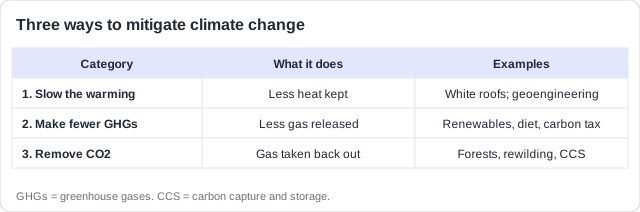
The first category does not cut greenhouse gases at all. It changes how much of the Sun's energy the Earth keeps.
Category 1: slowing the warming process
- Category 1 reduces the process of warming: less of the Sun's energy is kept.
- Household changes: pale or 'cool' roofs and walls reflect sunlight, so buildings need less cooling.
- Geoengineering: deliberate, large-scale changes to the climate system.
- e.g. spraying aerosols into the stratosphere, or brightening clouds so they reflect more sunlight.
- Risks: CO2 keeps rising, so ocean acidification goes on; side effects on rain are unknown.
- If it stopped suddenly, the hidden warming would return fast (termination shock).
Geoengineering: for
- Could cool the Earth quickly
- Cheap compared with cutting emissions
- Buys time
Geoengineering: against
- CO2 and acidification continue
- Unknown effects on rain
- Who controls the planet's thermostat?
Real example: since 2009, New York City's CoolRoofs programme has painted over 12 million square feet of roofs with a white, reflective coating. The buildings absorb less sunlight, cutting their cooling costs by 10-30%, so less electricity is burned for air conditioning.
Name the category: When asked for strategies from different categories, say which category each belongs to and how it works: reflect sunlight, cut emissions, or remove carbon dioxide.
Practice with exam-style questions
Answer exam-style questions and get AI feedback that shows you exactly what examiners want to see in a full-marks response.
Make less of the gas: Most mitigation stops greenhouse gases being made in the first place: in power stations, cars, homes, factories and farms.
Category 2: producing fewer greenhouse gases
- Category 2 reduces the production of greenhouse gases at the source.
- Energy efficiency: insulation, LED lights and efficient machines use less fuel.
- Renewable energy (and low-carbon nuclear, despite its waste, safety and cost issues).
- Food choice: less beef and dairy means less methane and less forest cleared.
- Farming changes: less fertiliser (nitrous oxide), better livestock feed, wetting and drying rice.
- Carbon tax: a price per tonne of CO2 makes fossil fuels dearer, so people and firms cut use.
- Also: public transport, cycling, electric vehicles, recycling and fuel switching in industry.
Real example: Sweden introduced a carbon tax in 1991, starting at about €23 per tonne of carbon dioxide and rising to about €120, one of the highest in the world. Between 1990 and 2013 its economy grew by about 61% while its greenhouse gas emissions fell by about 23%.
Percentage reduction: % reduction = (fall ÷ original) × 100. A coal plant releasing 900 tonnes of CO2 a day is replaced by a wind farm releasing 90: fall = 810, so (810 ÷ 900) × 100 = 90%.
The third category takes carbon dioxide back out of the air, by nature or by machine.
Category 3: removing carbon dioxide
- Category 3 removes CO2 already in the atmosphere.
- Carbon sinks: forests, soils, peat bogs, mangroves, seagrass and kelp absorb CO2 by photosynthesis.
- Afforestation (new forest) and reforestation (replanting cleared land).
- Rewilding: restore species and habitats, e.g. more sea otters eat urchins, so kelp regrows and absorbs more CO2.
- Carbon capture and storage (CCS): trap CO2 at a power station or gas field and pump it underground.
- Direct air capture: machines filter CO2 out of the air (very expensive, small so far).
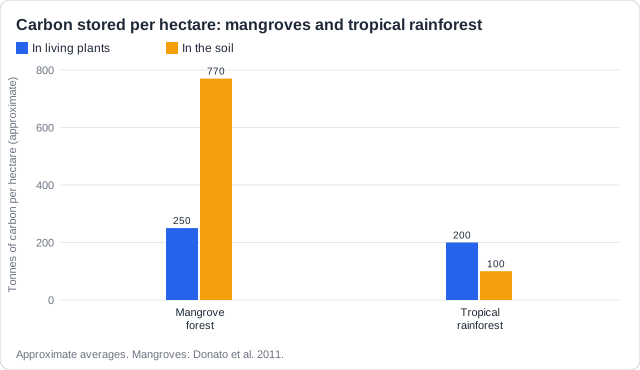
Reading the graph: Read the bars side by side: per hectare, mangroves store about three times as much carbon as rainforest, mostly in waterlogged soil where it does not rot. But rainforests cover a far larger area of the world, so in total they hold much more.
Real example: Costa Rica's forest cover fell to about 22% in 1987. The government then paid landowners to plant and protect trees and in 1996 banned clearing mature forest; by 2010 forest covered about 53% of the country, a growing carbon sink.
Feeling unprepared for exams?
Get a clear study plan, practice with real questions, and know exactly where you stand before exam day. No more guessing.
Judge a strategy, do not just describe it: Papers ask you to evaluate one strategy, often reforestation. Give points on both sides, then a judgement.
Reforestation: strengths
- Absorbs CO2 by photosynthesis
- Increases biodiversity
- Little technology or cost
- A renewable sink that lasts
- Holds soil: less erosion
- More cloud may raise albedo
Reforestation: limitations
- Darker trees absorb more heat
- More water vapour (a GHG)
- Takes farmland or building land
- Needs very large areas
- Slow: decades to grow
- Can burn, releasing the carbon
Five tests for any strategy
- Effectiveness: how much CO2 does it cut or remove, and for how long?
- Cost: who pays, and can poorer countries afford it?
- Feasibility: is the technology ready, is there land, will people accept it?
- Time scale: trees take decades; a carbon tax works as soon as prices change.
- Side effects: jobs, health, wildlife, water, food prices.
Real example: Kenya's Green Belt Movement, founded by Wangari Maathai in 1977, has planted over 50 million trees. They absorb carbon dioxide and hold the soil, and women earn money growing seedlings; but each tree takes years to store much carbon, and some seedlings die in drought.
Too vague to count: 'Trees improve air quality' or 'reduce pollution' do not count: link every point to carbon dioxide, heat, land or time.
Which strategies a society chooses depends on its values, and a real country's plan is usually a mix that works in some sectors and not in others.
Strategies and value systems
- Ecocentric mitigation: use less energy, eat less meat, protect forests, small local renewables.
- Technocentric mitigation: CCS, geoengineering, nuclear power, ocean fertilisation.
- Technocentric adaptation: sea walls, desalination, vaccines; ecocentric: mangroves, local crops.
- Anthropocentric tools: carbon taxes, emissions trading, laws, international agreements.
- So 'mitigation is ecocentric, adaptation technocentric' is only partly true.
Test the claim both ways: In an essay on values, find the exceptions: technocentric mitigation (CCS) and ecocentric adaptation (mangroves) show the claim is only partly true.
Limiting the harm without burning less fossil fuel
- Capture CO2 (CCS) or plant trees to absorb it.
- Clean exhausts: scrubbers on power stations, catalytic converters on cars, low-sulphur coal.
- Repair damage, e.g. add lime to acidified lakes.
- Adapt to the effects: sea defences, vaccination, masks.
- Not efficiency: it works by burning less, which the question rules out.
Real example: California makes about 54% of its electricity from renewable sources, has cut coal to under 1% and will allow only zero-emission new cars from 2035. But about 40% of its electricity still comes from gas, and record wildfires release carbon and destroy forests.
Memorize terms 3x faster
Smart flashcards show you cards right before you forget them. Perfect for definitions and key concepts.
How this comes up: Paper 2, Section A: a 4-mark evaluate question, strengths and limitations of one strategy.
Since 1977 Kenya's Green Belt Movement has planted over 50 million trees on land that had been cleared for farms and firewood.
Evaluate the role of reforestation in the mitigation of climate change.
Model answer plan
See the mark-by-mark plan — for / against / judgement, with marking guidance — in study mode.