A safe operating space: The planetary boundaries model sets a safe limit for each process. Climate change is one of the nine.
The points to remember
- Inside the limits is a safe operating space for humanity.
- Past a limit, the risk of large, possibly irreversible change rises.
- Each boundary is measured with a control variable.
- Limits are set with the precautionary principle: at the low end of the danger range.
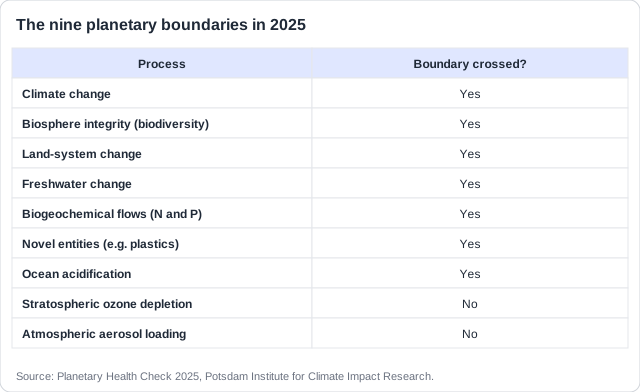
Real example (SL): the model was published in 2009 by a team of scientists led by Johan Rockström of the Stockholm Resilience Centre. Even then, they judged that the climate boundary had already been crossed.
Free preview
This is the free notes preview
You're reading the free notes. Aimnova Pro unlocks the full study experience — and you can try it with your first topic free to keep:
- FlashcardsLock in vocabulary and key terms with spaced repetition.
- Practice questionsAnswer exam-style questions and get instant AI marking.
- Mock exams & past-paper vaultSit full mocks and see exactly how examiners award marks.
- Personalised study planA daily plan built around your exam date and weak areas.
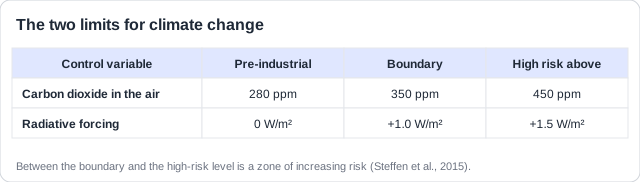
The climate boundary has two limits. Crossing either one means the boundary has been passed.
The points to remember
- Carbon dioxide: at most 350 ppm (ppm). Before industry it was 280 ppm.
- Radiative forcing: at most +1.0 W/m².
- Between the boundary and 450 ppm or +1.5 W/m² is a zone of increasing risk.
- The limits are set at the low end of that zone, to be safe.
Remember it as: 350 and 1: the two numbers of the climate boundary.
Real example (SL): why 350 ppm? In 2008 James Hansen and colleagues argued that above about 350 ppm the big ice sheets would slowly melt. About 3 million years ago, when carbon dioxide was near 400 ppm, sea levels were many metres higher than today.
Get feedback like a real examiner
Submit your answers and get instant feedback — what you did well, what's missing, and exactly what to write to score full marks.
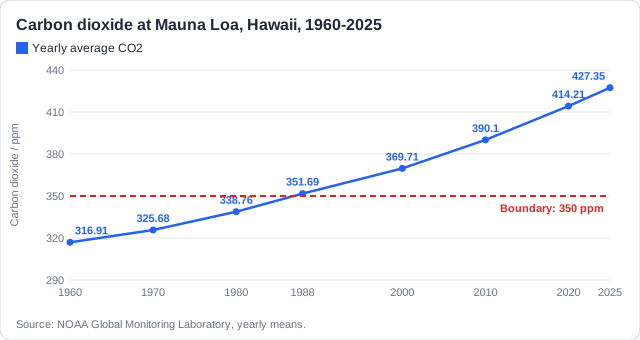
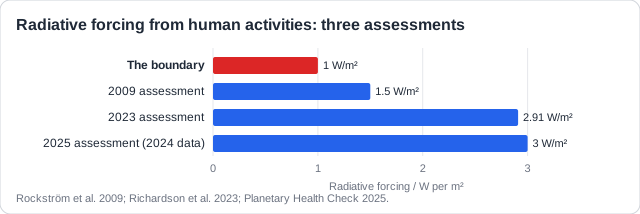
Published measurements show that both limits have been passed, and the gap is still growing.
The points to remember
- Carbon dioxide passed 350 ppm in 1988; in 2025 the yearly average was 427 ppm.
- That is about 22% above the boundary, and it still rises by about 3 ppm a year.
- Radiative forcing is about +3.0 W/m² (2024): three times the limit.
- Both are past the boundary; radiative forcing is past the high-risk level too.
Real example (SL): Charles Keeling began measuring carbon dioxide on Mauna Loa, a volcano in Hawaii, in 1958. His rising, zigzag curve, the Keeling Curve, is the longest direct record we have.
Crossing the boundary does not mean instant disaster. It means we have left the safe zone, and the evidence of harm is growing.
The points to remember
- Global temperature is now more than 1.2 °C above pre-industrial levels; 2024 passed 1.5 °C.
- Ice sheets in Greenland and Antarctica are losing ice; sea level rise is speeding up.
- Extreme events, such as heatwaves, floods and wildfires, are more frequent and intense.
- The risk of passing tipping points, such as ice sheet collapse, rises.
- Carbon dioxide stays in the air for centuries, so the overshoot lasts.
Real example (SL): the World Meteorological Organization reported that 2024 was the first calendar year more than 1.5 °C warmer than before industry, at about 1.55 °C.
Learn what examiners really want
See exactly what to write to score full marks. Our AI shows you model answers and the key phrases examiners look for.
The claim that the boundary has been passed is strong, but the boundary itself has limits.
The evidence is strong
- Direct, long records: Mauna Loa since 1958
- Both limits passed, in every study
- Matches the warming and melting seen
But the boundary has limits
- The exact safe level is uncertain
- One global number hides local harm
- It says nothing of who caused it
The points to remember
- Some argue a temperature limit, such as 1.5 °C or 2 °C, is easier to act on.
- Negative feedback, such as plants taking up carbon dioxide, slows warming a little.
- Fast mitigation (renewables, less methane, forests) can limit the overshoot.
- Getting back below 350 ppm needs net zero and removing carbon dioxide for decades.
Real example (SL): in the 2015 Paris Agreement, almost every country agreed to keep warming well below 2 °C and to try for 1.5 °C: a temperature limit instead of a carbon dioxide one.
How this comes up: Paper 2 Section B (c) [9] asks you to discuss a claim about climate change and tipping points, marked on bands. The best answers argue both sides with named examples and end with a judgement.
Carbon dioxide at Mauna Loa passed 350 ppm in 1988 and reached 427 ppm in 2025.
To what extent is there convincing evidence that the Earth has passed the planetary boundary for climate change?
Model answer plan
See the mark-by-mark plan — for / against / judgement, with marking guidance — in study mode.