Same hazard, different harm: Climate change affects societies at every scale, from one village to the whole world. How much harm it does depends on where people live and how rich they are.
The points to remember
- Scales: local (a flooded town), national (a failed harvest), global (food prices, sea level).
- Socio-economic conditions: wealth, jobs, housing, health care and government.
- Poorer, more exposed societies are usually hit hardest and recover slowest.
- Resilience decides how long the harm lasts.
- Climate justice: impacts are unequal.
Remember it as: Who is hit, how hard, how fast they recover.
Real example (SL): Pakistan, 2022. Record monsoon rain left about a third of the country under water. About 33 million people were affected, at least 1,739 died, and damage and losses passed US$30 billion. Pakistan produces less than 1% of the world's greenhouse gases.
Free preview
This is the free notes preview
You're reading the free notes. Aimnova Pro unlocks the full study experience — and you can try it with your first topic free to keep:
- FlashcardsLock in vocabulary and key terms with spaced repetition.
- Practice questionsAnswer exam-style questions and get instant AI marking.
- Mock exams & past-paper vaultSit full mocks and see exactly how examiners award marks.
- Personalised study planA daily plan built around your exam date and weak areas.
Climate change threatens food security through changing rainfall, heat and extreme events.
The points to remember
- Growing conditions change: some crops fail; growing zones move towards the poles.
- Water stress: droughts cut yields; changing monsoons upset irrigation.
- Extreme weather: floods, storms and heatwaves destroy crops and kill livestock.
- Pests and diseases spread into warmer areas.
- Soil degradation: intense rain erodes soil; drylands face desertification.
- Impacts are uneven: some cold regions gain longer growing seasons.
Real example (SL): the Horn of Africa. From 2020 to 2023, five rainy seasons in a row failed in Somalia, Ethiopia and Kenya. Crops withered and millions of livestock died, leaving millions of people short of food.
Never wonder what to study next
Get a personalized daily plan based on your exam date, progress, and weak areas. We'll tell you exactly what to review each day.
Water security is threatened as rain, snow and ice change.
The points to remember
- Glacier melt: at first more water in rivers, then less as glaciers disappear.
- Changing rainfall: some regions drier, others wetter, with more flooding.
- Groundwater depletion: people pump more during droughts, so water tables fall.
- Saltwater intrusion: rising seas spoil coastal wells and fields.
- Water quality: warmer water grows more algal blooms.
Real example (SL): Cape Town, 2018. After three dry years the city's dams fell so low that it planned for 'Day Zero', when taps would be turned off. People were limited to 50 litres each a day until the rains returned.
Climate change harms health directly, through heat and disasters, and indirectly, through disease and hunger.
The points to remember
- Heat illness: heatstroke, dehydration, strain on the heart, worst for the old and outdoor workers.
- Vector-borne disease: mosquitoes spread malaria and dengue to new, warmer areas.
- Waterborne disease: floods spread cholera and typhoid.
- Air quality: heat raises ground-level ozone; wildfire smoke harms lungs.
- Malnutrition after failed harvests; mental health strain after disasters and loss.
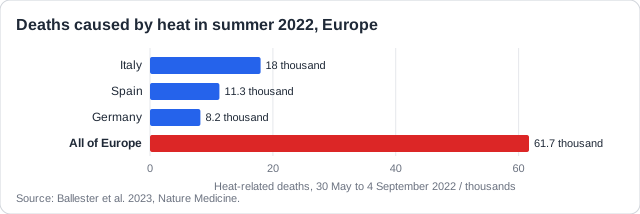
Real example (SL): Europe, 2022. A study in Nature Medicine estimated 61,672 deaths from heat between late May and early September, most of them older people.
Stop wasting time on topics you know
Our AI identifies your weak areas and focuses your study time where it matters. No more overstudying easy topics.
Rising seas, stronger storms and thawing ground damage what societies have built, and can force people to move.
The points to remember
- Coastal flooding threatens ports, cities and roads in low-lying areas.
- Permafrost thaw cracks buildings, roads and pipelines in Arctic regions.
- Storms destroy homes, power lines and bridges.
- Climate refugees or migrants: people forced to move by sea level rise, drought or disasters.
- Economic costs: repairs, lost work, and rising insurance prices.
Real examples (SL): Venice raised its MOSE flood barriers for the first time in October 2020 to hold back high tides. In Louisiana, USA, the community of Isle de Jean Charles, losing its land to the sea, was given US$48 million in 2016 to move inland.
Not every impact is harmful. Some places gain, at least for a while, so questions often ask you to weigh benefits against costs.
Possible benefits
- Longer growing seasons; crops further north or higher up
- Less heating in winter
- More river flow and hydropower at first
- New shipping routes and summer tourism
Common costs
- Lost snow and winter tourism
- Water shortages once glaciers shrink
- Landslides, floods, wildfires, heatwaves
- New pests, diseases and invasive species
Real examples (SL): warmer summers have helped vineyards spread across southern England, now known for sparkling wine. In the Alps, some low ski resorts have closed because the snow no longer lasts.
Benefits often fade: Many benefits are short-term: glacier rivers give more water only until the ice is gone.
See how examiners mark answers
Answer exam-style questions with model answers. Learn exactly what earns marks and what doesn't.
Two societies can face the same storm with very different results. What makes the difference is their resilience.
The points to remember
- Wealth: money for defences, repairs and insurance.
- Infrastructure: strong buildings, drainage, reservoirs, cyclone shelters.
- Early warning and good government: people are told in time and helped to leave.
- Health care and education: fewer deaths, faster recovery.
- Varied livelihoods and strong communities: one failed crop is not a disaster.
Real example (SL): Bangladesh's cyclones. Cyclone Bhola in 1970 killed several hundred thousand people. Since then Bangladesh has built thousands of cyclone shelters and an early warning system; before Cyclone Amphan in 2020 about 2.4 million people were moved, and about 26 died.
How this comes up: Paper 1 ends with a [6] such as 'To what extent will climate change be beneficial for this country?', using the resource booklet: up to 4 marks a side and 1 for a balanced conclusion.
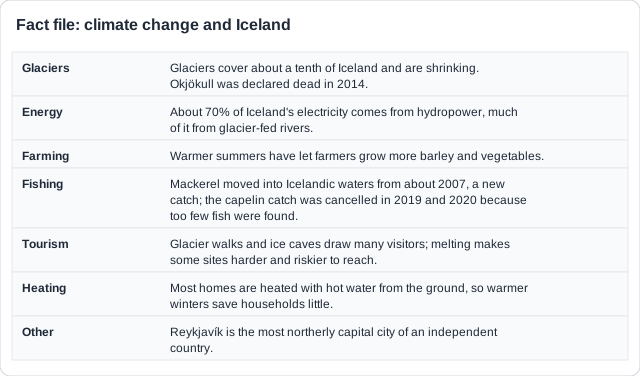
The fact file describes climate change and Iceland.
To what extent will climate change be beneficial for Iceland?
Model answer plan
See the mark-by-mark plan — for / against / judgement, with marking guidance — in study mode.