Climate decides what can grow: Farming looks very different across the world because climates and soils differ. A crop can only grow where it gets the warmth, water and growing season it needs.
The points to remember
- Temperature: crops need warmth; frost kills many and ends the growing season.
- Rainfall: how much falls, and when: a long dry season limits crops.
- Sunlight: long summer days help crops grow fast in high latitudes.
- To read a climate table, find the hottest and coldest months.
- Temperature range = hottest month minus coldest month, with units (°C).
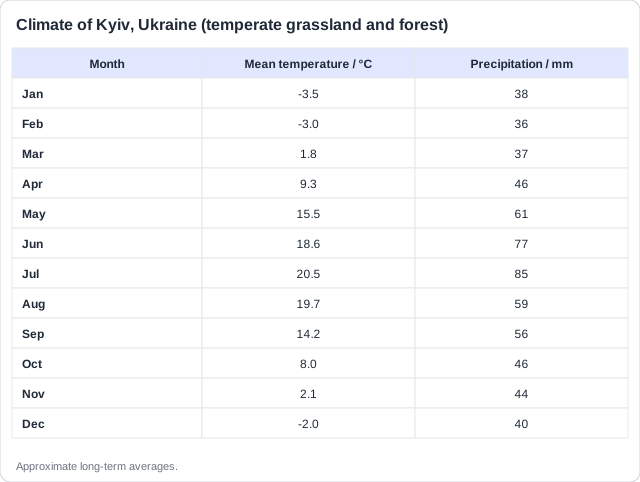
Example (SL): Kyiv, Ukraine. The range is 20.5 - (-3.5) = 24.0 °C. Winters freeze, so farmers sow wheat in autumn or spring and harvest it in the warm, wet summer. Nothing grows outside in January.
Free preview
This is the free notes preview
You're reading the free notes. Aimnova Pro unlocks the full study experience — and you can try it with your first topic free to keep:
- FlashcardsLock in vocabulary and key terms with spaced repetition.
- Practice questionsAnswer exam-style questions and get instant AI marking.
- Mock exams & past-paper vaultSit full mocks and see exactly how examiners award marks.
- Personalised study planA daily plan built around your exam date and weak areas.
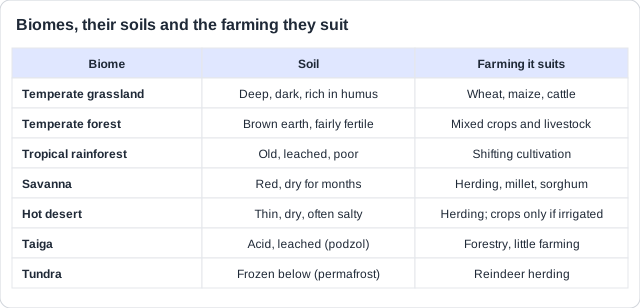
Each biome has its own kind of soil, and the soil decides which crops grow well and how much they yield.
The points to remember
- Temperate grasslands have the deepest, most fertile soils: the world's cereal belts.
- Rainforest soils are poor: most nutrients are in the trees, not the soil.
- Desert soils are thin and dry: crops need irrigation, otherwise herding.
- Taiga soils are acid and summers short: mostly forestry.
- Tundra is frozen below: reindeer herding, not crops.
Remember it as: Rich grassland, poor rainforest, dry desert, cold taiga.
Example (SL): Ukraine's black earth. Much of Ukraine lies on chernozem. It is one of the world's biggest growers of wheat, maize and sunflowers, and is often called the breadbasket of Europe.
Learn what examiners really want
See exactly what to write to score full marks. Our AI shows you model answers and the key phrases examiners look for.
Within one country, farming changes with height and slope. Air cools by about 6.5 °C for every 1,000 metres you climb, and steep slopes are hard to plough.
The points to remember
- Low, flat land: warm, easy to work: big plantations and arable fields.
- Higher land: cooler and often wetter: different crops, such as tea or coffee.
- Steep slopes: terraces or grazing, because ploughing causes erosion.
- Mountains: too cold and steep for most crops: forest or pasture.
- To describe a pattern, say where the crop is found and how it changes with altitude.
Reading a height pattern: Most plantations are found at low altitudes; as altitude increases, there are fewer of them. That one sentence is a full description.
Example (SL): Ethiopia. In the cool highlands, from about 1,500 to 2,000 metres, farmers grow teff and the coffee Ethiopia is famous for. In the hot, dry lowlands of the Afar region, crops fail, so people herd camels and goats.
Because farming varies, so do diets. What people eat depends on what their land and climate can grow, and on much more besides.
The points to remember
- Culture and religion: traditions and rules about food (no pork, no beef, vegetarian).
- Climate, relief and arable land: what the local land can grow.
- Water supply: rice needs a lot; dry lands rely on herds.
- Technology and know-how for certain ways of farming.
- Wealth and the cost of producing or buying food.
- Ideas of healthy eating, values about the environment, and whether food can be imported.
Example (SL): Japan and Mongolia. Japan is a wet island with warm summers, so its diet is built on rice from flooded paddies and fish from the sea. Mongolia is cold, dry grassland, so its diet is built on meat and milk from herds.
Never wonder what to study next
Get a personalized daily plan based on your exam date, progress, and weak areas. We'll tell you exactly what to review each day.
How this comes up: Paper 2 Section A gives a climate table to calculate from [1], or a diet to compare [2]; Paper 1 can give maps of biomes and land use.
The typical diet in Japan is built on rice, fish, vegetables and soya foods.
Outline two reasons why the typical diet in other regions of the world may differ from the Japanese diet.
Model answer plan
See the mark-by-mark plan — for / against / judgement, with marking guidance — in study mode.