Food security: Food security is the physical and economic availability of food, so that every person can get the balanced diet they need for an active and healthy life.
The points to remember
- Physical availability: enough food is actually there, grown locally or brought in.
- Economic availability: people can afford it or get it another way.
- Balanced diet: enough of the right foods, not just enough calories.
- All individuals: a country can have plenty while some of its people go hungry.
- It must last all the time, not only after a good harvest.
Remember it as: There, affordable, balanced, for everyone.
Example (SL): Singapore. It farms only about 1% of its land and imports more than 90% of its food, yet it is food secure: it is rich enough to buy food from about 180 countries and regions.
Free preview
This is the free notes preview
You're reading the free notes. Aimnova Pro unlocks the full study experience — and you can try it with your first topic free to keep:
- FlashcardsLock in vocabulary and key terms with spaced repetition.
- Practice questionsAnswer exam-style questions and get instant AI marking.
- Mock exams & past-paper vaultSit full mocks and see exactly how examiners award marks.
- Personalised study planA daily plan built around your exam date and weak areas.
Physical availability fails when food cannot be grown, stored or delivered.
The points to remember
- Low production: poor soils, drought, floods, pests.
- Conflict: farmers flee, fields and markets are destroyed, aid is blocked.
- Poor roads and storage: food spoils or cannot reach markets.
- Few imports: countries that cannot buy or ship food in run short.
- Shocks: a bad harvest or a blocked port can empty markets fast.
Example (SL): Haiti. In the Caribbean, the region's worst-hit area for hunger, armed gangs control roads around the capital, Port-au-Prince, so lorries of food often cannot get through.
See how examiners mark answers
Answer exam-style questions with model answers. Learn exactly what earns marks and what doesn't.
Economic availability fails when food is in the shops but people cannot pay for it.
The points to remember
- Poverty: low incomes leave too little for food.
- High prices: inflation, poor harvests or war raise food prices fast.
- A healthy diet costs more than a diet of cheap starchy food.
- In 2025, about 2.69 billion people could not afford a healthy diet.
- Help includes food aid, cash transfers, school meals and fair wages.
Example (SL): healthy diets in Africa. A healthy diet cost about 4.28 dollars a day in 2025 (in PPP dollars); 66.6% of people in Africa could not afford one.
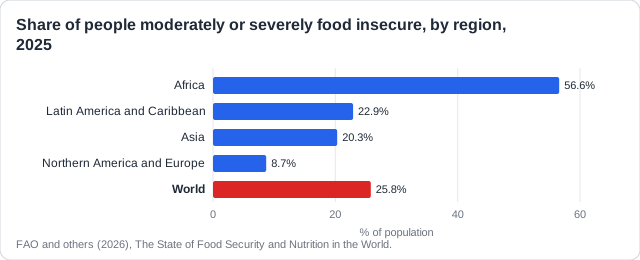
FAO measures food security in two main ways: hunger (too few calories) and moderate or severe food insecurity (people unsure they can get enough food, or going without).
The points to remember
- In 2025, about 645 million people (7.8%) faced hunger; about 2.1 billion (25.8%) were moderately or severely food insecure.
- Africa is worst: 20% hungry, 56.6% food insecure, and now the largest number of hungry people.
- Asia and Latin America are improving; Africa improved in 2025 for the first time in a decade.
- Northern America and Europe are the most food secure, but not fully: 8.7% are still food insecure.
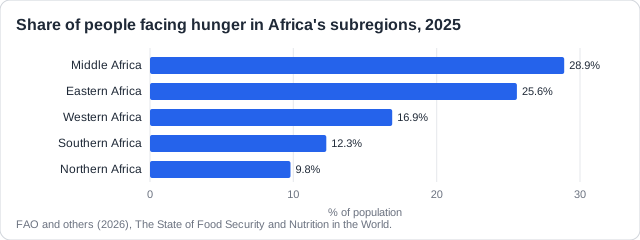
Example (SL): Middle Africa. Almost 3 in 10 people there faced hunger in 2025, the highest share of any subregion, where conflict and poverty cut both growing and buying food.
Study smarter, not longer
Most students waste 40% of study time on topics they already know. Our AI tracks your progress and optimizes every minute.
How this could come up: Paper 2 Section A can show a food-security indicator by region and ask you to describe it [1-2] and explain the differences [2-3].
The bar chart shows the share of people who were moderately or severely food insecure in each region in 2025.
Explain why food security is much lower in Africa than in Northern America and Europe.
Model answer plan
See the mark-by-mark plan — for / against / judgement, with marking guidance — in study mode.