Plastic is piling up in the sea: Plastic debris is building up in the oceans, because it is not biodegradable. It needs managing in two ways: stop it entering, and clear up what is already there.
Why plastic is worse than other rubbish
- Plastic is made in huge quantities and used everywhere, so a lot of it escapes.
- It is not biodegradable: it lasts hundreds of years, a problem for generations.
- It floats, so currents carry it thousands of kilometres from where it was dropped.
- It breaks into tiny pieces that spread widely and are eaten by small animals.
- Those pieces absorb toxins from the water, so they carry poisons into food chains.
Remember it as: Lots of it, lasts for ever, floats far, breaks small, carries poison.
Real example: about 11 million tonnes of plastic enter the ocean every year, roughly one rubbish truck every minute.
Paper and food waste are different: Food and paper rot in weeks or months. That is why plastic is a more serious pollutant than most other household waste: give the reason, not just 'it is bad'.
Free preview
This is the free notes preview
You're reading the free notes. Aimnova Pro unlocks the full study experience — and you can try it with your first topic free to keep:
- FlashcardsLock in vocabulary and key terms with spaced repetition.
- Practice questionsAnswer exam-style questions and get instant AI marking.
- Mock exams & past-paper vaultSit full mocks and see exactly how examiners award marks.
- Personalised study planA daily plan built around your exam date and weak areas.
Large pieces of plastic harm sea animals in several different ways. Each way is a separate point in an answer.
The points to remember
- Entanglement: nets, rings and lines wrap round seals, turtles and birds; they drown or are cut.
- Ghost nets: lost fishing nets keep catching fish and animals for years.
- Ingestion: animals mistake plastic for food; a stomach full of plastic means starvation.
- Suffocation: bags block the airways of turtles and smother corals and the seabed.
- Rafting: floating plastic carries invasive species to new coasts.
Wrapped up
- Nets, rings and lines
- Animals drown or are cut
Swallowed
- Mistaken for food
- Full stomach, no nutrition
Carried
- Plastic rafts
- Invasive species reach new coasts
Real example: on Midway Atoll, in the middle of the Pacific, Laysan albatross parents feed their chicks plastic lighters and bottle tops picked up at sea. Many chicks die with stomachs full of plastic.
Study smarter, not longer
Most students waste 40% of study time on topics they already know. Our AI tracks your progress and optimizes every minute.
Plastic does not stay where it is dropped. Ocean currents carry it into a gyre, which collects it in one place.
The points to remember
- Winds and the spin of the Earth drive currents round each ocean in a ring: a gyre.
- There are five big gyres: North and South Pacific, North and South Atlantic, Indian Ocean.
- Plastic from rivers and coasts is carried round, then drifts into the calm centre.
- There it is trapped and builds up: a garbage patch, mostly small pieces, not an island.
- The biggest is the Great Pacific Garbage Patch, between Hawaii and California.
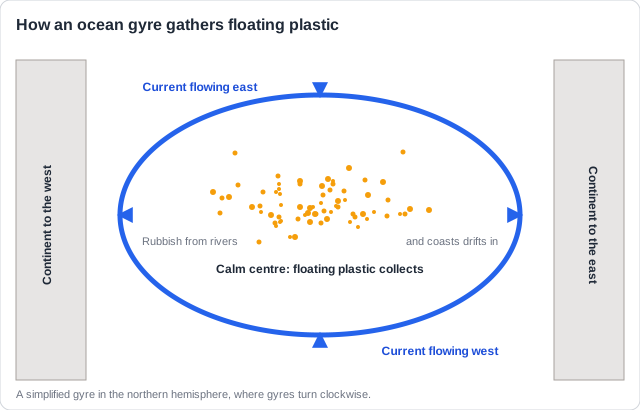
Remember it as: Round and round, then stuck in the middle.
Real example: the Great Pacific Garbage Patch, between Hawaii and California, covers about 1.6 million km², about three times the size of France. A 2018 study estimated it holds about 80 000 tonnes of plastic.
Not an island of rubbish: Most of a garbage patch is small pieces spread through the water, like a soup. You could sail through it and see little, which makes it hard to clean up.
Sunlight and waves break big plastic into microplastics. Some are made small: fibres from clothes, factory pellets (nurdles) and microbeads in cosmetics. These enter food chains.
The points to remember
- Microplastics are pieces under 5 mm: made small (fibres, pellets, microbeads) or broken down by sun and waves.
- They accumulate: small animals eat them and cannot get rid of them, so they build up.
- They magnify: each predator eats many prey, so concentrations rise up the food chain.
- They transport toxins: oily poisons at the sea surface (PCBs, DDT) stick to plastic.
- So top predators, including people who eat seafood, get the highest doses.
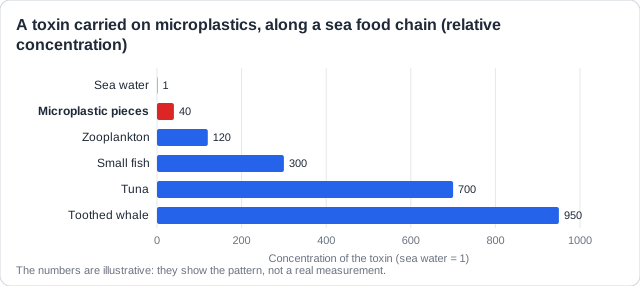
Two words, two meanings: Bioaccumulation happens in one animal. Biomagnification happens along the chain.
Real example: scientists have found microplastics in mussels bought in UK supermarkets, so people who eat seafood swallow them too.
Practice with exam-style questions
Answer exam-style questions and get AI feedback that shows you exactly what examiners want to see in a full-marks response.
Papers give a graph of plastic over time, with the mean of many samples and its standard error.
The points to remember
- Trend: describe the overall shape first: 'rising, faster and faster' (exponential).
- Mean: the dot is the average of all the samples taken in that period.
- Error bars show the spread: short bars mean the samples agree, so the mean is more reliable.
- n is the number of samples: a larger n makes the mean more reliable.
- Say which set is more reliable AND why: 'larger n' or 'smaller error bars'. Note any exception.
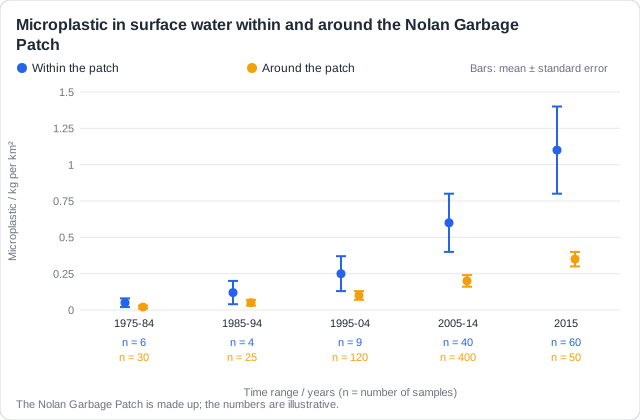
Reading this graph: Trend: microplastic within the patch rises faster and faster, from 0.05 to 1.1 kg per km². Reliability: the results around the patch are more reliable, because most periods have larger samples and shorter error bars (except 2015, where n is larger within the patch).
The guide asks for two kinds of management: take plastic out of the supply chain, and clear up the plastic already in the sea. A question about REMOVAL wants only the second kind.
The points to remember
- Out of the supply chain (stop it entering): ban or tax single-use plastic, ban microbeads.
- Deposit-return schemes for bottles, better recycling, products designed to last or to be reused.
- Clear up what is there: booms and nets in the gyres, river barriers, beach clean-ups.
- Removal needs satellite mapping, money (UN, rich countries, NGOs) and political support.
- The fishing industry can help collect it; the plastic is shipped to countries that recycle it.
- Clean-up alone never ends while plastic keeps flowing in; prevention alone leaves what is already there.
Out of the supply chain
- Bans and taxes on single-use plastic
- Microbead bans
- Deposit-return for bottles
- Stops the problem growing
Clear up what is there
- Booms and nets in gyres
- River barriers and wheels
- Beach clean-ups
- Costly; cannot reach microplastics
Remember it as: Turn off the tap, then mop the floor.
Real examples: Kenya banned plastic bags in 2017, with heavy fines. The UK banned microbeads in rinse-off cosmetics in 2018. In Baltimore, USA, 'Mr. Trash Wheel', a water-wheel barrier, scoops rubbish out of a river before it reaches the sea.
Removal is not reduction: 'Describe a strategy to remove plastic from a garbage patch': 'use fewer plastic bags' scores nothing there. Describe collecting it: map it, collect it with booms or nets, fund it, ship it for recycling.
Feeling unprepared for exams?
Get a clear study plan, practice with real questions, and know exactly where you stand before exam day. No more guessing.
How this comes up: Paper 2, Section A: describe a strategy for the removal of plastics from a garbage patch [2].
A garbage patch of floating plastic has formed in the South Pacific Gyre, far from any one country's coast.
Describe a strategy for the removal of plastics from the South Pacific garbage patch.
Model answer plan
See the mark-by-mark plan — for / against / judgement, with marking guidance — in study mode.