One huge store, five small ones: Almost all of Earth's water sits in one store, the oceans. The other stores are tiny by comparison, but they hold the fresh water that life on land depends on.
The main stores, biggest first
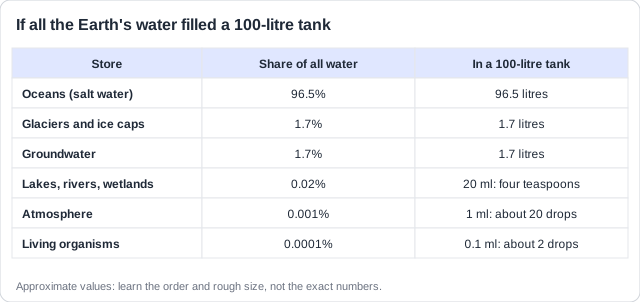
- The oceans hold about 96.5% of all water, and it is salty.
- Glaciers and ice caps hold about 1.7%: most of the world's fresh water.
- Groundwater holds about 1.7%, in rocks called aquifers.
- Surface fresh water (lakes, rivers, wetlands) is only about 0.02%.
- The atmosphere holds about 0.001%; living organisms about 0.0001%.
- Learn the order and rough size: oceans by far the biggest, organisms the smallest.
Real example: the Antarctic ice sheet is up to 4.8 km thick and holds about 70% of all the fresh water on Earth, locked away as ice.
Free preview
This is the free notes preview
You're reading the free notes. Aimnova Pro unlocks the full study experience — and you can try it with your first topic free to keep:
- FlashcardsLock in vocabulary and key terms with spaced repetition.
- Practice questionsAnswer exam-style questions and get instant AI marking.
- Mock exams & past-paper vaultSit full mocks and see exactly how examiners award marks.
- Personalised study planA daily plan built around your exam date and weak areas.
Earth is called the blue planet, so why do so many places run short of water? Because almost none of it is fresh, liquid and on the surface.
The points to remember
- About 97% of all water is salty: we cannot drink it or water crops with it.
- Most fresh water is frozen in ice caps or held underground.
- The fresh water easiest to use, in lakes and rivers, is a tiny fraction.
- Deep groundwater refills very slowly, so it is hard to use sustainably.
Remember it as: Salty, frozen or underground: very little is easy to use.
Hard to use
- Ocean water: salty
- Ice caps: frozen and far away
- Deep groundwater: slow to refill
Easy to use
- Lakes
- Rivers
- Shallow groundwater
Real example: the five Great Lakes of North America hold about a fifth of all the fresh surface water on Earth, yet even they are part of the 0.02% of the world's water held in lakes and rivers.
Stop wasting time on topics you know
Our AI identifies your weak areas and focuses your study time where it matters. No more overstudying easy topics.
A common question shows a water-cycle figure and asks for a store that is not on it. Run through the list of stores and pick one that is missing.
Stores to choose from
- Fresh water stores: lakes, rivers, glaciers, groundwater (aquifers), reservoirs, soil water.
- Animals and other organisms are a store too, not only plants.
- The atmosphere (clouds) and the oceans are stores as well.
- Name a store (a place, a noun), never a flow such as 'rain' or 'evaporation'.
- If the question asks for a store and a flow, give both for the mark.
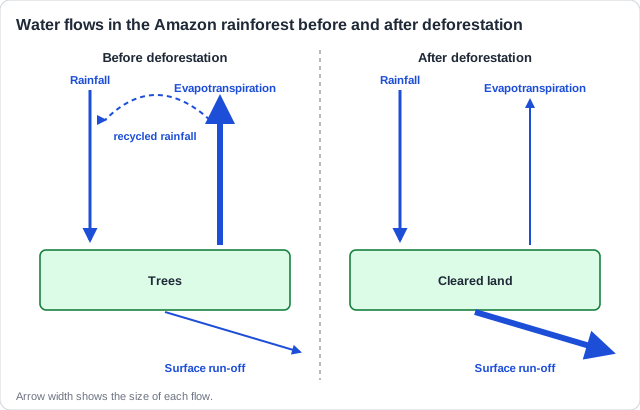
Real example: in this Amazon figure, the only store drawn is the trees. A river, a lake or the groundwater under the forest would each be a correct answer.
A store, not a flow: 'Rainfall' or 'run-off' cannot be a store. And trees are already drawn, so 'plants' would not count.
Glaciers are frozen stores of fresh water that feed rivers as they melt. Most of them are now shrinking, which changes the rivers below them.
What a shrinking glacier does to its river
- A glacier is a store of fresh water that releases meltwater, mostly in summer.
- While it melts fast, the river gets more water for a while, and muddier water.
- As it shrinks and disappears, the river gets less water, especially in late summer.
- So towns and farms downstream face summer shortages and droughts.
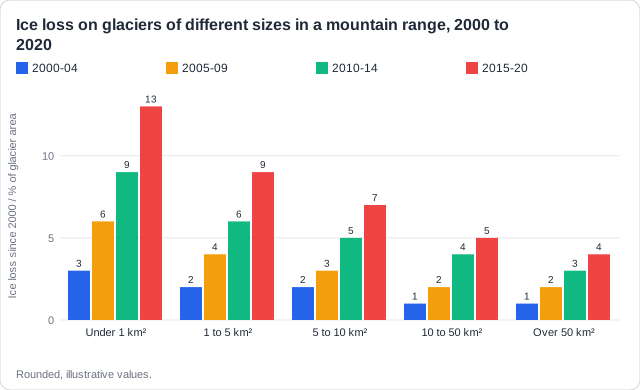
- To read a trend, describe a pattern across the bars, never one bar on its own.
Real example: Swiss glaciers lost about 10% of their volume in just two years, 2022 and 2023. They feed the Rhine and the Rhône; as they shrink, these rivers will carry less water in late summer.
Link the change to its cause: 'The river gets bigger' is not enough. Write 'more meltwater as the glacier melts raises the river's flow at first, but as the glacier disappears the summer flow falls'.
See how examiners mark answers
Answer exam-style questions with model answers. Learn exactly what earns marks and what doesn't.
How this comes up: Paper 1: a chart of glacier ice loss [1], and what retreat means for a river [1].
Figure 1 shows ice loss on glaciers of different sizes in a mountain range that feeds a major river.
(a) Identify one trend in glacier ice loss shown in Figure 1.
(b) Outline how the retreat of these glaciers is likely to affect the river they feed.
Model answer plan
See the mark-by-mark plan — for / against / judgement, with marking guidance — in study mode.