Two engines: The hydrological cycle never stops. Two things keep it moving: energy from the sun and gravity.
The points to remember
- Solar radiation heats water so it evaporates; it also melts ice and drives transpiration.
- The sun heats the Earth unevenly, which makes winds that carry vapour and clouds (advection).
- Gravity pulls water down: rain falls, water drains through soil, rivers flow to the sea.
- Name two energy sources when asked: solar (thermal), kinetic (wind) or gravity.
- The sun lifts water up (energy in); gravity brings it back down.
Remember it as: The sun lifts water up; gravity brings it back down.
Real example: sunlight evaporates water from the Atlantic Ocean. The trade winds carry the vapour west over the Amazon rainforest, where it falls as rain. Gravity then drains it down the Amazon River back to the Atlantic: about a fifth of all the river water that reaches the world's oceans.
Name two, not one: 'State two sources of energy' needs two: the sun and gravity (or wind). One source alone gets no mark.
Free preview
This is the free notes preview
You're reading the free notes. Aimnova Pro unlocks the full study experience — and you can try it with your first topic free to keep:
- FlashcardsLock in vocabulary and key terms with spaced repetition.
- Practice questionsAnswer exam-style questions and get instant AI marking.
- Mock exams & past-paper vaultSit full mocks and see exactly how examiners award marks.
- Personalised study planA daily plan built around your exam date and weak areas.
Water can be ice, liquid water or invisible water vapour. Changing from one to another is a phase change, and it needs or releases energy called latent heat.
The points to remember
- A phase change is water changing state: liquid to gas, gas to liquid, solid to liquid.
- Latent heat is the energy taken in or given out in a phase change.
- The temperature does not change while it happens: the energy breaks or makes bonds.
- Breaking bonds takes energy in (evaporation, melting); making bonds gives it out (condensation, freezing).
Remember it as: Breaking bonds takes energy in; making bonds gives it out.
Takes heat in (cools)
- Evaporation: liquid to gas
- Melting: ice to liquid
- Sublimation: ice to vapour
Gives heat out (warms)
- Condensation: gas to liquid
- Freezing: liquid to ice
- Deposition: vapour to ice
Real example: heat a kettle and the water warms from 20 °C to 100 °C. Then it boils, and although the heater is still on, the temperature stays at 100 °C until the water has turned to steam. That energy is latent heat: it is 'hidden' in the vapour, not shown on a thermometer.
Get feedback like a real examiner
Submit your answers and get instant feedback — what you did well, what's missing, and exactly what to write to score full marks.
Evaporation is the sun's way of lifting water into the air. Because it takes latent heat in, it cools whatever the water evaporates from.
The points to remember
- Evaporation needs energy to break the bonds between water molecules.
- It takes this latent heat from the surroundings.
- The surroundings lose energy, so they cool down.
- Plants do the same through transpiration: forests cool the air around them.
Your body
- Sweat evaporates and takes heat from your skin.
- You feel cold after a swim, even in the sun.
- A dog pants and wet clothes chill you for the same reason.
Forests
- A large tree can transpire up to 400 litres of water a day.
- Forests can be 2-8 °C cooler than nearby cities.
Whole regions
- Up to half of the Amazon's rain comes from its own transpiration.
- Clear the forest and that cooling, and that rain, are lost.
Real example: in northern Nigeria and Sudan, farmers keep vegetables fresh in a zeer pot. Water in the sand evaporates through the outer pot, taking heat with it, so the inner pot stays far cooler than the hot air outside.
'But a pan on the stove gets hotter': The stove gives far more heat than the evaporating water takes. Evaporation is still taking heat; the stove just wins. With no stove, as on your skin, you feel the cooling.
Condensation is evaporation in reverse. The latent heat that went into the vapour comes back out, and it warms the air around the cloud.
The points to remember
- Condensation turns vapour back into liquid droplets: clouds, dew, mist.
- Making the bonds releases the latent heat to the surroundings.
- The surroundings gain energy, so they warm up; the warm air rises.
- This is what powers hurricanes over warm seas, and why steam burns are so bad.
- A steamy bathroom feels warm: vapour condensing on the cold walls gives out its heat.
Evaporation
- Liquid to gas
- Latent heat taken in
- Surroundings cool
Condensation
- Gas to liquid
- Latent heat given out
- Surroundings warm
Real example: in August 2005 Hurricane Katrina passed over the very warm Gulf of Mexico. Huge amounts of water evaporated; as the vapour rose and condensed into storm clouds it released its latent heat, which warmed the air, made it rise faster and strengthened the storm before it hit New Orleans.
Three steps for the marks: Condensation releases energy as bonds form; the energy passes to the surroundings; the surroundings warm up. One step per sentence.
Learn what examiners really want
See exactly what to write to score full marks. Our AI shows you model answers and the key phrases examiners look for.
The sun lifts water up, but everything that comes back down is pulled by gravity. Winds, made by the sun heating the Earth unevenly, do the sideways moving: advection.
The points to remember
- Gravity makes precipitation fall from clouds to the ground.
- It pulls water down through the soil (infiltration) and deeper rock (percolation).
- It makes surface run-off and rivers flow downhill to the sea.
- It moves groundwater slowly towards rivers and the sea.
- Wind (kinetic energy from uneven heating) carries vapour and clouds over the land.
Moved by gravity
- Precipitation
- Infiltration and percolation
- Surface run-off and streamflow
- Groundwater flow
Moved by the sun's energy
- Evaporation and transpiration
- Melting and sublimation
- Winds: advection of vapour and clouds
Real example: rain and meltwater in the Swiss Alps run into the Rhine. Gravity carries the water downhill for 1,230 km, through Germany and the Netherlands, to the North Sea.
Say what gravity does: 'Infiltration' alone gets no mark. Write 'gravity pulls water down through the soil' or 'gravity makes rivers flow downhill to the sea'.
Evaporation and condensation do more than move water. They carry the sun's heat around the planet, and the oceans store it, so the water cycle shapes the climate.
How water shapes climate
- Evaporation is greatest where sunlight is strongest (the tropics) and takes in heat.
- Winds and storms carry the vapour to higher latitudes and altitudes.
- There it condenses, releases the heat and forms clouds and rain: the tropics-poles gap shrinks.
- Oceans store heat in summer and by day, and release it in winter and at night: milder coasts.
- Warm currents carry heat towards the poles; cold currents cool and dry the coasts.
- Ice and clouds reflect sunlight (cooling); melting ice reflects less, so it warms further.
- Water vapour is a greenhouse gas; the oceans also absorb carbon dioxide.
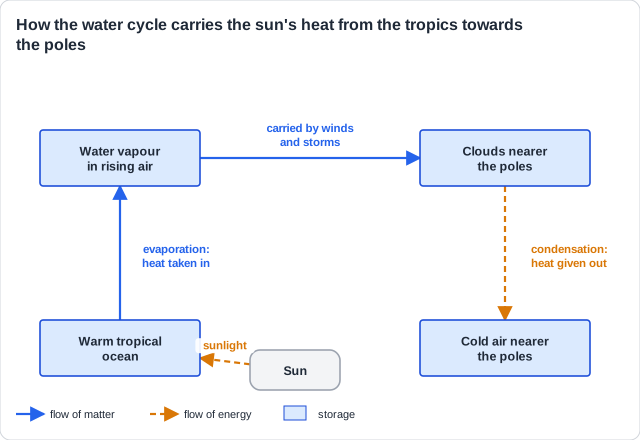
Real example: the Gulf Stream, a warm ocean current, carries tropical heat to north-west Europe. London's January average is about 5 °C; St John's in Canada, at a similar latitude but with a cold current offshore, averages about -5 °C.
In a [7], one mechanism per point: Each point names a process and its effect on climate: 'condensation releases latent heat at higher latitudes, warming them'. Global warming points count for at most two marks.
Never wonder what to study next
Get a personalized daily plan based on your exam date, progress, and weak areas. We'll tell you exactly what to review each day.
How this comes up: Paper 2, Section B (a): outline how energy drives the water cycle [4]. One process and its energy per point.
The River Rhine starts as rain, snow and glacier ice in the Swiss Alps and flows to the North Sea.
Outline how energy drives the movement of water through this part of the hydrological cycle.
Model answer plan
See the mark-by-mark plan — for / against / judgement, with marking guidance — in study mode.