Every aquatic food web starts with a producer: In lakes, rivers and the sea, the energy for every animal comes from producers. There are two kinds: phytoplankton and macrophytes.
The points to remember
- Producers turn light energy into chemical energy in food, by photosynthesis.
- Phytoplankton are microscopic and drift in the water of oceans, seas and lakes.
- Macrophytes are water plants large enough to see.
- Macrophytes can be emergent (stick out of the water), floating or submerged (under water).
- Producers are the first trophic level: all other aquatic life depends on the energy they store.
Remember it as: Tiny drifters and big water plants: the food at the bottom of the water.
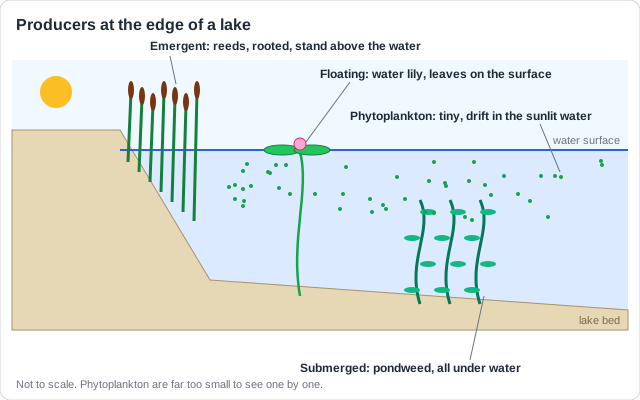
Example (SL): a lake in England. Reeds fringe the shore, water lilies float in the shallows, pondweed fills the clear water, and in spring the open water turns green with phytoplankton. Water fleas eat the phytoplankton, roach eat the water fleas, and pike eat the roach.
Free preview
This is the free notes preview
You're reading the free notes. Aimnova Pro unlocks the full study experience — and you can try it with your first topic free to keep:
- FlashcardsLock in vocabulary and key terms with spaced repetition.
- Practice questionsAnswer exam-style questions and get instant AI marking.
- Mock exams & past-paper vaultSit full mocks and see exactly how examiners award marks.
- Personalised study planA daily plan built around your exam date and weak areas.
Phytoplankton are the main producers of the open sea and of large lakes. They are single cells or small chains of cells, such as diatoms, so small that a drop of sea water can hold thousands.
The points to remember
- They live only in the sunlit surface water, where there is enough light to photosynthesise.
- They also need nutrients such as nitrate, phosphate and iron.
- Where deep water rises (upwelling), it brings nutrients up, so phytoplankton grow fast.
- More phytoplankton means more food for zooplankton and fish: high secondary productivity too.
- Together they make about half of all the photosynthesis on Earth.
Remember it as: Light from above, nutrients from below.
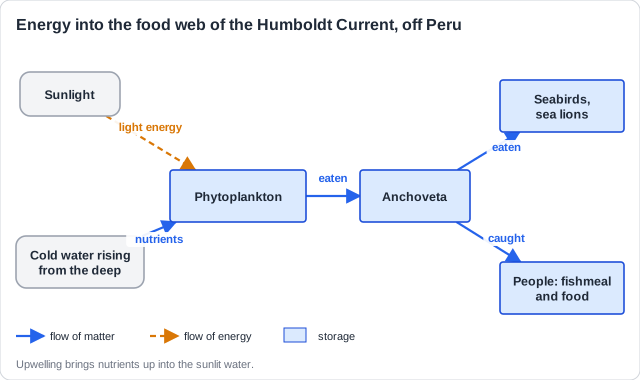
Example (SL): the Humboldt Current, off Peru. Winds push surface water away from the coast, and cold water full of nutrients rises in its place. Phytoplankton bloom, and they feed the anchoveta: the biggest catch of any single fish species in the world, often several million tonnes a year.
Explain the chain, not 'lots of fish': Asked why upwelling waters are so productive? Link each step: deep water brings nutrients up, so phytoplankton grow fast in the sunlit water (high primary productivity), so there is more food for zooplankton and fish (high secondary productivity).
Memorize terms 3x faster
Smart flashcards show you cards right before you forget them. Perfect for definitions and key concepts.
Macrophytes grow where light reaches the bottom: along lake shores, in rivers, marshes and shallow seas. They are rooted, or float freely.
Emergent
- Rooted under water; stems and leaves stand in the air.
- Reeds, bulrushes, papyrus.
Floating
- Leaves float on the surface, rooted or free.
- Water lilies, duckweed, water hyacinth.
Submerged
- Grow wholly under the water.
- Pondweed, eelgrass, seagrass.
The points to remember
- They are producers: grazers such as snails, ducks, manatees and turtles eat them.
- Most of their energy enters the food web when they die, as detritus for decomposers.
- They give shelter and nursery areas to young fish and crabs, and oxygen to the water.
- They need clear water: cloudy water full of algae shades them out, and the food web loses them.
Example (SL): manatees in Florida. Manatees eat seagrass, about a tenth of their body weight every day. When pollution made the Indian River Lagoon green with algae, the seagrass died, and in 2021 over 1000 manatees died in Florida, most of them from starvation.
Is seaweed a macrophyte?: Large seaweeds such as kelp are algae, not true plants, but they do the same job: big, visible producers that feed and shelter animals. Many books count them with the macrophytes.
Producers store energy; animals pass it up the food chain. At each step most of it is lost, so the amount of energy the producers capture limits how much life the whole water body can hold.
The points to remember
- Only about 10% of the energy at one level reaches the next (it varies, roughly 5-20%).
- The rest is lost as heat in respiration, or is not eaten or not digested.
- Efficiency = energy at the higher level ÷ energy at the level below x 100.
- So food chains are short, and there are few top predators.
- Dead producers and animals form detritus, eaten by detritivores and decomposers.
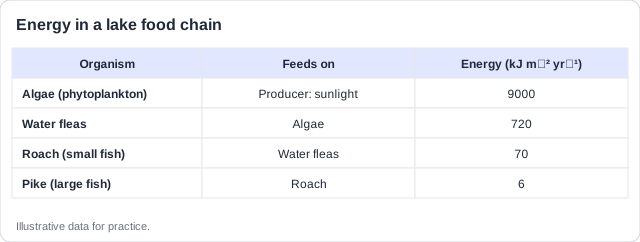
Worked example: efficiency of a transfer: Algae to water fleas: 720 ÷ 9000 x 100 = 8%. Water fleas to roach: 70 ÷ 720 x 100 = 9.7%. Divide the higher level by the lower level, then multiply by 100.
Example (SL): the Humboldt Current again. Because anchoveta eat phytoplankton directly, the chain is very short, so little energy is lost before the fish. That is one reason the area gives such huge catches.
Know your predicted grade
Take timed mock exams and get detailed feedback on every answer. See exactly where you're losing marks.
How this comes up: Data questions give a food chain and ask for the efficiency of a transfer [1], or a fact file on a rich fishing area and ask why it is so productive [2-3].
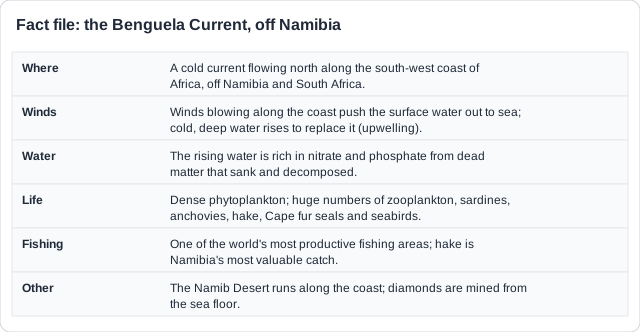
The fact file describes the Benguela Current off Namibia.
Explain why primary and secondary productivity are high in the waters of the Benguela Current.
Model answer plan
See the mark-by-mark plan — for / against / judgement, with marking guidance — in study mode.