One country, many strategies: Water scarcity can be reduced. A mitigation strategy adds supply, cuts demand, or works with other countries. The best-known examples use all three.
The points to remember
- A mitigation strategy reduces water scarcity or its effects.
- Increase supply: reservoirs, desalination, recycled water, imported water.
- Reduce demand: prices, taxes, rules, efficient devices and efficient farming.
- Work with others: water agreements, shared river management, trading food (virtual water).
- A country uses several strategies together, so no single failure leaves it dry.
Remember it as: Add water, waste less, work with others.
Real example: Singapore is a small, crowded island with no large rivers or aquifers. It is one of the most water-stressed countries in the world, yet its taps do not run dry.
Name the country: Questions on this statement want a named country and its named strategies. Learn one country well, with three or four facts and numbers.
Free preview
This is the free notes preview
You're reading the free notes. Aimnova Pro unlocks the full study experience — and you can try it with your first topic free to keep:
- FlashcardsLock in vocabulary and key terms with spaced repetition.
- Practice questionsAnswer exam-style questions and get instant AI marking.
- Mock exams & past-paper vaultSit full mocks and see exactly how examiners award marks.
- Personalised study planA daily plan built around your exam date and weak areas.
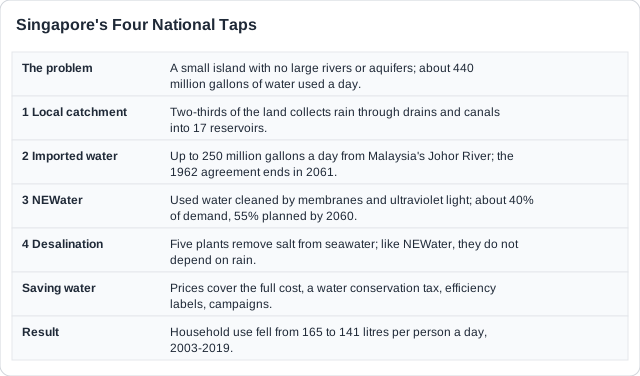
Singapore calls its supply plan the 'Four National Taps': four different sources of water, so it never depends on just one. NEWater and desalination are the newest.
Adding supply
- Local catchment: rain from two-thirds of the land flows into 17 reservoirs.
- Imported water from Malaysia under an agreement that ends in 2061.
- NEWater: used water cleaned by membranes and UV light; about 40% of demand.
- Desalination: plants remove salt from seawater.
- NEWater and desalination are weather-resilient: they work even in a drought.
Memorize terms 3x faster
Smart flashcards show you cards right before you forget them. Perfect for definitions and key concepts.
Adding supply is expensive, so Singapore also works hard to make people use less.
Cutting demand
- Pricing: water is priced to cover the full cost of supplying it.
- A water conservation tax on every bill reminds people that water is precious.
- Efficiency labels on taps, toilets and washing machines.
- Campaigns and school programmes teach people to save water.
- Result: household use fell from 165 to 141 litres per person a day (2003-2019).
Real example: in 2017 Singapore raised its water price by 30%, the first rise in 17 years, to reflect the rising cost of NEWater and desalination.
Supply and demand in one answer: Strong answers use both sides: one strategy that adds water and one that cuts use, each with a fact from the named country.
Water and food cross borders, so countries can tackle scarcity together. Virtual water lets a dry country save its own water by buying water-intensive food from wetter places.
Working with other countries
- Water agreements (treaties) set how much water each country may take or sell.
- Joint management bodies let countries run a shared river together.
- Water markets: users buy and sell the right to use water, so it goes where it is most valued.
- Virtual water trade: importing water-intensive food saves the water needed to grow it.
- Technology sharing: drip irrigation and desalination spread from country to country.
Real example: Singapore's 1962 agreement lets it take water from Malaysia's Johor River until 2061. Because that date is fixed, Singapore built NEWater and desalination plants, so it can meet its needs on its own by then. Another lasting agreement is the Indus Waters Treaty of 1960, which shared the Indus rivers between India and Pakistan.
Virtual water in an answer: Link it to scarcity: 'importing wheat saves the water that growing it at home would need'.
Know your predicted grade
Take timed mock exams and get detailed feedback on every answer. See exactly where you're losing marks.
Questions often ask you to evaluate the strategies: how well do they work, and at what cost?
Strengths and limits
- Strength: several sources, so a drought or a broken agreement does not stop supply.
- Strength: recycling and desalination do not depend on rainfall.
- Limit: desalination uses a lot of energy, often from fossil fuels, and makes salty brine.
- Limit: high costs, so poorer countries cannot copy it easily.
- Limit: imports depend on neighbours; some people dislike drinking recycled water.
Works well because
- Four sources, not one
- NEWater and desalination work in droughts
- Use per person has fallen
But
- Desalination needs a lot of energy
- Imports depend on Malaysia until 2061
- High costs passed on in prices
End with a judgement: An evaluation needs both strengths and limits, then a conclusion: 'Singapore's strategies work well, but they depend on energy and money that many countries do not have.'
How this comes up: Paper 2, Section B (b): evaluate two named strategies used by a country to address water scarcity [7].
Singapore uses about 440 million gallons of water a day, and its demand is expected to almost double by 2065.
Evaluate two strategies that Singapore uses to address water scarcity.
Model answer plan
See the mark-by-mark plan — for / against / judgement, with marking guidance — in study mode.