Store the wet season for the dry season: A dam creates a reservoir. It catches water when there is plenty and lets it out when there is little.
The points to remember
- A dam blocks a river; the reservoir behind it stores water for the dry season.
- Uses: drinking water, irrigation, hydropower, flood control, recreation, a new lake habitat; little upkeep.
- Costs to people: high set-up cost; villages flooded and people moved; the water's weight can trigger earthquakes.
- Costs to nature: habitats flooded, fish migration blocked, less silt and nutrients downstream.
- Still water: evaporation losses, mosquitoes that spread disease, rotting plants give off methane.
- Stored volume varies with seasonal rain in and seasonal water taken out for farms and towns.
Remember it as: Dams give water, power and safety, but drown valleys, block fish and lose water to the sky.
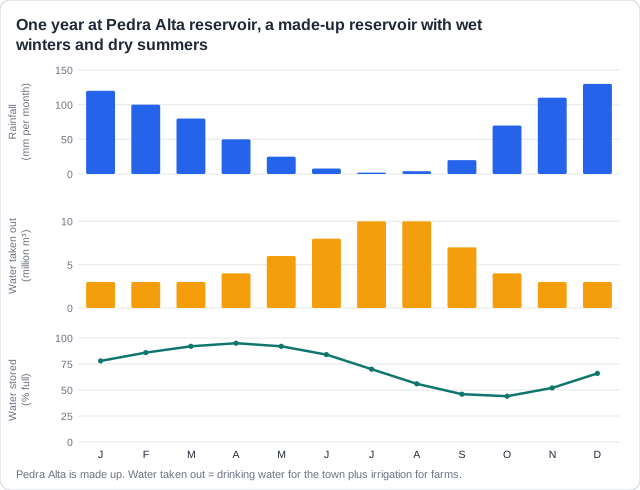
Why the stored volume changes: two traps: Not just 'less rain'. Say it is seasonal: rain in winter, little in summer, AND more water is taken out in summer for crops and towns.
In a 'one advantage, one disadvantage' of a dam, 'high building cost' and 'hydropower cuts emissions compared with fossil fuels' do not count. Give an effect from the case: fish migration, habitat loss, algal blooms or methane.
Real example: China's Three Gorges Dam on the Yangtze is the world's biggest hydroelectric power station. It controls floods, but about 1.3 million people had to move as its reservoir filled.
Free preview
This is the free notes preview
You're reading the free notes. Aimnova Pro unlocks the full study experience — and you can try it with your first topic free to keep:
- FlashcardsLock in vocabulary and key terms with spaced repetition.
- Practice questionsAnswer exam-style questions and get instant AI marking.
- Mock exams & past-paper vaultSit full mocks and see exactly how examiners award marks.
- Personalised study planA daily plan built around your exam date and weak areas.
Some places have no good river to dam, so they bring water from far away with a transfer scheme, or pump it from an aquifer.
The points to remember
- A transfer scheme moves water from a wet region to a dry one by canal or pipeline.
- Gains: water for a dry city's homes, farms and industry; often hydropower and flood control too.
- Costs: people moved, habitats lost, less flow downstream, water lost on long journeys, high cost.
- Relying on one source is risky if that region has a drought.
- Aquifers can be pumped from wells, but pumping faster than recharge lowers the water table.
- Artificial recharge: put spare water into the aquifer in wet months; pump it out when needed.
Remember it as: Water moved far is water lost on the way, and taken from someone else.
Real example: China's South-North Water Diversion carries water over 1,200 km from the Danjiangkou reservoir to Beijing; by 2020 it supplied about 70% of the city's water. The dam was raised, villages were moved and less water flows down the Han River.
Recharge, not just pumping: Pumping an aquifer is sustainable only if no more is taken than rain and rivers put back. Faster pumping lowers the water table, dries wells, can make the ground sink and lets seawater in near coasts.
Get feedback like a real examiner
Submit your answers and get instant feedback — what you did well, what's missing, and exactly what to write to score full marks.
Catch the water before it runs away: Rainwater harvesting and fog nets take water straight from the sky, close to where people need it.
The points to remember
- Rainwater harvesting: roofs and gutters lead rain into tanks for later use.
- Pros: low cost, low technology, a renewable supply that saves treated drinking water.
- Cons: depends on the weather; too little for farm irrigation; roof water may hold air pollutants.
- Untreated rainwater is often not safe to drink: use it for gardens, washing and toilets.
- Fog nets: fine mesh on hills catches fog droplets, which drip into pipes.
Real example: on Bermuda, an island with no rivers or lakes, the law requires new houses to catch rain: white stepped roofs lead it into a tank under each house.
Not enough for big farms: Say why rainwater harvesting is limited: it depends on the weather, and the quantity is far too small for irrigating commercial farms. 'It is cheap' on its own is not an evaluation: link it to sustainability.
Turning seawater into drinking water: Desalination uses the biggest store of all, the sea. The main method is reverse osmosis.
The points to remember
- Desalination removes salt and other minerals from water to obtain freshwater.
- Reverse osmosis: a pump pushes seawater through a semi-permeable membrane; salt stays behind.
- Pros: a vast supply of seawater, safe drinking water, works whatever the rain: water security.
- Cons: high cost; much energy, so emissions if fossil-fuelled; coastal places only.
- Cons: brine returned to the sea harms marine life and fishing; plants are noisy.
- It becomes more sustainable when renewable power (sun, wind) runs it.
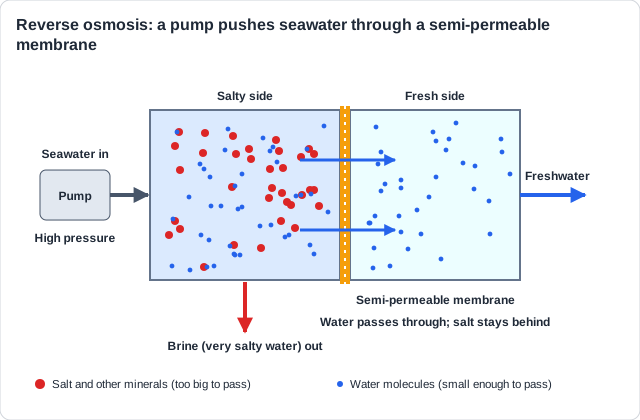
Remember it as: Sea in, pressure on, membrane between, fresh out, brine back.
Real example: Israel's Sorek plant, opened in 2013, is one of the largest reverse osmosis plants in the world. Desalination now gives Israel most of its drinking water.
Name the membrane: When you mention reverse osmosis, say what it is: seawater pushed through a semi-permeable membrane.
Learn what examiners really want
See exactly what to write to score full marks. Our AI shows you model answers and the key phrases examiners look for.
Nature already stores and cleans water. Protecting and restoring wetlands and forests increases the water a place can use.
The points to remember
- Wetlands store water like a sponge and release it slowly in dry weather.
- They filter water: plants and mud trap silt and pollutants, so less treatment is needed.
- Forests raise infiltration, so more rain soaks in and recharges aquifers.
- Restoring them is cheap, needs no energy and gains biodiversity.
- Limits: needs land, takes years, and adds less water than a dam.
Remember it as: Let nature be the sponge and the filter.
Real example: New York City protects the forests and wetlands of the Catskill Mountains, where its water comes from. Clean water from that land means the city has not needed to build a huge filtration plant.
A strong evaluation point: Wetland restoration scores well on sustainability: low cost, no energy, more biodiversity and a more resilient ecosystem. Its weakness is size: it adds less water than a big scheme.
Exam questions often pair a supply method with a way to use less, so learn both sides of each. Using less makes the same supply go further.
The points to remember
- Water taxation / meters: people pay for what they use, so they use less.
- Tax pros: realistic price, raises money for pipes; cons: unpopular, hard on the poor, needs meters.
- Grey water (from sinks, showers) reused for toilets and gardens: less fresh water needed, lower bills.
- Grey-water cons: costly to install; badly treated water is a health risk and smells; may encourage wasting water.
- Drought-resistant crops need less irrigation and grow on dry land; seed can be costly, few kinds exist.
- Also: fix leaks, water-saving appliances, campaigns, restrictions (no hosepipes), drip irrigation.
Water taxation
- Cuts use; cost matches use
- Funds pipes and repairs; can be adjusted
- Unpopular: water is a basic need
- Needs meters and policing; poor may use unsafe water
Grey-water recycling
- Less fresh water taken; lower bills
- Less waste water to treat
- Costly to fit; needs expert advice
- Treatment errors: health risk, smell
Real example: since 2006, plant breeders have developed drought-tolerant maize for farmers in Africa, so harvests survive dry spells with less water.
Strategies, not habits; less use, not more supply: When asked for management strategies, 'take shorter showers' is a personal choice: say how a government or company makes it happen (meters, restrictions, campaigns).
When asked how use per person fell, 'collect rainwater' adds supply, and 'reduce farm use' is not per person.
Never wonder what to study next
Get a personalized daily plan based on your exam date, progress, and weak areas. We'll tell you exactly what to review each day.
A question may show the water cycle and ask how its water could be enhanced for people. Every method must be linked to a use.
The points to remember
- Pick a flow or store in the figure, add a method, then say what the water is used for.
- Rivers and runoff: a dam stores it for drinking, irrigation or hydropower.
- Groundwater: wells for drinking; artificial recharge to save winter water for summer crops.
- The sea: desalination by reverse osmosis for drinking water.
- Precipitation and fog: rainwater tanks or fog nets for gardens and villages.
- Evaporation: covers or shade balls on a reservoir keep more water to use.
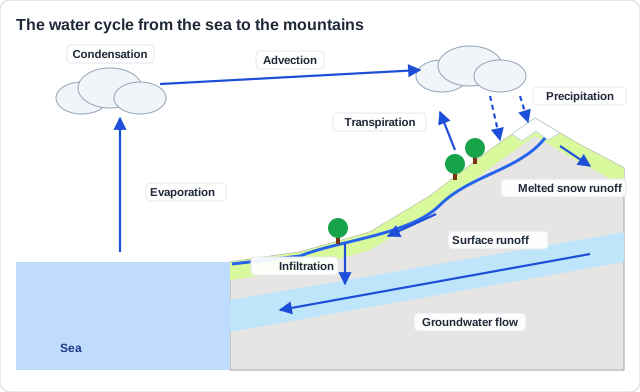
Method + use, every time: 'Build a dam' alone is half an answer. Write 'build a dam to store the snowmelt runoff, releasing it in summer to irrigate crops'.
Real example: the Three Gorges reservoir stores Yangtze floodwater and uses it to make hydroelectric power.
To evaluate whether a strategy is sustainable, test it against the same few questions.
The points to remember
- Cost: can the society afford to build and run it for decades?
- Energy and climate: does it burn fossil fuels, or can it run on renewable power?
- Ecosystems: does it flood habitats, cut biodiversity or lower resilience?
- Natural cycles: does it take more than nature replaces (aquifer recharge, river flow)?
- Geography: does it fit the place (coast, rain, mountains)?
- Up to 4 points a strategy, both pros and cons, then a judgement.
Remember it as: Cost, carbon, creatures, cycles, the place.
Real example: Israel's desalination gives a water supply that no drought can cut, but it runs on large amounts of electricity, so its sustainability depends on how that power is made.
Link every point to sustainability: 'It is cheap' or 'it is efficient' alone does not count. Say why it matters: 'its cost is too great for a low-income country to keep running, so it is not economically sustainable'.
Stop wasting time on topics you know
Our AI identifies your weak areas and focuses your study time where it matters. No more overstudying easy topics.
How this comes up: Paper 2, Section B (b): evaluate two named ways of managing water supply [7]. Up to 4 points for each, both pros and cons.
Many fast-growing cities in dry regions are looking for new sources of water.
Evaluate dams and desalination as means of sustainably managing water supply.
Model answer plan
See the mark-by-mark plan — for / against / judgement, with marking guidance — in study mode.