Not enough water for the people who need it: water scarcity is the limited availability of water to human societies. It is measured by how much of the water available is already being taken out each year.
The points to remember
- Water scarcity: water is limited for people; there is not enough to meet demand.
- It is shown as the share of the supply withdrawn: water taken out / water available x 100.
- Over 40% withdrawn is high; the higher the share, the more scarce the water.
- Two kinds: too little water (physical) or no way to store and move it (economic).
- Reading a map: give the overall pattern, then a named country and the direction of change.
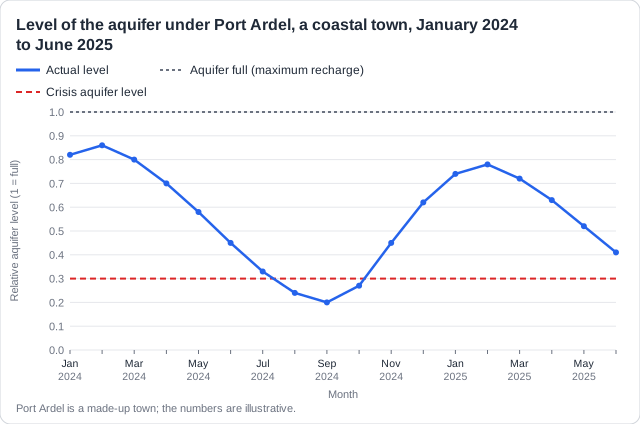
- Reading an aquifer graph: the lowest level is the month of greatest scarcity.
Remember it as: Taken out, divided by what is there: the bigger the share, the scarcer the water.
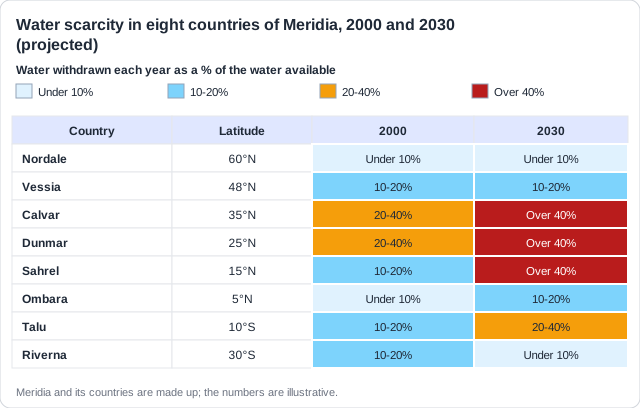
Reading a scarcity map: Pattern first: 'scarcity rises in many countries, most near the equator and in the mid latitudes'. Then a named country and its direction: 'Sahrel rises from 10-20% to over 40%'.
Real example: in 2023 the World Resources Institute found that 25 countries, home to a quarter of the world's people, face extremely high water stress every year: they use over 80% of their supply.
A country, not a region: When asked for a country, give a country's name: 'Europe' or 'Africa' is a region and scores nothing. For a change, give the place AND whether scarcity rises or falls.
Free preview
This is the free notes preview
You're reading the free notes. Aimnova Pro unlocks the full study experience — and you can try it with your first topic free to keep:
- FlashcardsLock in vocabulary and key terms with spaced repetition.
- Practice questionsAnswer exam-style questions and get instant AI marking.
- Mock exams & past-paper vaultSit full mocks and see exactly how examiners award marks.
- Personalised study planA daily plan built around your exam date and weak areas.
The first kind of scarcity is about nature: the water is simply not there. This is physical water scarcity.
The points to remember
- Physical scarcity: there is not enough water in the place to meet demand.
- Causes: low rainfall and high evaporation, in an arid (very dry) climate.
- Few rivers, lakes or stores, or a long dry season, or a drought.
- People can cause it too: taking more than nature replaces, so rivers and aquifers run dry.
- Found in the Middle East, North Africa, parts of Australia and the south-west USA.
Remember it as: Physical: the water is not there.
Real example: Jordan is one of the driest countries on Earth. Most of it is desert, it has very few rivers, and each person has less than 100 cubic metres of renewable water a year.
People can make it worse: Physical scarcity is not only climate. A river that is over-used, so it no longer reaches the sea, is physically scarce because of people.
Memorize terms 3x faster
Smart flashcards show you cards right before you forget them. Perfect for definitions and key concepts.
The second kind is about money and building. The water is there, but the infrastructure is not. This is economic water scarcity.
The points to remember
- Economic scarcity: the water exists, but people cannot get it.
- Missing storage: dams, reservoirs and tanks to keep water for the dry season.
- Missing transport: pipes, pumps and canals to bring water to homes and farms.
- Missing money to build them, and weak management: leaks, broken pumps, no plan.
- Missing treatment: the water is there but unsafe, so people walk far or buy from sellers.
- Common in sub-Saharan Africa and parts of Asia.
Physical scarcity
- Not enough water exists in the region
- Causes: dry climate, drought, overuse
- Middle East, North Africa, Australia
- Fixes: desalination, transfers, using less
Economic scarcity
- Water exists, but people cannot reach it
- Causes: poverty, no pipes or storage, weak management
- Sub-Saharan Africa, parts of Asia
- Fixes: investment, wells, pipes, better management
Remember it as: Physical: no water. Economic: no pipes.
Real example: the Congo River carries more water than any other river in Africa, yet most people in the Democratic Republic of the Congo have no safe water at home. There are too few pipes, pumps and treatment works.
High rainfall is not the same as no scarcity: A country with heavy rain can still be short of water. If people cannot store it, move it or make it safe, that is economic scarcity.
Scarcity gets worse when demand rises or the usable supply falls. Each factor below is a change, and climate change is one of them.
The points to remember
- More people: more water for homes, food and industry.
- Richer lifestyles and meat-rich diets use more water.
- More intensive farming and irrigation, thirsty crops (cotton), pumping faster than recharge.
- Water moved out of the river basin by canals, or taken upstream by another country.
- Deforestation and pollution leave less usable water.
- Climate change: less rain and drought; more evaporation; glaciers melt (more, then less water).
- Rising seas let salt water into coastal rivers and aquifers.
Remember it as: More people, richer diets, thirstier farms, a hotter climate.
Climate change: the cause
- Rainfall patterns shift
- Higher temperatures
- Ice melts
- The sea rises
Its effect on water
- Less rain in some places, more droughts
- More evaporation: lakes, rivers, reservoirs dry
- More meltwater at first, then less
- Salt water gets into coastal aquifers
Real example: Lake Chad, in West and Central Africa, has shrunk by about 90% since the 1960s. Droughts cut the rain, while a fast-growing population took more of its water for irrigation.
It must be a change: 'The area has a dry season' or 'it has low rainfall' does not explain an INCREASE in stress. Say what changes: 'less rain because of global warming'. For climate change, name the change AND its effect on water.
Know your predicted grade
Take timed mock exams and get detailed feedback on every answer. See exactly where you're losing marks.
Both farms and growing cities make water scarcer. They change how much water there is (its availability) and how clean it is (its quality). A dirty river is water people cannot use.
The points to remember
- Farms take about 70% of the freshwater people withdraw, mostly for irrigation.
- Over-pumping for irrigation depletes aquifers; near the coast, salt water seeps in.
- Farm fertiliser leaches into rivers (eutrophication); pesticides build up in food chains.
- Cities pack demand into one place; sewage and factory waste (heavy metals) pollute rivers.
- Concrete stops rain soaking in: more runoff and floods, less recharge; building adds sediment.
- But cities can make water (treat sewage, desalination) and farms can save it (drip irrigation).
Farms
- Use most water: irrigation
- Over-pump aquifers
- Eutrophication from fertiliser
- Bioaccumulation of pesticides
Cities
- Demand packed into one place
- Sewage and heavy metals in rivers
- Concrete: floods, less soaking in
- Can recycle sewage and desalinate
Remember it as: Farms drink most; cities dirty most; both can do better.
Real example: in 2007 a huge bloom of toxic algae, fed by fertiliser from farms and sewage from towns, covered Lake Taihu in China. About 2 million people in the city of Wuxi had no drinking water for days.
Weigh both, both ways: In a 'which does more harm' essay, give farms AND cities, quality AND availability, harm AND the fixes each can make. Then decide.
Population growth affects water at two scales: local (a town, a lake, an aquifer) and regional (a whole river basin or country). Most effects are harmful; one can help.
The points to remember
- More people need more water for drinking, cooking and washing.
- More food means more irrigation; more jobs mean more industry using water.
- Rivers and lakes dwindle, aquifers fall: worst where water is already physically scarce.
- Pumping more groundwater near the coast lets salt water seep in.
- More sewage and factory effluent pollute the water that is left.
- Dams built for the extra demand change the river downstream and can start conflict.
- Fast growth with poverty brings economic scarcity; but pressure can spur technology and efficiency.
Remember it as: More mouths, more fields, more factories, less water left.
More people
- Egypt's population passed 100 million in 2020
- More drinking and washing water needed
More food
- More irrigated farmland along the Nile
- Groundwater is pumped faster than it refills
Dams
- The Aswan High Dam (1970) made irrigation water steadier
- But Lake Nasser loses water to evaporation and traps the fertile silt
Conflict
- A big new dam upstream in Ethiopia worries Egypt and Sudan
Do not forget the good news: Growing demand can push people to invent and save: recycling, drip irrigation, better management. One point in a [7] can be a positive effect.
Get feedback like a real examiner
Submit your answers and get instant feedback — what you did well, what's missing, and exactly what to write to score full marks.
When water is scarce, its users compete for it. A conflict over water is a dispute between two users who want the same water.
The points to remember
- A conflict over water is between two users who want the same water: name both.
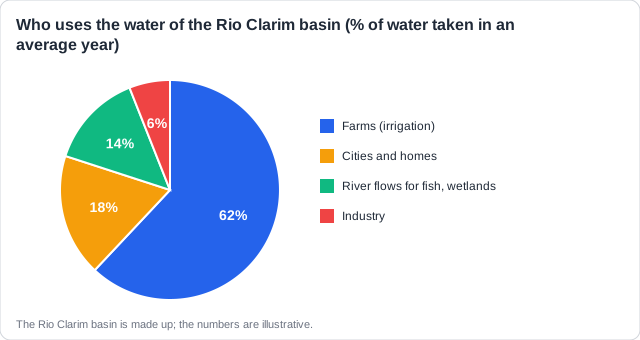
- Farms (irrigation) v cities (homes and businesses).
- Farms or cities v the environment: water left in rivers for fish and wetlands.
- Hydroelectric power v irrigation: dams hold water back when farms need it.
- Upstream v downstream users: countries, states or neighbouring farmers.
- The source area v the area that receives a transfer of its water.
Real example: the Colorado River supplies about 40 million people in seven US states and Mexico. In 2022 its main reservoir, Lake Mead, fell so low that Arizona, Nevada and Mexico had their shares cut, setting farmers against fast-growing cities.
A supply problem is not a conflict: 'Less snow is falling' or 'the pumps need electricity' are problems of supply. A conflict needs two sides: 'farmers who irrigate v the city that needs drinking water'.
There are two ways to fight scarcity: change how people use and value water, or build technology that makes more water or wastes less. Desalination often uses reverse osmosis and leaves salty waste, brine.
The points to remember
- Behaviour: use less. Campaigns, pricing and meters, rationing and bans, less meat.
- Behaviour tackles the root cause (demand), costs little and works for rich and poor.
- But it needs people to comply, works slowly and can be unpopular.
- Technology: make more or waste less. Desalination, recycled sewage, grey water, drip irrigation.
- Also artificial recharge of aquifers and rainwater harvesting.
- Technology works fast where scarcity is severe, but costs a lot, uses energy and makes brine.
- Technocentrists trust technology; ecocentrists want less demand. Most places need both.
Changing behaviour
- Cheap, works everywhere
- Tackles the root cause: demand
- Slow; needs people to comply
- Can be unpopular, e.g. higher prices
New technology
- Fast, big new supply
- Works where scarcity is severe
- Costly, energy-hungry, makes brine
- Can lead people to use more
Real example: Singapore has little land to store rain, so it built 'Four National Taps': rain caught in reservoirs, water bought from Malaysia, NEWater (used water cleaned to drinking standard, able to meet up to about 40% of today's demand) and desalinated sea water. It also prices water at its full cost, adds a water conservation tax and runs campaigns.
A conclusion that scores: 'Technology is needed where scarcity is severe, but changing behaviour tackles the root cause and is affordable everywhere, so the two work best together.' Back it with your named examples.
Ready to ace Water scarcity?
You've seen the preview. Here's what you'll unlock:
Bite-Sized Study Notes
Full syllabus broken into chunks that stick
Exam Practice
See exactly how to score full marks
AI Feedback
Know exactly what examiners want
Smart Study Plan
Know exactly what to study next