Decline can be turned around: Conservation and regeneration measures can be used to reverse the decline in biodiversity, so that humanity stays within the planetary boundary for biodiversity.
The points to remember
- Biodiversity loss is one of the nine planetary boundaries: inside them is a safe operating space for humanity.
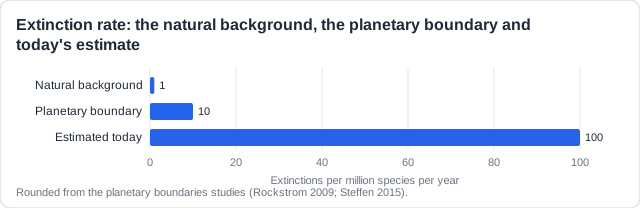
- Species are dying out at least 10 times faster than the boundary allows: it has been crossed.
- Wildlife populations tracked since 1970 have fallen by 73% on average (Living Planet Index, 2024).
- Losing species weakens the ecosystem services people rely on: pollination, clean water, a stable climate.
- Conservation protects what is left; regeneration restores what was lost. Together they can reverse the decline.
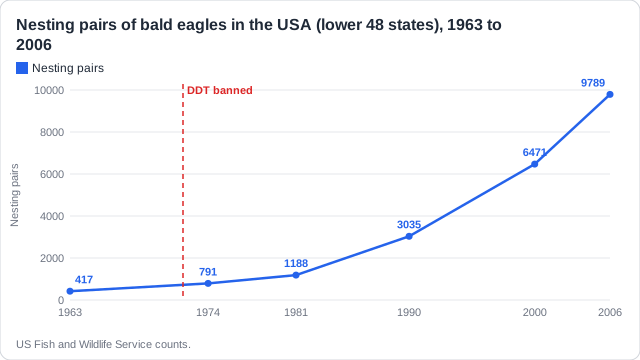
Real example: the bald eagle, the USA's national bird, fell to 417 nesting pairs in 1963, poisoned by the pesticide DDT. After DDT was banned in 1972 and the eagle was protected by law, it recovered.
Free preview
This is the free notes preview
You're reading the free notes. Aimnova Pro unlocks the full study experience — and you can try it with your first topic free to keep:
- FlashcardsLock in vocabulary and key terms with spaced repetition.
- Practice questionsAnswer exam-style questions and get instant AI marking.
- Mock exams & past-paper vaultSit full mocks and see exactly how examiners award marks.
- Personalised study planA daily plan built around your exam date and weak areas.
Protected areas are the most common measure. On land they let forests grow back; at sea, a no-take zone lets fish recover.
How protected areas reverse decline
- Protected areas stop or reduce logging and land clearing.
- They prevent conversion to farms and cattle ranches.
- On used land, secondary succession rebuilds forest cover, and biodiversity returns with it.
- No-take zones at sea: no fishing, so fish, and the animals that eat them, have more food.
- Safe breeding sites: controlled access, guarded nests, rangers against poachers.
- Tourist income pays for rescue centres, habitat restoration and artificial nests.
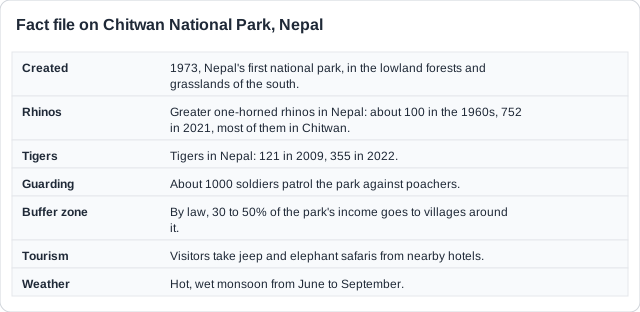
Real example: in Chitwan National Park, soldiers patrol against poachers and the villages around the park share its income, so they help protect it. Nepal's rhinos rose from about 100 in the 1960s to 752 in 2021.
Say how, not just 'it is protected': 'The species is protected' is too thin. Each reason needs a measure and what it does: 'a no-take zone stops fishing, so there are more fish to eat'.
Never wonder what to study next
Get a personalized daily plan based on your exam date, progress, and weak areas. We'll tell you exactly what to review each day.
Forests and wildlife recover when harming them becomes illegal or strictly controlled, and the rules are actually enforced.
What effective enforcement looks like
- Laws ban or limit clearing, hunting, fishing and trade in wildlife.
- Clear rules say where cutting or fishing is allowed and where it is banned.
- Monitoring: rangers, satellite checks and inspections find illegal activity fast.
- Penalties: fines, lost permits, prosecution, cut-off bank loans.
- A law alone is not enough: enforcement decides whether it works.
Remember it as: Rule, watch, punish.
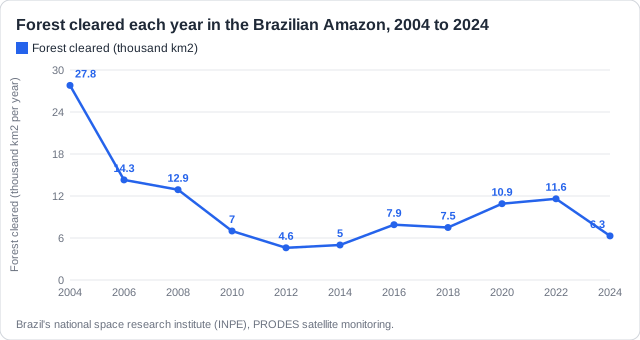
Real example: from 2004 Brazil used satellites to spot new clearings within days, sent police and fined landowners, and cut bank loans in the worst areas. Clearing fell by about 80% by 2012. When enforcement was weakened after 2018 it rose again, then fell when it resumed.
Laws need enforcement: A reserve that exists only on paper, with no patrols, loses its forest to illegal logging.
Measures can be taken to conserve and regenerate biodiversity at four levels. The strongest recoveries use all four.
The four levels
- Individual: buy certified products, eat less meat, give to or volunteer for conservation, join citizen science.
- Collective: communities, NGOs and businesses manage land, fund projects, monitor species, campaign.
- National: governments pass laws, create protected areas, and fund and enforce them.
- International: agreements across borders, such as CITES on trade and the CBD's 30% by 2030.
- The biggest recoveries use several levels at once.
| Level | What was done for the red kite |
|---|---|
| Individual | People report poisoned birds; birdwatchers count nests. |
| Collective | The RSPB, a charity, and the government's nature agency released kites from 1989. |
| National | UK law has protected all birds of prey since 1954. |
| International | Birds were brought from Spain and Sweden; the EU Birds Directive protects them. |
Real example: the red kite, a bird of prey, was poisoned and shot until only a few pairs were left in Wales. After reintroductions from 1989, the UK now has more than 4000 breeding pairs.
Why international?: Many species cross borders, like migrating birds and whales, and trade is global, so no country can protect them alone.
Stop wasting time on topics you know
Our AI identifies your weak areas and focuses your study time where it matters. No more overstudying easy topics.
Forests recover faster when people earn money by keeping them standing. Payment for ecosystem services (PES), ecotourism and certification are the main incentives.
Economic incentives
- Payment for ecosystem services (PES): landowners are paid to keep or replant forest.
- The payment makes conservation profitable: it covers what clearing would have earned.
- Ecotourism: living wildlife earns money, which pays rangers and gives local jobs.
- Certification labels reward sustainable producers with better prices and markets.
- Incentives work best when they are fair (small farmers included) and long-term.
PES
- Pays owners to conserve or replant.
- Links to carbon, water and flood control.
Ecotourism
- Income for communities.
- Money for park rangers and enforcement.
Certification
- Access to higher-value markets.
- Rewards sustainable forestry and farming.
Real example: Costa Rica banned turning forest into farmland in 1996 and since 1997 has paid landowners to protect forest, funded partly by a fuel tax. Forest cover rose from about a fifth of the country in the 1980s to over half today.
Fairness matters: If payments reach only large landowners, small farmers may keep clearing to survive. Including them makes a scheme fairer and more effective.
How this comes up: Paper 1 gives a fact file and a map on a population that has grown, and asks you to suggest reasons [2]. Paper 2 Section B asks how measures at different levels reverse decline [4] or [7].
Use the fact file on Chitwan National Park in section 2.
Suggest two reasons why the number of greater one-horned rhinos in Nepal has increased since the 1960s.
Model answer plan
See the mark-by-mark plan — for / against / judgement, with marking guidance — in study mode.
One point per paragraph: Each mark is one reason. Put each in its own paragraph with its 'so', and the marker finds both.