Helping nature heal itself: Rewilding means letting nature repair itself. Think of a trampled lawn: stop walking on it and it grows back. Natural processes in ecosystems can be regenerated by rewilding.
The points to remember
- Rewilding restores an ecosystem's natural processes, so that it can run itself again.
- The processes: predation and grazing, seed spreading, flooding and natural regrowth (succession).
- People step back: less management, control and harvesting as the ecosystem recovers.
- It works best over large, connected areas.
- The aim: a self-sustaining ecosystem with more biodiversity and resilience.
Bring back
- Yellowstone, USA: 31 grey wolves from Canada were released in 1995 and 1996.
- Wolves had been wiped out there by the 1920s.
Join up
- Banff, Canada: wildlife bridges and tunnels let bears, elk and wolves cross a busy highway.
Stop
- Hinewai, New Zealand: sheep farming stopped in 1987 and the hills were left to regrow.
Step back
- Hinewai: no herbicides and no burning; only wild goats and deer are controlled.
Remember it as: Bring back, join up, stop, step back.
Real example: Hinewai Reserve was a sheep farm covered in gorse. Since 1987 it has been left to regrow, and native forest has returned.
Free preview
This is the free notes preview
You're reading the free notes. Aimnova Pro unlocks the full study experience — and you can try it with your first topic free to keep:
- FlashcardsLock in vocabulary and key terms with spaced repetition.
- Practice questionsAnswer exam-style questions and get instant AI marking.
- Mock exams & past-paper vaultSit full mocks and see exactly how examiners award marks.
- Personalised study planA daily plan built around your exam date and weak areas.
The first method brings back the missing animals: the apex predator and the keystone species. Their effects spread through the whole food web as a trophic cascade.
How returning species regenerate processes
- An apex predator hunts grazers that nothing else controls, e.g. wolves eat and scare elk.
- Fewer, warier grazers let young trees and plants regrow: a trophic cascade down the food chain.
- A keystone species has a large effect for its numbers: beavers build dams that make ponds and wetlands.
- Returning species rebuild food webs, habitat variety and processes people cannot run by hand.
- Reintroduction brings back a native species; introducing an alien species can make it invasive.
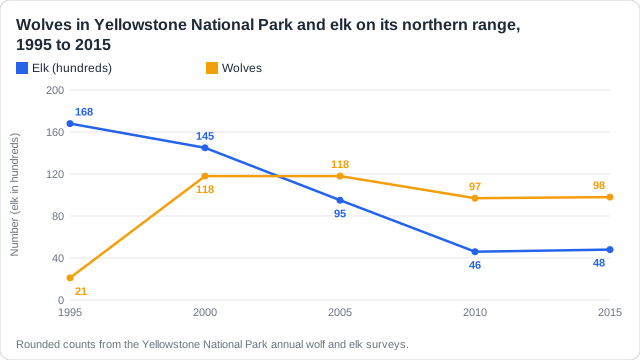
Real example: after wolves returned to Yellowstone in 1995, elk fell and began to avoid open river valleys. Willow and aspen regrew along some streams, beaver colonies on the northern range rose from 1 to 9, and ravens, eagles and bears fed on wolf kills.
Show the chain: Wolves return, so elk fall and move; so young trees regrow; so birds, beavers and fish return. One step per point, each with 'so'.
Feeling unprepared for exams?
Get a clear study plan, practice with real questions, and know exactly where you stand before exam day. No more guessing.
The second method joins wild areas back together with wildlife corridors, so that animals and plants can spread across a whole landscape again.
The points to remember
- Many wild areas are fragments: islands of habitat cut off by farms, roads and towns.
- Wildlife corridors, green bridges over roads and underpasses join them up.
- Animals can then move to find food and mates, and shift their range as the climate changes.
- Large joined-up areas hold viable populations of wide-ranging animals, with more gene flow.
- Rewilding plans link reserves across whole landscapes, even across borders.
Real example: the Trans-Canada Highway cuts through Banff National Park. Six wildlife bridges, 38 underpasses and fences along the road have been used more than 150 000 times by bears, wolves, elk and cougars, and road deaths of large animals fell by over 80%.
Why size matters: A wolf pack needs hundreds of square kilometres. A small, cut-off reserve cannot hold enough wolves to breed without inbreeding.
The third and fourth methods are about people doing less: stop using the land, then let natural succession do the work, stepping in only where nature cannot fix a problem alone.
The points to remember
- Stop farming, logging, fishing or hunting on the land (cessation of agriculture and harvesting).
- Let natural regeneration happen: seeds blow or are carried in, and succession rebuilds the vegetation.
- Remove human influence: take out fences, drains and dams, so rivers can flood and move again.
- Use ecological management only where needed: control invasive species, cull deer or goats that have no predators.
- Then step back and monitor: interfere less as the ecosystem looks after itself.
Remember it as: Stop taking, then step back.
Stopped
- Sheep farming ended in 1987.
- No burning, no grazing, no herbicides.
Nature's work
- Gorse covered the hills.
- Native seedlings grew up in its shade, then shaded it out.
Result
- Native forest returned within about 20 years.
- Birds such as the kereru spread seeds; streams run clear.
Real example: at Hinewai, the manager Hugh Wilson let the hated gorse act as a nurse plant instead of spraying it. Wild goats and deer, which have no predators in New Zealand, are the only thing still controlled.
Memorize terms 3x faster
Smart flashcards show you cards right before you forget them. Perfect for definitions and key concepts.
Real projects combine the methods. Most follow the same steps.
The steps of a rewilding project
- Stop the damage first: poaching, war, farming or hunting.
- Bring back the missing species, often from other parks or countries.
- Protect and join up enough land for them.
- Involve local people: jobs, health and a share of the income win their support.
- Monitor numbers, then step back as the ecosystem recovers.
What was done
- From 2004, rangers stopped poaching.
- Buffalo, wildebeest, zebras and wild dogs were brought back.
What came back
- Fewer than 10 000 large animals in 2000.
- More than 100 000 by 2018.
People
- Local people work as rangers and guides.
- Tourism pays for clinics and schools.
Real example: in Mozambique's civil war (1977 to 1992), more than 90% of Gorongosa National Park's large animals were killed. Since 2004 the Gorongosa Project and the government have restored the park with local communities, and it is full of life again.
Nature and people together: Projects last when local people gain from them. Wildlife does not see borders, so countries also have to work together.
Regenerating damaged land is not simple. A paper may give a model of land degradation and a fact file and ask for the problems.
Problems in restoring degraded land
- Cost: restoring land is expensive and labour intensive, and the longer it is left, the more it costs.
- Success falls with time: the further the land has degraded, the lower the chance of recovery.
- Unforeseen effects: a plant sown to stop erosion can turn invasive and crowd out native plants.
- Fixes can harm: herbicides pollute water; mowing or grazing the invader can expose soil to erosion.
- Nature and the wider world: a harsh climate, poor soils, or a global cause such as climate change.
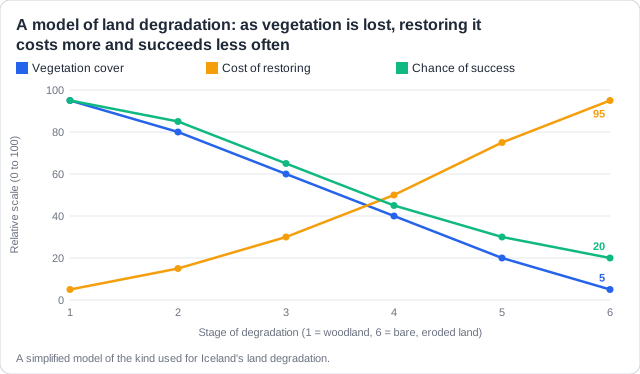
Real example: when settlers reached Iceland in 874, birch woodland covered at least a quarter of the land; about 1.5% is left. Nootka lupin was sown to hold the soil, but it spread over native heath and moss, and removing it is slow and costly.
Link success to time: 'It might not work' is too thin. Say why: 'the longer the land is left, the less soil and seed remain, so the lower the chance of success'.
Know your predicted grade
Take timed mock exams and get detailed feedback on every answer. See exactly where you're losing marks.
Bringing a species back brings gains and problems. A paper may ask for one of each, for one mark each.
Reintroductions: gains and problems
- Benefits: new habitats and biodiversity (beaver ponds), ecotourism, a former ecosystem restored, food for other species, wetlands back.
- Problems: damage to property and crops, flooding when dams collapse, conflict with landowners and farmers.
- Ecological risks: upset food webs and competition, short-term change to existing habitats.
- Survival risks: animals may not adapt and die; poaching; genes unlike the original stock; no predator to limit numbers.
Gain, with its effect
- Beaver dams make ponds, so more habitats and species.
- Visitors pay to see beavers: ecotourism.
- Beavers lived here before: the old ecosystem is restored.
Problem, with its effect
- Gnawed trees and flooded fields anger landowners.
- A collapsing dam can flood land downstream.
- Released animals may not adapt and die.
Real example: beavers on the River Otter in Devon, England, were allowed to stay in 2020 after a five-year trial showed their dams slowed floods and held back soil, though some farmers lost fields to flooding.
Two answers that do not score: 'Beavers build dams that regulate water flow' is not a benefit on its own: add the effect. And a native species brought back is not 'an alien' or 'invasive species'.
How this comes up: Paper 1 gives a case study with a model and a fact file: problems of restoring land [4], a benefit or a problem of a reintroduction [1]. Paper 2 Section B asks you to explain or discuss rewilding with named examples [7] or [9].
Hinewai Reserve in New Zealand and Yellowstone National Park in the USA are both described as rewilding projects.
Explain how rewilding can regenerate natural processes in ecosystems. Refer to named examples.
Model answer plan
See the mark-by-mark plan — for / against / judgement, with marking guidance — in study mode.
One point per paragraph: Each mark is one point. Put each in its own paragraph, so every step of the chain is easy to see.