Know it to protect it: To protect biodiversity, managers must first know it: which species and habitats are where, how many there are, and which are in trouble. That knowledge is needed at two scales: global and regional.
The points to remember
- Global knowledge shows where species are richest, most endemic and most threatened, so effort goes there first.
- Regional and local knowledge shows which species live in a place, how many, and whether they are declining.
- It identifies endangered species and priority habitats, and what threatens them.
- It sets a baseline, so change can be measured and management can be judged.
- Without it, management can miss species or even make things worse.
Global
- The IUCN Red List: over 150 000 species assessed for extinction risk.
Regional
- A national survey of every breeding bird, repeated every few years.
Local
- Volunteers counting the plants and insects of one nature reserve.
Why some regions matter most
- Many endemic species, found nowhere else.
- Very high species richness: a large share of the world's biodiversity.
- Under high threat from logging, farming, hunting or building.
- Many ecosystems in one region.
- Natural capital and ecosystem services: tourism, food, carbon storage, flood control.
- Intrinsic value: its species have a right to exist.
Real example: about 90% of Madagascar's plants and animals, such as its lemurs, are endemic, and much of its forest has been cleared, so it is a top priority for conservation money.
Too vague to score: 'Ethical reasons' alone is too vague. 'Beautiful' counts only with a use, such as tourism. 'It has endangered species' or 'it is large' is not enough on its own.
Free preview
This is the free notes preview
You're reading the free notes. Aimnova Pro unlocks the full study experience — and you can try it with your first topic free to keep:
- FlashcardsLock in vocabulary and key terms with spaced repetition.
- Practice questionsAnswer exam-style questions and get instant AI marking.
- Mock exams & past-paper vaultSit full mocks and see exactly how examiners award marks.
- Personalised study planA daily plan built around your exam date and weak areas.
Knowledge of biodiversity is gathered by many people, not only professional scientists.
Who gathers it
- Citizen scientists: volunteers who record what they see, often with an app.
- Government-funded agencies: national park staff and national surveys, often required by law.
- Voluntary organisations: charities such as the WWF and local wildlife trusts run surveys and projects.
- Indigenous people and parabiologists: local people trained to find, record and identify species.
- International networks share data across borders, because species migrate and threats spread.
Real example: in the Christmas Bird Count, tens of thousands of volunteers across the Americas count birds each winter. The results show which species are declining.
Local knowledge plus science: Local and Indigenous people notice changes first and know why they happen. Real example: Indigenous rangers in Australia use traditional skills, such as tracking, to find and protect endangered species.
Law
- Many countries require a biodiversity survey before a new road or mine is allowed.
- Agencies must monitor protected species by law.
Ethics
- Whose knowledge counts: scientists' or local people's?
- Indigenous knowledge should be used only with the community's consent.
Remember it as: Volunteers, agencies, charities, local experts, and the whole world sharing data.
Stop wasting time on topics you know
Our AI identifies your weak areas and focuses your study time where it matters. No more overstudying easy topics.
Is it really there?: To confirm that a species is present, use a monitoring method: one that finds the animal or its traces.
Ways to confirm a species is there
- Camera traps: photos or video, without disturbing the animal.
- Field signs: tracks, droppings, hair, scratch marks, burrows.
- eDNA: DNA the species leaves in water, soil or snow.
- Sound recorders: for species with calls you can recognise.
- Live trapping and tagging (radio or GPS collars), by trained teams.
- Reports from rangers, local people or citizen scientists, checked by experts.
Real example: snow leopards are almost never seen, so researchers in Mongolia's mountains set camera traps along ridges; each leopard's spot pattern identifies it.
What citizen scientists use
- Keys and apps to identify species, with photos or sound recordings.
- Transects, quadrats, pitfall traps and kick sampling in rivers.
- Organised bird counts, nest monitoring and camera traps.
- Not tools that only measure abiotic factors (such as water acidity), and not questionnaires.
Monitor, not protect: Fences, guards and corridors protect a species; they do not confirm it is there. For [2], give two different methods, one sentence each.
Citizen science brings huge numbers of people into research. Real example: in the RSPB's Big Garden Birdwatch, hundreds of thousands of people in the UK count their garden birds for one hour each January, every year since 1979.
Strengths
- Many more people: far more data, over large areas and many years.
- Shows trends, such as a species declining or an invader spreading.
- Volunteers, so costs are low.
- Local people know where to look.
- Raises public awareness of local issues.
Limits
- Weak methods can cause errors, bias or disturbance.
- Many record only interesting or rare species.
- Popular places are surveyed far more.
- Limited knowledge: species misidentified.
- Irregular days and times; motivation fades.
- Managing the data needs experts and money.
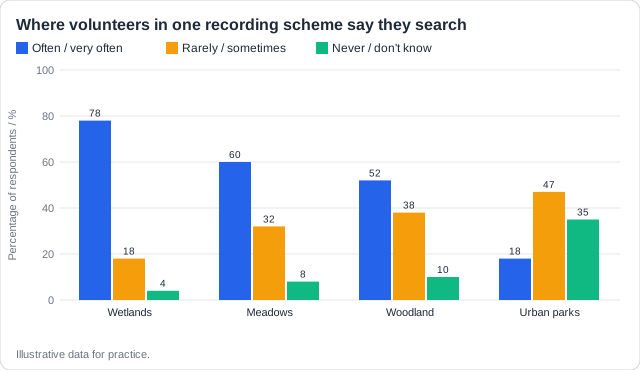
Reading the chart: 78% search wetlands often, but only 18% search urban parks often. Rarer species, the wish to support conservation and more to learn draw volunteers to wetlands; parks hold mostly common species.
The verdict: Citizen science gives far more data than scientists could collect alone, but the data can be biased. It works best when an NGO or a government agency organises it, trains the volunteers and checks the records.
See how examiners mark answers
Answer exam-style questions with model answers. Learn exactly what earns marks and what doesn't.
Monitoring turns knowledge into numbers. Two calculations come up: a percentage change over time, and a region's percentage share of the species.
The formulas: Percentage change = (new − old) ÷ old × 100
Percentage share = part ÷ whole × 100
Four steps
- Write the formula first.
- Change: take the old number from the new one, then divide by the old number.
- Share: divide the part by the whole.
- Multiply by 100, add the % sign, and round only at the end.
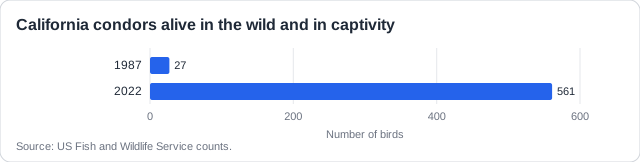
Worked examples: Change: condors rose from 27 in 1987 to 561 in 2022. (561 − 27) ÷ 27 × 100 = 534 ÷ 27 × 100 = 1978%.
Share: 6 of the world's 7 sea turtle species are threatened. 6 ÷ 7 × 100 = 85.7%.
The most common slip is dividing by the new number. For a change, always divide by the old number.
How this comes up: Identify why a region matters for conservation [2]; outline how survey data could be used [1]; calculate a percentage change or share [1]; read a survey of citizen scientists and evaluate citizen science [1-4].
A city council asks residents to record the wildlife they see in their gardens with a phone app.
Evaluate the use of citizen science for collecting and monitoring biodiversity data in the city.
Model answer plan
See the mark-by-mark plan — for / against / judgement, with marking guidance — in study mode.
Evaluate means both sides: Give strengths and limits, then a judgement. Three strengths and no limit cannot reach full marks.